| OCR Text |
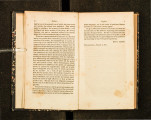
Show Lewis cwd Cla1"1~e's Expedition the bank the land is low, and subject to be overflowed. This day was exceedingly fine and pleasant, a storm of wind and rain from north-northeast, last night, having cooled the air. July 14. We had some hard showers of rain before seven o'clock, when we set out. We had just reached the end ofthe sand island, and seen the opposite banks falling in, and so lined with timbct• that we could not approach it without danget·. whrn a sudden squall, from the northeast, struck the boat on the starboard quartet·, and would have certainly dashed her to pieces on the sand island, if the party had not leaped into the river, and with the aid of the anchor and cable kept her off: the waves dashing over her for the space of forty minutes; after which, the river became almost instantaneously calm ami smooth. The two periogues were ahead, in a situation nearly similar, but fortunately no damage was done to the boats or the loading. Tho wind having shifted to tlle southeast, we came at the distance of two miles, to an island on the nol'th, where we dined. One mile above, on the same side of the river, is a small factory, where a merchant of St. Louis traded with the Ottoes and Pawnees two years ago. Near this is an extensive lowland, part of which is overflowed occasionally, the rest ii rich and well ti mbercd. The wind again changed to north· west by north. At seven and a half miles, we reached the lower point of a large island, on the north side. A small distance abo,•e this point, is a ri\'cr, called by the Maha In· ilians, Nislmahbatona. rrbis is a considerable creek, ncar· ly as large as the Mine river, and runs parallel to the l\1issouri the greater part of its course, being fifty yards wide at the mouth. In the }Wairies or glades, we saw wiltl-timot~ y, lambsquartet·, cuckleberries, and on the edges of the river, summer-grapes, plums, and gosseberries. We also saw to-day, for the first time, some elk, at which some ofthc party shot,. but at too. gt·eat a distance. We encamped on the •n orth stde of the Island' a little above N1' s h na1 1 b a t ona, hanng made nine miles. The rive1• fell a little. Up t11e Missouri. July 16. A thick fog pt·cvcnted our leaving the encampment before seven. At about four miles, we reached the extremity of the large ishmd, and crossin~ to the south, at the distance of seven miles. arrived at the Little Nemaha, a small riverft·om the south, forfy yards wide a little above its mouth, but cont l'acting, as do almost all the waters emptying into the Missouri, at its confluence. At nine and three quarter miles, we encamped on a woody point, on the south. Along the southern bank, is a rich lowland covered with peavine, an(\ t·ich weeds, and watered by small streams rising in the adjoining pt·a.iries. 'l'hey too, arc rich, and though with abundance of gl'ass, have no timber except what grows ncar the 'vater: interspersed thorugh both arc grapevines, plums of two kinds, two S}lrcics of wild-cherries, hazlcnuts, and gosscbcrrics. On the south there is ono unlJI'okcn plain; on the north the river is skirted with some timber. behind\\ laich the I,lain extends four Ol' five miles to the hills, which seem to have little wood. July 16. 'Ve continued our route between a large island O}lposite to om· last night's encampment, and an extensive prairie on the south. About six miles, we came to anothc1• large island, called Fairsun island, on the same side; ahove which is a. spot, whct•c about twenty ac·rcs of the hill have fallen into the river. Ncar this, is a cliff of sandstone for two miles, which is mueh frequented by birds. At this I>laec the river is about one mile wide, but not deep; as the tim· ber, or sawyers, may be seen, scattered across the whole of its bottom. At twenty miles distance, we saw ou the south, ao island called by the ·F1·ench, l'lsle Chance, 01~ Bald island, O})posite to a large p1·ai1~ie. which we called Baldp:ttcd prairie, fa·om a ridge of naked hills which bouud it, running parallel with the river as fat• as we could see, and ft·om three to six ntiles distance. To the south the hills touch the river. 'Ve encamped a quat~ter of a mile beyond this, in a point of woods on the north side. The rivc1· continues to fall. |