| OCR Text |
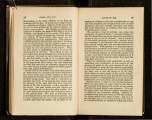
Show 282 VEGETABLE LIFE. cessive years of that century, there is nothing in the { museums half so curious. But we can trace them in the cross section of the bole, and so virtually ar- · rive at all the rest. When the infant oak sprouts out of the acorn, it is nothing but pith and pellicle, the former a small portion of jelly, and the latter very soft and tender. Even then the oak is ?-n orO'anized beinO' from the moment that we can dtscern it · and previ~us to that, there is nothing but conje~ ture: The vital princip~e of the plant i~ not a quality or property of the p1th, or of the pellicle, for both of these are mere matter, and neither of them could of itself originate an oak any ~1ore th?-n t~e soil in which the acorn is set. The hfe cons1sts 1n the union of the two, the action of the one upon the other· and that action takes place at the surface wher~ they meet. During the first year that action converts the food of ·the plant (derived at the first from the cotyledons, or lobes of the acorn, and then from the soil and the air) into a new substance, the cambium or " changeable matter." That begins to be form~d as soon as ever the little plant puts out a leaf but the nature of the substance which is formed dep~nds not a little upon extern~l circumstan.ces; and the quality of the ~i_mber wh1C~ the tree 1s _to produce is, in all prob~b1hty, determmed by the c1r cumstances under whiCh the young plant performs its very first action. We know from observation, that no plant will live without air or be healthy if the air is not pure and good; and ~e know, from the_ sam~ s~mrce, that if the plant is shut up from the light, 1t 1s colourless, and contains little or no charcoal. If1 ~h~refore, t~e young plant be in air that is tain~e~, or too ~eep m the grqund, it action mu~t be v1t~ated, ~~d 1t mus_t, as one may say, "start w1th bad timber. .Now, 1f a taint is given at the commence~ent_, that IS a. ~onstitutional taint, and must remam w1th and v1t1ata ISFERIORITY OF PLANTED OAK. 283 tb~ tre~, how long soever it may live, or what size soever It may attain. - Compl~ints are every day made of the badness of the oak ttmber now, as compared with what it was fonnerlr; and these complaints are well founded . . What w1th dry rots in confined air, and rots in water, and slo~ dec_omposition in the atmosphere, mod~ rn oak, wh1ch 1s, generally speaking, planted oak, IS ~bsolutely less durable than even some of the inf~ nor species of pine, and far inferior to the native pme of the mountains. A piece of heart of oak 1 chosen by the king's bu,ilder for royal purposes had )been seasoned and prepared in the most careful :nanner; and after that, it had been kept dry in the cen- ·tr~ of a trussed. bea~ for more than twenty years. l~ IS net easy t? 1magme how a more desirable specu; nen of oak hmber could be procured ; and it certau~ ly appeared welL The colour was good, the gram close, and the texture very hard and firm to ~he tool. Wen, a piece of this same oak was let m~o the ground, in a dry soil, and so s1tuated that no dnp fell upon it, or trickled down it; and it remained between three _and fo?r ye~rs. Upon its being taken up, a~l that portwn of 1_t _whlch had been in the ground was u1 the same condltiOn as the alburnum, or sapw~ d, o~ very old oak_ piles when they are taken out of the water,-more hke compact clay than timber · and when dried, it "broke short," and crumbled int~ pow~r. In oolour it was more like rotten 'pear-tree 1 than rotte_n oak, [or there was no blackening, and 1 yet t~e sotl con tamed a great deal of iron, so that .the tunber must haye been deficient both in tannin an.d gallic acid. It was not, as ha~ bee~ said, the sap-wood, but the very best part of the tree, and from inspection of the cross-~ut, the tree h4d not grown with any ~ery extraordmary rapidity. As little was the in. Jnry done at the "weather line," just by the surface D{ the earth, where the durability of timber is put to |