| OCR Text |
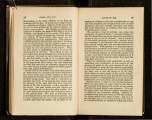
Show 226 THE SCOTCH LAIRD AND THE PEBBLES. a~ the place where in one day each season a snffiCient supply had been collected, during the time that th~ stones had been in fashion. The owner of the mme of so much beauty, and as it appeared to him from the price that he had paid, of so much wealth: would ~ave been glad to exchange his purchase for sometlung that he could not get at home; but still he was pleased that the mine was his freehold. Home he returr~ed ; the present from London was duly seen and admued .i an~ the very. n.e~t morning, taking his mol~-statfwith him as a divmmg rod, he was early at his rhabdomancy. Three days he consumed in diligent and laborious search, keeping the secret of his wealth with great care, until he should astonish the world with its amount. In the course of his labour he picked up many stones, but, as they were al1 very rough and unpromising to look at he cast away as fast as he gathered, till the third' day and his patience were nearly at a close together. When he had nearly reached his home, he took up one of those nodules of which he had previously taken up · and thrown down so many, and dashed it upon the rock ':'ith all. his force, as if. in vengeance for the deceptwn whtch he had practised on himself. The stone broke in pieces, and in the fractures he found the colours, but not the lustre, of those disks which· had so pleased him in London. He soon began to reflect that his uncut pebbles were not saleable trinkets, any more than the soil of his farm was saleable quarters of wheat; so he prudently resolved to ~ollow his farming, and leave the pebbles to the lapidary as before. The purchase, too, retained its value, as the pebbles that were collected from the fields as an e~lCumbr~nce, and used in paving the court and fillmg drams, could not rival it· and he eyen boasted that the trinkets were the pr~duce of his own estate, and spoke with admiration of the art and skill of the Londoners, who could make a few ounces of that which was not worth sixpence WHERE TO STUDY ROCKS. 227 a tun where it was found, worth several pounds in the market. That is a homely anecdote, but it is a useful one, as it points out one of the reasons why those whom we would, without reflection, think should study natural substances the most, yet actually study them the least. It shows, too, that that is especially the case with minerals. The occupation of the people of any district runs in a train ; those who are not required for the working of that train migrate to other (places; and if any one betakes himself to the study 10f nature, he is branded as an idler, or wizard, according as the current of popular belief and feeling sets,-and whether it set the one way or the other, he is equally certain to be ejected from the companionship of the district, and must either associate with those at a distance, or be an idler in reality. It is only in what may be termed sublime or romantic places, such as mountains, and crags, and ravines, or bold and caverned shores, that stand beetling over the flood, that we can observe the grand features of the earth ; because it is at such places only that we can see sections of the strata of rocks, sufficiently deep and extended for enabling us to judge in what order, and guess by what means, those which we may term the living rocks-the skeleton of the globe-those gigantic masses, which can have been produced and arranged by no surface action, but are the result of energies which, whatever they may have been, have had their origin and their place of action within the globe itself, whether the influence of that action was more general or more local-whether it went to the uplifting of a continent, or the building of a chain of mountains, or merely raised the point of a volcanic cone above the waters of the sea. There is no knowing how much land and how much water,-inclnding, under the term "land," all suhstances which are neither water nor air, whether |