| OCR Text |
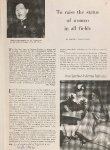
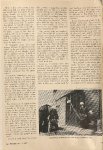
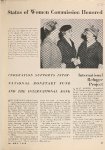
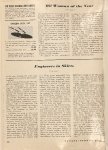
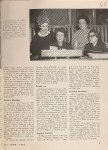
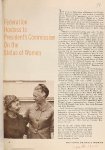
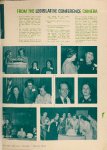
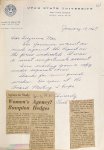
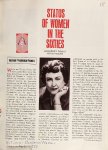
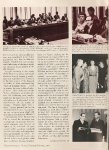
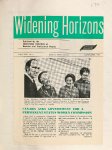
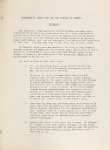
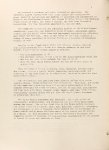
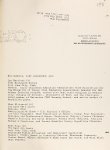
Show At the Conference of Business and Professional Women of the Amer icas held in Puerto Rico last N 0uember sat, left to right, the Honor able Roberto Sanchez Vilella, Secre tary of State in Puerto Rico, Presi dent Katherine Peden and Confer ence Co-chairman Helen Krauss of sponsoring Natumal Federation of Business and Professional Women's Clubs, Inc., and Dr. Gabriela Pelaez Echeverri, President of the Inter American Commission of Women. THE GRE/AT CHALLENGE FOR WOMEN OF THE AMERICAS By Jeane Kenworthy " A LL THE WOMEN of the Americas now can vote," said l\_ attractive Dr. Gabriela Pelaez Echeverri from Colombia, seventh and youngest president of the Inter American Commission of Women, an official specialized agency of the Organization .of American States, in her wide offices in the Pan American Union, Washington, D.C. "Our Commission has worked hard for women dealing with American governments for 33 years. Now, with the women of Paraguay last July getting the vote, this mission has been accomplished." When the Inter American Commission was first organized by the Sixth Inter-American Conference in 1928, the United States was the only country of the 21 member countries where had the right to vote. "Now," Dr. Pelaez said, her voice confident and deter mined, belying her femininely delicate features, soft women brown hair and lustrous brown eyes, "our Commission has a Long Range Plan to work with the women of the Americas, to help the women to be strong and get them to use their voting rights to improve themselves, their communities-and their countries." The Long Range Plan includes seminars, technical meetings and training of all kinds, much of it directed toward developing leaders. In the Spring of 1960, the Commission's president then, Mrs. Graciela Quan V., visited 15 countries, her object being to interest govern ments in sending representatives to the Commission's first working conference-the Inter-American Seminar on the Strengthening of the Family Institution. This Semi nar was based on the principle that woman's place within the family must be strengthened before women could begin to exert leadership elsewhere. The Inter-American Commission knows that it must provide programs the women of Latin America can build on step by step. __) The Scope of the Problem It is the easiest thing in the world to quote statistics. The attention of women in the United States is being di rected daily through television and all information media 4 roughly estimated but significant statistics such as the following: The average life expectancy of a Latin Amer ican is less than two-thirds as long as in the United States, to some areas less than half. In some parts of Cen tral and South America where disease is widespread and doctors few, one child out of five dies before the age of and in four. In many areas the average person does not get enough to eat, about one-third less than in the United States. Large numbers of people get only 800 of the 2,400 calories a day usually considered adequate. 100 million people-half the population of Latin America-lack an adequate supply of drinking water. These are the statistics but, as Dr. Pelaez reminds us, it is much more difficult to record, understand and meet human need translated into terms of the heart-felt long ings of people, their hurts and prides and small happi nesses. However, the Commission knows that understand able and common to all, even though perhaps at times held latent and guarded, are the self-determining strengths of dignity and self-respect in women and in all human beings. They know very well that the people of Latin America are among the most proud and fervent people of the world. But they are not discounting the worst part of hunger and disease, so often coupled with ignorance, which breaks the will and shames the individual so that he feels it is hopeless to try, so that he feels that perhaps it is he himself who is unworthy of anything better than his present lot. These personal qualities and circum stances especially with the vast majority of Latin America -the rural people-are so intricately interwoven that it is difficult to know where cause ends and effect begins. But this need, says Dr. Pelaez-of strengthening confi dence and resources-is perhaps one of the greatest challenges of women leaders who work for and with the Latin American people today. And this is why the Commission is striving to develop many more leaders, especially among the rural people, many of whom neither read nor write, nor receive the necessary bare minimum of food so that bodies and minds NATIONAL BUSINESS P, \1(1 I ! 1 b 2-- WOMAN |