| OCR Text |
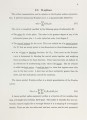
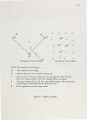
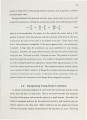
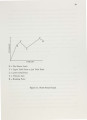
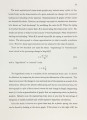
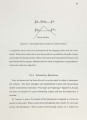
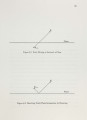
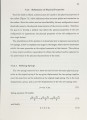
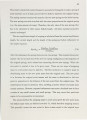
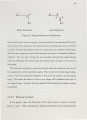
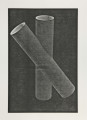
Show 41 This system serves to prevent introducing numerical error by keeping accelerations small. 7.2.2.2 Refining Hinges This section gives an analysis of the difficulties when trying to refine a hinge to ensure the same torsional properties exist after refinement as before refinement. Three consecutive points in a mesh, P1 , P2 , and P3, are used to define a hinge (ignoring the 4th point in this discussion). Suppose, after refinement, there is P4 , a point whose location in the mesh is between that of P2 and P3 • It is now desired to define two hinges over these four points where the new hinges have the same overall characteristics as the original hinge. If() is the original angular displacement and 01 and 02 are the angular displacements of the two new hinges: From the geometry of Figure 7.3 it is seen (with angles expressed in radians) that: . () - 1r = ( ()1 - 1r) + ( ()2 - 1r) (7.5) rearranging gives: (7.6) Because the desired result is to get the same force vector for the endpoints of the hinge, the hinge equation (equation 3.3) has to be modified to represent a force on an endpoint, not the torque. This is done by dividing through by H, H1 , and H2 , the length of the old and new hinges, respectively. Substituting: </>(k- FH) = ¢ 1 (k- FHI) + ¢ 2 (k- FH2) -1r k k k (7.7) This result cannot be reduced any further. The implication is that replacing one hinge with two cannot be done where the two new hinges act the same for all angles as the original hinge. Information must be maintained about the original hinge so |