| OCR Text |
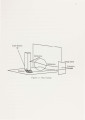
Show 53 the designer's workbench. The research encompassed by Alpha_! covers a wide range of areas, from animation to manufacturing techniques. Alpha_! shapes are generated with a large program called Shape-edit. Shapeedit supports a very large knowledge base of geometry that is invoked to produce a variety of shapes. These range from simple arcs and lines to more sophisticated solid primatives. A number of "shape operators" are available to modify surfaces in a number of ways[9]. Shape-edit provides interactive display of the geometric forms under construction. Although the user may see several different forms of geometry (lines, arcs, spheres, cylinders, etc) shape-edit uses a single internal representation (NURBS) for all of them. Once the model is complete, shape-edit dumps the result in a file. Several tools are available to operate on these data files. They include interactive viewing and rendering tools (such as PRT), tools to perform boolean operations on solid surfaces, and other analytic tools such as mass property calculation. 5.3 PRT data structures and operation 5.3.1 The input data The Shape-edit program produces a data file describing the model in terms of Nonuniform Rational B-Spline surfaces or simple polygons. (Shape-edit can also produce two-dimensional lines and curves, but these are currently ignored by PRT). The surfaces generated by Shape-edit may be structured in terms of groups and instances. A group is simply a collection of objects. An instance is an object or group of objects that are positioned by a set of transformations. In Shape-edit, the same object or group can be instanced several times. PRT uses hierarchical bounding volumes called subworlds to reduce the search space for tracing rays. Subworlds are specified to PRT as groups with a "subworld" |