| OCR Text |
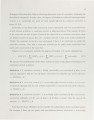
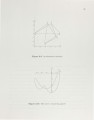
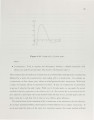
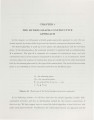
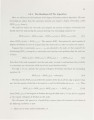
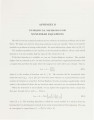
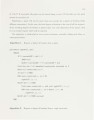
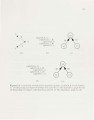
Show APPENDIX B NUMERICAL METHODS FOR NONLINEAR EQUATIONS We will review the numerical methods for the solutions of nonlinear problems used in thjs thesis. We begin our study by discussing problems in just one variable. Then we ext nd the methods to problems involving multivariable. For more information, please refer to [29, 47). The nonlinear problems in one variable can be formulated as follows: Given a real-valued function f of a real variable, find the value oft for which f(t) = 0. If the first derivative is available, we can use Newton-Raphson iteration. The method begins with an estimate t0 oft. At each iteration, the function is approximated locally with a tangent line and then the point where the tangent line meets the t-axis is found. That is, (B.l) where k is the number of iteration and (k ;:::: 0). The iteration will be terminated when either the error (itk+I-tki or if(tk)i) is less than some tolerance, or a prescribed limit on the number of iterations is exceeded. Newton-Raphson iteration converges quadratically, which makes it the method of choice for any function whose derivative can be evaluated efficiently. When the derivative is not available, we can replace the tangent line with a secant line that goes through f at tk and tk-I· That is, (B.2) where (k ;:::: 1). The resulting algorithm is called the secant method. It is obvious from the formula that two initial points instead of one must be prescribed at the beginning. The rate of convergence is super-linear ((1 + VS)/2 ~ 1.62 < 2). |