| OCR Text |
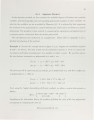
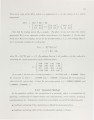
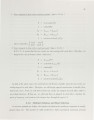
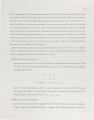
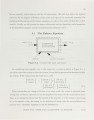
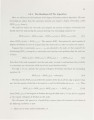
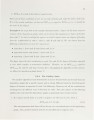
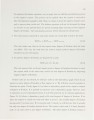
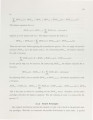
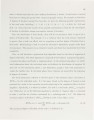
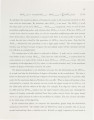
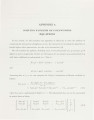
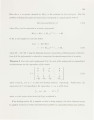
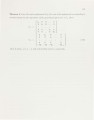
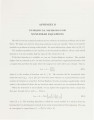
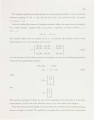
Show APPENDIX A SOLVING SYSTEMS OF POLYN OMIAL EQUATIONS In this section, we will introduce the algorithm by Manocha to solve the problem of computing the intersection of algebraic curves. For treatment of extending the algorithm to handle higher order intersections, we refer to his dissertation [41]. We will consider the problem of finding zeros of two polynomials f(x, y) and g(x, y) of degree m and n, respectively. Firstly, we will express f(x, y) and g(x, y) as polynomials in y with their coefficients as polynomials in x. That is, f(x,y) = fo(x) + J1(x)y + ... + fm(x)ym and g(x,y) = 9o(x) + 91(x)y + .. . + 9n(x)yn Assuming that m 2: n, we can compute the Cayley's formulation of Bezout resultant as follows: h(x,y,a) f(x,y)g(x,a)- f(x,a)g(x,y) y-a ho(x,y) + h1(x,y)a + h2(x,y)a2 + ... + hm_1(x,y)am-1 (A.1) where hi(x, y) is a polynomial of degree m -1. The polynomials hi(x, y) can be represented in matrix form as below: [ ho(x, y) l ho,o( x) ho,1(x) ho,m-1 (x) l 1 h1(x,y) h1,o( x) h1,1(x) h1 ,m-1(x) y y2 (A.2) hm-t~X, y) - hm-1,o(x) hm-1,1(x) hm-1,m-1 (X) ym-1 |