| OCR Text |
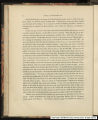
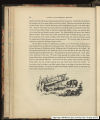
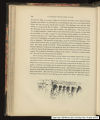
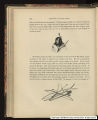
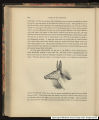
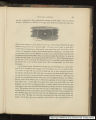
Show MAUCH CHUNK-----THE COAL MINES. 49 railroad stages are light carriages, with four low wheels, and seats for eight persons; they are covered at top, and open at the sides. The wheels are of iron, and have a groove, which fits into the rail, and runs upon it. The driver sits in front, and has a long tin horn, which he blows, to announce his approach to such as may be coming in the opposite direction; in the other hand he holds, in the descent, the machine with which the carriage is stopped when necessary. This contrivance consists of a pole, at the lower end of which there is a stuffed leather cushion, which, by moving the pole, is brought close to the wheels, and by its friction checks the rapidity of the motion. As a train of coal-wagons was expected, we slackened our pace. The two stages were fastened together, and though both were quite full of. passengers, a couple of horses drew them up with great ease. We had not proceeded far, when we heard the rolling of a train of coal-wagons. It was interesting to see the black train advance, and dart by us with the rapidity of an arrow. These are built of strong beams and planks; each contains two tons of coals, and forty-five wagons go at the same time, which carry 90 tons; they run five times a day, thus 450 tons, or 25,200 bushels, are brought down to Mauch Chunk daily. Every fifteen wagons are fastened together by strong iron bands, and in the middle of this train is a man who holds a chain in his hand, by means of which he can check the rapidity of the motion, or even stop it entirely. Four or five hundred paces behind the first column comes the second, and then, at an equal distance, the third, and after these, seven wagons, in each of which there are four mules, with provender, and a bridge for them to get in and out. Their heads are turned to the front, and they eat quietly, as they descend. These mules are to draw up the empty coal wagons. It: was interesting to see the thundering column approach us, and then hasten by. As soon as it had passed, our horses trotted up the mountain, which could not be attempted, except on an iron railroad. The road runs along the rocky wall, always through a forest, where single settlers have here and there built their little wooden dwellings. Cattle were feeding in the neighbourhood, whose bells we heard in the woods. The valley at our left hand was very wild and romantic. Both the high mountain and the valley below, in which the Mauch Chunk flows, are clothed with a forest of fir and other timber, and wild vines twine about the bushes by the road-side. The number of miles is marked on white boards nailed to the trees. When we reached the top we came to an inn, which had a small park with Virginian deer. The fawns of these deer were still spotted a little at the end of August. As soon as our company had rested a little, and taken some refreshment, as it was very hot, we got again into our carriage, and proceeded, this time without horses, to the coal mines, about ten minutes from our inn, to which the railroad declines a little. You reach these interesting works by a deep section of the upper stratum of sandstone, and then enter the pits, which may be 300 paces long, 150 wide, and 30 feet deep; quite open at top, having been gradually sunk to that depth. 112 men were at work in and about these mines, and 130 mules were employed H |