| OCR Text |
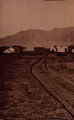
Show N^H5TTW£I^^ The Gentiles Flee A Profitable Centennial Year The new year, 1876, did not start out auspiciously for the Mormon narrow-gauge railroad. An unusually heavy snowfall blocked the track almost continuously from early January until the end of March. Passengers from Montana were either compelled to stay in Franklin "until the Bishop gets a revelation when the road shall be open" or had to pay exorbitant prices to hire any kind of conveyance available to take them to Corinne. A force of two hundred men was employed to clear the line over the Mendon Divide but could barely shovel down to the tracks before another storm would hit. Most observers agreed with the Deseret News that the route across the hills to Logan would ultimately have to be abandoned in favor of a shortcut through the more protected Bear River gorge.1 Joseph Richardson and the Mormon promoters of the Utah Northern seemed determined to build the road from Franklin to Soda Springs, Idaho. One Gentile observer was certain the plan came from Utah Delegate William Hooper and some of his friends who had invested heavily in property at the Idaho village in expectation of making large profits when the rail line reached there. The writer concluded that the railroad and its managers were both frauds. The New Northwest of Deer Lodge, Montana, on the other hand, described the route as going directly north to Eagle Rock bridge at Snake River 295 Looking toward Brigham City from Corinne. Andrew J. Russell photograph, Utah State Historical Society collections. which would leave Soda Springs eighteen miles to the east and save twenty-five miles of travel by the Corinne stage route.2 Montana residents, desperate for a rail connection to the States, enacted legislation in February 1876 to subsidize the Northern Pacific Railroad for $3,000,000 and the Utah Northern for $1,500,000. The two proposals were to be voted on by the citizens of the territory on April 3, but the people in the Missoula region were opposed. The whole question became academic, anyway, when the Utah Northern officials declined to consider the subsidy because the company would be required to build two hundred miles of road north of Franklin before one dollar of the proposed aid would be granted to the firm. Royal M. Bassett, president of the narrow-gauge line, was confident that the next year would bring a more reasonable subsidy from the Montana legislature and would not include any money at all for the Northern Pacific.3 The Mormon press was discouraged but recognized that the difficulty lay in the financial uncertainty that had gripped the country for three years. One Ogden resident met a man who had just arrived from Helena after spending three days and two nights in a stagecoach. The traveler expressed his "pleasure at being enabled at Franklin, Idaho, to exchange his mode of conveyance at that place, from the cooped up, dusty, suffocating stage to the neat little coach on the Utah Northern." He was certain that the people of Montana, who were practically isolated from the rest of the world, were ripe for a proposal to help finance the narrow-gauge line.4 296 Corinne Despite optimistic reports from Mormon newspapers about construction progress during the year, by late December no rails had been laid beyond Franklin, although twenty-five miles of roadbed had been completed as far as Cottonwood. The engineers expected that $30,000 would complete this extension of the line. It soon became generally known that the reason for the work stoppage during the summer was a default on the interest payments by the Mormon stockholders on the mortgage held by Richardson on the completed portion of the railroad. 5 An unfriendly observer was more specific - the poorly rewarded construction workers who only received $1.75 per day for a man and team had not even been paid this amount by "that bilking institution of a railroad." ° The bright hopes of Utah Northern officials for Franklin as a point of departure for northern freight also seemed lost. George S. Kennedy, who made a trip to Montana in May 1876 to drum up some business for the town, confided to any willing listener that on his way up he had passed fifteen winterbound trains from Corinne bogged down at Portneuf River, whereas he had just dispatched some wagons the past week. To Montana residents his declaration sounded as brass, the Helena Herald holding to the position that eighty miles of completed Utah Northern track had lessened the distance to the transcontinental railroad by only thirty miles, while the transfer of goods from broad-gauge to narrow-gauge cars was an expensive and time-consuming nuisance.7 A Salt Lake Herald correspondent found Franklin to be "a deserted-looking, forsaken, dull village, which has seen better times," but he hoped that an extension of the railroad would revive the fortunes of the town.s There was even talk of moving the mails back to Corinne because of a thirty-six-hour delay by way of the Utah Northern and sometimes no mail at all when snow blocked the tracks. The Ogden Junction responded to suggestions from the citizens of Corinne that they were going "to make the fur fly" unless the mails were transferred to Corinne by expressing pseudo condolences to the "expiring 'burg.' ' A Corinne resident spoke for his town by calling the Utah Northern "hardly as good as a respectable bull train . . . the Enoch road cannot be relied on to transport the mails." ° To some, neither Franklin nor Corinne seemed to exude an air of confidence or progress. When the Utah Northern took up the tracks of the branch line to Corinne in The Gentiles Flee 297 early 1876, many Saints thought the move would destroy the hated Gentile town. One Salt Lake Herald correspondent wrote of visiting the dead city, while another maintained that the freighting business of Corinne did not amount to one-quarter of what it had been a few years before. This became the typical point of view of the Mormon newspapers in 1876, and when rumor came that prominent Corinne citizen J. W. Guthrie was planning to move his business to Ogden, many Saints could see the fulfillment of Brigham's prophecy.10 But as one advocate wrote, "The dusty Burg on the Bear, like the god-like Daniel, still lives." Interested citizens of the town kept the Salt Lake Tribune informed of prospects for a lively freighting season in 1876, and by May one was able to report favorable and prosperous conditions. Despite living under the prophet's curse, Corinne had corralled nearly all of the northern freight by June and left the Utah Northern the task of "transporting carrots for the faithful." The businessmen of the town were jubilant over the increased business as the threat of Franklin receded.11 Army officers at Fort Hall, Idaho, very carefully listed the advantages of Corinne over the Mormon town and concluded there was nothing to be gained by shifting the transportation of supplies away from Corinne. The difference in freight rates was only five cents a pound in favor of Franklin. The difference in distance was forty-five miles, but the hostility of the wagon freighters to the UNRR and to the Bear River toll bridges led them to carry goods from Corinne to Helena for the same price as from Franklin.12 By September the forwarding houses at Corinne had almost 2,000,000 pounds of goods on hand. The warehouses were full with the overflow occupying the sidewalks in front, and another 100,000 pounds were arriving each day with not enough teams to pick up the goods. One of the principal reasons for the glut of merchandise was the low water in the Missouri River that prevented the normal shipment of goods by that route. Corinnethians were exuberant as they contemplated the new Studebaker freight wagons ordered by such firms as Berryman and Rodgers. The giant vehicles had a carrying capacity of 14,000 pounds and were drawn by twelve mules. The Helena newspapers were just as pleased as they noted such typical arrivals as those of C. Y. Reeder's train of twelve wagons and forty mules and Berryman and Rodgers's mule train with 80,000 pounds of machinery for a concentrating works.13 By year's end almost 7,000 298 Corinne tons of goods had been transported from Corinne to western Montana and Idaho, the largest freighting business the town had ever enjoyed in one year. A rumor circulated that the stagecoaches were to be moved back to Corinne from Franklin. There seemed to be almost as much business activity in Corinne in December as there had been at the height of the season in August, and one evidence of the briskness of trade was the unusual number of gamblers in town.14 As long as the Utah Northern Railroad lay supine at the. north end of Cache Valley, Corinne apparently woujd continue to control the trade with Montana. Utah and Northern Railroad Although the snow blockades were not as frequent or as massive on the Mendon divide during the winter of 1877, Corinne observers and the Salt Lake Tribune started the new year with typical jibes at the Utah Northern Railroad: The company was forced to employ thirty-six yoke of oxen to pull its trains over the hill to Logan, the "Mormon Tramway" stopped frequently to allow passengers to warm themselves at nearby farmhouses, or one jackrabbit on the tracks was sufficient to stop a train.15 The scoffing was perhaps understandable in light of a quite serious observation made late in the year by the Ogden Freeman whose editor wrote of a little girl who injured her foot while playing with some other youngsters on their pet line: The narrow gauge cars are particularly attractive to children, who push them up grade, crowd upon them, let fly the brakes, and away they all go on a free ride. There should be some way to fasten the cars so that children could not endanger their lives and limbs as they do.10 The narrow-gauge trains were obviously toylike in appearance to more than opponents of the railway. Those Montanans who had looked with favor on an extension of the Utah Northern to their territory during 1876 were discouraged and despondent about the wheelbarrow line and its backers as the new year dawned. Granville Stuart charged that the eastern financiers involved with the road "don't care a d n for Montana" and concluded that he was "pretty much disgusted with them as the Dutchman said to his wife when she played triplets on him, T got nuff mits The Gentiles Flee 299 Utah and Northern Railroad train in front of the station at Logan, ca. 1885. Utah State Historical Society collections. such foolishness.' " Another Montanan said he would favor the railroad if the promoters would accept "jawbone" as a subsidy.17 Then came the amazing news that Jay Gould and Sidney Dillon were interested in investing in the narrow-gauge line and pushing it into Montana. Gould proposed to bond the territory of Montana for $1,500,000, which one Corinnethian said would allow the New York financier to gain control of affairs in Montana just as Brigham Young presided over Utah Territory. In response to the Gould suggestion the legislature at Helena passed an act granting a subsidy of $1,700,000, or $5,000 a mile, if the road could be constructed to Montana within three years. The New Northwest objected that the amount was too great; it should have been no more than $4,000 a mile.is The controversy soon ended when Gould refused the proposition because of a clause that asked for a monthly royalty from the revenues of the entire road. Montana backers and Mormon stockholders were again disappointed. When a rumor spread through Ogden that the council of that city was considering a pledge of $10,000 to invest in Utah Northern Railroad stock to encourage the eastern syndicate to proceed with its extension plans, the Ogden Freeman pointed out that the 300 Corinne stock was worth about only twenty cents on the dollar, much of it being sold on the streets for as little as ten cents and taken out in store pay.10 Despite the failure of the Montana subsidy proposal, Jay Gould and his associates in the Union Pacific Railroad were quite aware of the profits to be made by a feeder road from the northern territory and were also sensitive to Central Pacific Railroad efforts to make Corinne the terminus for a road to Montana. When the Utah Northern had built to Ogden instead of using the Corinne connection, the Central Pacific had retaliated by cutting its rates from Ogden to Corinne by half. Gould and a party from the East visited the Utah Northern once during the summer of 1877 and observed the improvements being made on the tracks and roadbed by the new superintendent of the line, George W. Thatcher, and began negotiations looking toward a takeover of the small railroad.20 In a second excursion to Utah in October, Gould and Dillon completed a reorganization of the line and made arrangements to have the mortgage foreclosed and the property sold at auction, with the understanding that Joseph Richardson would relinquish the $365,000 in interest accrued on his bonds and that the construction company that had done the grading and furnished the ties would receive stock worth $6,000 for each mile from Ogden to Franklin. The name of the company was to be the Utah and Northern Railroad. The new owners traveled from Ogden to Franklin to inspect the line, enjoying the trip "as the vigorous little engine, like a bantam rooster crowed merrily to the morn, and ran along the three-foot track." Their only disapproval was directed to the Mendon Divide route that they intended to change to one through Bear River Canyon.21 Speculation continued during the year concerning which direction the road would take to Montana. When a rumor came in June that Gould intended to send out two surveying parties to investigate routes from Evanston and Corinne, the editor of the Corinne Record contended that the one from his town was the most practicable, while Royal M. Bassett of the Utah Northern was still talking about an extension by way of SodaSprings. Engineers from the new Utah and Northern finally inspected the Soda Springs and Marsh Valley routes in October and decided to build the road through Marsh Valley because of the level grade, the lower costs, and the shorter distance to an interception with the wagon road to Montana.22 The Gentiles Flee 301 By November Mormon farmers from Cache Valley were at work on a six-mile contract for grading on the new route with the expectation that another section would be let to them before winter closed the construction. About two hundred teams and three hundred men were employed in the grading at a cost of about eleven cents a yard for the work. The old roadbed toward Soda Springs was abandoned.23 The effect on Franklin, as the base of operations for the railroad extension, was nothing short of miraculous. Whereas in March an observer had noted that "those engaged in selling bad whiskey and the proprietors of gambling saloons have had to leave for want of customers," by December the town had changed from a quiet Mormon village to a very lively place. By then the construction crews were laying a mile of track a day, had completed the eleven-mile section to Bear River, and expected to be at Watson's Station in Marsh Valley, forty-five miles away, by the first of May 1878.24 The year-long activities concerned with a possible injection of Union Pacific money and energy into the moribund Utah Northern Railroad had certainly not gone unnoticed at Corinne, whose citizens became more and more apprehensive about the future of the town. Corinnethians and their supporters no doubt cringed when they read Richard Reinhardt's description of Corinne published in 1877 by Leslie's Magazine: There is not much to see: the long, low station buildings; the shabby shops; the staring, square, white saloons, from whose windows blaze the brightest lights in the whole town; the dreary absence of a single cozy cottage, green tree or garden patch, or anything that savors even slightly of home.2n To offset this gloomy view, the Chicago Journal of Commerce printed a letter describing the trading activities and the fruits and vegetables grown in Corinne. The Deseret News quoted the blurb and then poked fun at the Chicago newspaper's attempt to praise the dusty hamlet. The editor did agree with one statement of the Chicago news sheet that Corinne did not display any architectural beauty. The Salt Lake Herald by this time had adopted the practice of quoting from the Corinne Record and then making snide comments about each item. To the observation that the leading sensation for one day was a dog fight, the editor responded that such mundane incidents provided about the only exciting news; and to a remark that the streets 302 Corinne of Corinne looked like a second New York, the editor manifested utter boredom.20 Corinne, nevertheless, had one of the most active freighting years in its history during 1877. The forwarding houses, merchants, and suppliers anticipated a successful trading season and agreed with one correspondent that "the Freighters [are] Ready with Vim and Zip, to Crack the Long-tailed Buckskin Whip." 27 Montana looked forward to an estimated delivery of 25,000 tons of goods to the territory at a freighting cost of $ 1,500,000, and Corinne expected a good share of both the tonnage and the profit. By April a hundred fifty wagons of the smaller freighters were parked north across the tracks, while the large trains were expected in soon from the upper country. The city council appointed one of its members to investigate the possibility of getting the Gilmer & Salisbury stage line moved back to Corinne, and such military posts as Fort Hall signed contracts with Corinne firms for the annual supplies needed.28 A comment from the Salt Lake Tribune in September confirmed the success of the year, the most prosperous since the late "Profit" cursed the town, according to the editor. And an observation from the Salt Lake Herald in November claimed that the freight from Corinne to Montana was double that of 1876. The article continued that the UNRR had captured very little of the business because teamsters were reluctant to tackle the bad roads from Franklin. Discounting this slight exaggeration, the Bear River town shipped 5,700 tons of goods to Idaho and Montana and returned 1,128 tons of ore. The sun had smiled on the dusty trail town for one more year.20 But the organization of the new Utah and Northern Railroad and the evident construction progress towards the Montana trail station at Watson brought the sharp realization of doomsday to the Burg on the Bear. The saving of from twelve to fourteen days of wagon travel from Corinne to Watson and return meant the inevitable end of the town as a freight transfer station. The Salt Lake Herald expressed what was soon reported up and down the Montana road - "This is a death blow to the fortunes of Corinne." 3" Said the New Northwest, "Corinne is one of the things of the past." An old friend, the Salt Lake Tribune, printed an obituary, "The Shipping season in this town is closed, and perhaps forever." :n Kiesel and Company, McCormick & Hardenbrook, and the lesser forwarding firms prepared to move to Ogden or to the railroad terminus. The Gentiles Flee 303 As if to punctuate Mormon success in finally eradicating Corinne as a Gentile blot on the Utah landscape, the Corinnethians also endured another, delayed-reaction Indian scare in 1877. The year before, correspondents had noted that George W. Hill was still proselytizing among the remnants of the large encampment of Indians north of Bear River City, and one writer insisted the Corinnethians were ready for another fray. An army map accurately located "Indian town" at a spot eleven miles north of Corinne between the Malad and Bear rivers. In April 1877 the city council became concerned enough to appoint a committee to visit the Indian farm to scout means of removing the Indians and to discover whether or not the natives had actually complied with the homestead laws and secured patents for their land. The committee reported finding only five unoccupied shanties. The mayor met with the governor to expostulate against the presence of the Indians,32 while the Corinne Record began beating the war drums to get troops stationed in the town to protect the citizens: The treacherous Indians now camped in close proximity to this city could easily put to death the Gentile residents here. . . . If troops are needed anywhere in Utah, it is here, surrounded by Indians and Mormons, both of whom hate us as the devil. The result of priestly teachings - our position is to say the least, a most unenviable one. . . . The Deseret News poked fun at these fears, concluding that the citizens of Corinne could not have enjoyed any sound sleep for two years and deserved some troops because if they were denied sleep any longer they might become raving maniacs.33 Gov. George W. Emery finally listened to his Gentile constituents and made a personal visit to Corinne, holding a public meeting where reassuring speeches were made to the fearful citizens. The chief result of this investigation was the calling of a grand jury. It soon reported that about a hundred Indians under the control of George Hill were being used as stooges by certain unprincipled white men to obtain patents on homestead land, after which the whites would take possession. Furthermore, the Indians kept stampeding stock and were a general nuisance to the settlers of the area. The reaction of the Mormon press was predictable. While the Salt Lake Herald dismissed the findings of the grand jury as a silly paper,34 the 304 Corinne Deseret News was more caustic: "The untruths it utters, the insinuations it contains and the hearsay statements and opinions it repeats, mark it as the offspring of spiteful bigotry and malignant falsehood." A correspondent to the latter paper said that his investigation showed a hard-working settlement of Indians who were learning to farm and who wished to change their Indian costumes for civilized attire.3' To a white man of the 1870s this last was proof indeed of upright, moral, and ethical conduct on the part of a formerly primitive people. In defense of the frightened Corinnethians, it should be remembered that just the year before George Custer and his troops had been wiped out, while the summer of 1877 witnessed the Nez Perce war fought in a running engagement north of Corinne. Perhaps recognizing the influence of these events on the Gentile mind still alive to the supposed machinations of the Mountain Meadow church, the governor authorized a stand of a hundred arms to be delivered to the citizens of Corinne after the city council posted a $2,500 security bond. Although no Indians appeared, the townspeople evidently enjoyed some target shooting and prepared to challenge the Salt Lake City riflemen to a peaceful shootout. The Salt Lake Herald dismissed the whole episode as a "repetition of the Corinne fizzle." 30 The Freighting Ends Of much more consequence than a possible Indian raid on Corinne was the continuing threat of the Utah and Northern Railroad's all-out offensive to capture the Montana trade and reduce Corinne to a cabbage patch. To complete the takeover of the Mormon narrow-gauge line, S. H. H. Clark, acting for Jay Gould, bought the old Utah Northern at auction in April 1878 for $100,000. Clark was the only bidder. Gould had purchased the holdings of Richardson for $400,000 at about forty cents on the dollar and had paid the chiefly Mormon stockholders $80,000 for the common stock, or ten cents on the dollar. The new concern, the Utah and Northern Railroad Company, began operations on May 1, 1878. By this time Corinne's old rival, Ogden, was adding insult to injury by referring to the line as either the Ogden & Montana Railroad or the Ogden & Northwestern Railroad.37 When winter storms stopped construction the tracks were nearly to a crossing of Bear River, and vigorous efforts were made by the The Gentiles Flee 305 Union Pacific to have sufficient supplies on hand to push the road forward rapidly with the coming of spring. Sidney Dillon informed the Montana merchants that the next summer's business would be conducted from the various termini as the rails moved northward. An intersection with the wagon road from Corinne was only thirty-six miles away, which would direct all traffic away from that town on the Central Pacific Railroad. The Union Pacific expected to build a broader grade, to use longer ties and heavier rails, and generally to improve the line so that trains could travel at a speed of forty miles an hour. By May 10, 1878, track was being laid at the rate of a half-mile a day, and the terminus was moved to a temporary station at Dunn-ville in Round Valley about twenty miles north of Franklin.38 The application of Union Pacific money and know-how to the Utah and Northern transformed the attitude of Montanans and other former detractors of the line. The people of the northern territory had considered the UNRR's primitive locomotives and cars a laughing stock: Its trains rarely exceeded an average of seven miles an hour; bull trains traveling parallel with the road to Corinne competed successfully in both price and time. And, more humiliating, its passengers often disembarked to help push the train up the light grades between Ogden and Franklin. In contrast to this 1877 report, the editor of the Helena Herald took a ride on the railroad in February 1878 and confessed that he had sided earlier with many from Montana who had sneeringly referred to the road as the wheelbarrow line. Now he thought the railroad was safe, comfortable, and capable of taking care of Montana's shipping problems for many years.30 Montanans were pleased to see the new railroad free of Mormon control, an indication that Corinnethians were not the only Gentiles upset with the Saints of Utah. One correspondent, writing from Franklin about the extension of the rail line, took a sly dig at church leader John Taylor who had asked him if Montana would be a good place for Mormon missionaries. Supposedly, the Gentile had replied that "there was plenty of material up there to make saints of." I0 And Margaret Ferris, just moved from Corinne to Franklin, in November 1878 wrote her sister, I am getting pretty tired of staying here . . . I want to see somebody I can talk with. These people are so ignorant and so Mormony. It sticks out all the time. There cannot be anything 306 Corinne but antagonism between them and the Gentiles. I realize it more than ever before. . . .41 The Mormon farmers near Franklin and from Cache Valley generally were too busy making money as graders on the new railroad to be concerned over the few Gentiles at Franklin who would soon be following the tracks north anyway. The Utah and Northern also began making a good profit, as a thousand tons of goods were transported over the line by May 10. The transfer people at Ogden were forced to increase their crew from four men to a dozen to get goods changed from the broad-gauge to the narrow-gauge cars. To attract more business the Union Pacific agent at Omaha announced that for each mile of track completed beyond the crossing at Bear River rates would be reduced correspondingly and that his company expected to control most of the season's business.l2 The flurry of activity at Franklin and north to Dunnville left Corinne to contemplate the stagnation beginning to affect its business houses. In a new year's evaluation of the prospects of the town, its long-time supporter, the Salt Lake Tribune, recognized that many observers expected Corinne to lose most of its people or, worse yet, to "pass into Mormon hands." Many of the older residents were already moving to Ogden and other nearby towns, while the Fred J. Kiesel and McCormick & Hardenbrook firms were planning to continue their forwarding businesses at the terminus of the Utah and Northern. J. W. Guthrie and a few others were still hopeful that Corinne would continue as a trading center for the Mormon towns in the area. Most residents expected that the first loads of the season would leave from Corinne, with the second and remaining loads destined to be picked up at the railroad terminus.43 Firms like the Walker Brothers decided to ship their heavy mining machinery by way of the Utah and Northern, depending upon wagon transport only as far as necessary. By the middle of May, Dunnville was a busy tent town with many of the former businessmen of Corinne operating ramshackle stores at the terminus. Fred J. Kiesel not only established a canvas and frame forwarding house at the terminus but also hired a company to move his permanent warehouse buildings from Corinne to Ogden." As one writer observed, "the town of Corinne commenced to emigrate. . ." '' The Gentiles Flee 307 Although the Deseret News led the Mormon press in chortling over the demise of the "sick" town taken with "galoping consumption" and although the city council reported that retail liquor licenses for the town's saloons had declined to an alarming low of only nine establishments, a lot of freight had already been placed under contract so that the spring and early summer were still busy seasons for the Corinne merchants. The forwarding companies at Dunnville helped out by making freight rates so low that teamsters refused to load the goods piling up both at the terminus and at Ogden. Some freight was, therefore, diverted to Corinne until the teamsters were granted a better profit.40 Margaret Ferris watched her husband's forwarding business at Corinne begin to dwindle, yet the couple hoped to stay the whole year in the town before having to move to the terminus. She wrote in April that there was still much activity in the town, but she expected a lonesome time during the summer as several families had gone or were leaving. By July, packed and ready to leave, too, she witnessed a fire that almost got out of control and could have destroyed the town.47 The distress and rapid descent of the "City of the Gentiles" received some attention from the eastern press. While the Springfield Republican mentioned that Corinne was in its third decline,48 the New York Tribune editorialized at length on Mormon oppression of the town: Mormonism hardly appears in darker colors in the history of the Danites than in this persecution of the men who dared to found a Gentile city in the heart of Utah. . . . It is probably the only town in America . . . that has in recent years been the object of religious persecution, and the material interests of which have been made to suffer through religious intolerance.40 The New York newspaper, as quoted by the Salt Lake Tribune, described Brigham's curse of Corinne as he stood on the railroad bridge at the edge of the town, raised his arms to heaven, and invoked the vengeance of the Lord upon the Gentile enterprise. The prophet then abjured his followers to have no dealings with the citizens of "Hell." But, said the editorial writer, Corinne grew despite these prophetic anathemas, although now it was suffering tribulation. There was still hope for this "pluckiest town of the West" if only irrigation 308 Corinne water could be carried to its determined, never-say-die residents.50 Corinne had friends, but they were far away. The blade of the guillotine finally fell in late June when the Utah and Northern tracks reached Watson's Station, renamed Oneida, on the trail to Montana, effectively cutting off wagon traffic from Corinne. The descriptions of the new town read very much like those of the Burg on the Bear when it was in its infancy with a number of hotels, a plethora of saloons, wagon dealers, stores, and tons of freight awaiting teamsters to load up for the north.51 The Union Pacific intended only to pause at Oneida and expected to be beyond the Fort Hall Indian Reservation and located at Blackfoot before winter ended construction. By December 10, except for some local freighting activities, the business of moving goods by wagon from the Central Pacific cars to Idaho and Montana had ended. As the Salt Lake Independent had written at the beginning of the year, Corinne belonged to the past. Margaret Ferris had planned to move back to Corinne to spend the winter while her husband closed out his forwarding business but decided against it when news came that an epidemic of diphtheria was ravaging the town.52 Portions, at least, of Corinne were still actively engaged in the freighting business. A Salt Lake Tribune correspondent at Oneida noted sign boards from Corinne and other bits and pieces of the town at the new terminus. Furthermore, Pat O'Neill was operating the best hotel at Oneida, the Corinne House, and many expected that the "Corinne of the North" would soon be built at Snake River.53 As the Gentiles fled Corinne they could at least carry some old memories, along with the old lumber, to help start a new town, this time apart from the LItah Mormons. A Curse Consummated Corinne's descent into anonymity was rapid. For a year or two the town kept up a semblance of being a forwarding station by the operation of a local stage line to Oneida on the Utah and Northern. The fare was six dollars and the advertisement in the Salt Lake newspapers announced, "The Best Outfitting Point for the Salmon and Snake River Mines." 54 City government deteriorated with the 1880 municipal election attracting only twenty-nine voters. Marshal Dan Ryan's salary was reduced to a dollar a month in April 1880, raised to The Gentiles Flee 309 ten a month in August, and boosted to twenty a month in October. He was instructed to enforce the Hog Law and to abate the nuisance of open cellars in the town, apparently the only weighty matters under his jurisdiction.55 When Gov. E. H. Murray demanded the return of the remaining guns furnished Corinne during the second Indian scare, Mayor Guthrie replied that Mormon Indians were still camped near the town and might at any moment execute their hatred against the defenseless inhabitants. When the mayor's request to keep the guns permanently was denied, Marshal Ryan was instructed to correspond with former citizens to try to retrieve the weapons.50 The 1880 census revealed just how precipitously Corinne's population had declined. There were only 277 inhabitants compared to 2,184 in Brigham City and 340 in Bear River City. The Utah directory for 1879-80 listed forty-three establishments, including three churches, one hotel, one saloon, one bank, one firm of attorneys, and the opera house. The major business was the H. G. Merritt slaughterhouse which dressed and shipped 750 head of stock per month.57 Alex Toponce remembered the scene: Corinne decayed. The buildings went without paint, stores and dwellings stood vacant. Many of them were torn down or moved out on farms. People lived in houses rent free, Corinne men were found all over the west. The few who remained lived on the hope of what would happen when the irrigation water was brought out on the broad valley. But for awhile it looked as if Brigham had made a good guess.5S The Pacific Tourist of 1881 called Corinne the largest Gentile town in Utah Territory, a place hated by many Mormons and studiously avoided by residents of the nearby settlements. The editor maintained that the town was "an object of defamation" by the Saints.50 But the Gentile predominance was changing rapidly, as witnessed by Warren B. Johnson who stopped for the night at Corinne while on his walking tour across the continent in 1882. Granted sleeping accommodations at a local farm and given breakfast by the farmer's wife the next morning, he inquired of her, "Are there many Mormons in Corinne?" She replied, "We are all Mormons, here." 00 That was not yet quite accurate but was fast becoming so. An 1885 article in the Utah Journal described the dilapidated and deserted buildings and the general decay of Corinne, but it also 310 Corinne Corinne in the early 1900s. Utah State Historical Society collections. struck an optimistic note in that at least a few of the residences were neat and even elegant in appearance, while there was an air of business about the stores. The editor attributed this step back from the grave to the energy and determination of Mayor J. W. Guthrie, a banker who had purchased many of the abandoned lots and buildings and was maintaining a mercantile establishment and the only hotel as well as his bank. The gazetteer of 1888, however, listed only twenty-one business establishments, of which several were stock raisers. Four years later, the gazetteer noted thirty-one establishments, among them a new and most important enterprise, the Bear River Canal Company, incorporated with a capital of $2,100,000.01 Phil Robinson, an Englishman who spent three months in Utah in 1891, could still write about "Corinne, ghastly Corinne, a Gentile failure on the very skirts of Mormon success. . . . as discreditable a settlement. without plan, treeless and roadless . . a scattered hamlet of crazy looking shanties." '''- The census of 1900 revealed a slight increase of population to 323 inhabitants and a listing of thirty-four businesses, although Corinnethians seemed to be up to their old trick of boosterism.03 The Gentiles Flee 311 Several of the establishments were listed twice, under the owner's name and then again under the name of the firm. Throughout the agonizing period of decay after 1878, Corinne was still a way station on the Southern Pacific Railroad, and its residents could daily watch the transcontinental freight and passenger trains ascend and descend the road to Promontory Summit, one of the steepest grades on the whole line. The railroad decided to end the laborious and time-consuming climb by building a new road west across Great Salt Lake. On November 26, 1903, the Lucin Cutoff was completed after three years of effort and a cost in excess of $8 million. The new route reduced by 43.77 miles and seven hours the travel from Ogden to California and eliminated the Promontory Summit grade which was ninety feet to the mile.04 From then on Corinne saw only occasional local trains on the track through the town. It was no longer even a way station on a main railroad line. By 1912-13 the town was described as a village with a long-distance telephone and seventeen business firms.05 Mormon families gradually took over the town, sustaining the long-held belief of many Gentiles in the legendary prophecy of Brigham Young. On July 10, 1910, a branch of the LDS faith was organized for Corinne, and the opera house, profaned by many a Gentile two-step, was purchased and dedicated on November 22, 1914, as a chapel for the Saints of the area.00 About thirty years later, in June 1943, a new brick chapel was erected on the site of the old twenty-room Central Hotel for approximately five hundred Mormons who lived in "sprawling Corinne." The opera house then reverted to its original use as a recreation hall. According to the Deseret News account of the dedication exercises, "The non-Mormons who are left are very friendly to the church, and have been enthusiastic cooperators in the new building project. . . ," some serving actively on the building committee.07 Another event was chronicled on July 29, 1942, by the Cincinnati Times-Star, completing a full circle of about seventy years from the time when J. H. Beadle was reporting Corinne events to his paper, the Cincinnati Commercial. Starting the article with the fact that the people of Cincinnati probably had never heard of Corinne, Utah, the editorial writer explained the series of calamities that had left the place "a sleepy, semi-ghost town of a few weather-beaten buildings 312 Corinne and a bare 400 inhabitants" and then announced that a week earlier the town had suffered its final humiliation. The Utah Public Utilities Commission had ordered the rails of the Corinne-Promontory branch taken up to provide steel for America's effort in World War II. The writer felt that Corinne would have only a few memories left but that "in the longer view, the nation will have lost something, too." °8 The freighters, teamsters, and stagecoach drivers who once thronged the streets of the frontier town in the 1870s might have been slightly amused at that sentimentality. To them Gentile Corinne was the end-of- the-trail where the ubiquitous saloons, hotels, and shops could provide them with inner sustenance and outer regalia before they would again have to point their wagons toward the north where lay Montana. Conclusion The entry of the Pacific railroad into Mormon Utah broke the isolation of the Saints and focused national attention once again on their peculiar doctrine of polygamy, the remaining relic of barbarism once slavery had been eradicated. Corinne, the newly founded Gentile town on the Central Pacific Railroad, began to probe the weaknesses of Mormondom and undertook the task of attacking and publicizing the priestly control of Utah and the supposedly un-American and disloyal practices of Brigham Young and his followers. The Corinne newspapers led the Gentile opposition and, until the Salt Lake Tribune became firmly established as an anti-Mormon journal, the Utah The main street of Corinne in 1940. Utah State Historical Society collections. The Gentiles Flee 313 Reporter and the Corinne Reporter helped attract the attention of the nation to the widely believed sins of Mormonism. The businessmen of Corinne, who wished to protect their financial investment in the town, used the anti-Mormon propaganda as a means of diminishing the success of the Mormon cooperatives and weakening Brigham Young's political control of the territory. These goals coincided with national desires under the administration of President Ulysses S. Grant who appointed federal officials bent on destroying the theocracy of the Saints. Corinne, therefore, became a symbol of resistance to Mormon control and an object of sympathy because of the economic and social persecution its Gentile people were believed to be suffering. Eastern capital, interested in opening up the unexploited mineral districts of Utah, worked hand-in-glove with Corinnethians in the assault on Mormon control. It is significant that Patrick E. Connor who first undertook the exploration and discovery of mines in the territory was one of the prominent leaders of early Corinne. The contrast between the well-ordered and tightly controlled Mormon towns and the very democratic and rather untidy political and social atmosphere of a rough-and-ready frontier freighting town led Corinne's neighbors to call the new settlement the Burg on the Bear. Smarting from the sobriquet, the editor of the Reporter replied in kind and undertook a campaign of ridicule and hostility towards the Saints and their press. The uncertainty of existence as a freight transfer station to provide wagon transportation of goods to Montana made Corinnethian editorials, speeches, and denunciations even more strident and feverish than they might otherwise have been. The Gentiles of Corinne sought to break up the solid Mormon control of Utah by seizing upon every opportunity that offered some chance of success. They attempted to get one of their citizens appointed territorial governor, endeavored to have Corinne named the capital of Utah, tried to divide the territory by annexing the northern area to Idaho, and opposed statehood which would have placed Utah completely in Mormon hands. To achieve all these objectives, the town supported a lobby in Washington, D.C. Corinnethians were in the forefront in organizing the first effective non-Mormon political party in the territory, the Liberal party, and continued to work with the Liberals after leadership shifted to Salt Lake Citv. The anti- 314 Corinne Mormon activities of federal officials in the territory were uniformly praised and actively supported. And finally, Corinne worked assiduously to gain control of Box Elder County affairs and particularly rejoiced in the success of its free market in attracting Mormon farmers to its shops and mercantile establishments. In addition to their political and economic assaults on the Mormon stronghold, Corinnethians played up their Americanism and, by contrast, the alleged lack of patriotism of the Saints by staging extravagant Fourth of July celebrations and by expressing in every way possible the "disloyal" proclivities of the residents of Utah. The three Protestant churches established in the town beat the drums nationally for contributions to help stop the heathenish practices of the Mormons, and the citizens flaunted their public school as the only "free" school in the territory. Even baseball and horse-racing became tinged with the emotionalism of beating the predominant Mormons. Realizing their tenuous position as a forwarding point for goods to the north, Corinne sought to capture the transport of ores from central Utah by building a steamboat line across Great Salt Lake and to ensure the control of freighting to Montana by promoting the Utah, Idaho, and Montana Railroad. The paddle-wheel steamer, City of Corinne, did not succeed in taking the ore business away from the Mormon-controlled Utah Central Railroad; and the Utah, Idaho, and Montana Railroad was an abject failure. Instead, the Utah Northern Railroad, built by Mormons to Franklin, Idaho, soon posed a real threat to the very existence of Corinne. The people of the town swallowed hard and for about two years enjoyed a branch line of the Utah Northern between Corinne and Brigham City until an Ogden connection led the Mormon operators to discontinue the road to the Gentile town on Bear River. Stymied in their attempts to build a permanent transportation system with Corinne as the terminus, the citizens next turned to a grand colonization scheme to attract a large Gentile population to lower Bear River Valley by constructing an irrigation project using a large canal from the river. When this plan failed the town newspaper, no doubt with much support from frustrated and angry businessmen, whipped up an Indian scare against a large group of Shoshoni Indians engaged in a farming venture under Mormon tutelage a few miles north of the town. Coinciding as it did with the failure of a jury to The Gentiles Flee 315 convict John D. Lee, the alleged perpetrator of the infamous Mountain Meadow Massacre, the "scare" frightened many citizens of Corinne who gained some feeling of security again only when a company of troops was stationed in the town. The Indians were dispersed, and the Mormon press reacted bitterly to the combination of military force and Gentile duplicity in creating this anti-Mormon demonstration. The final dismemberment of Corinne came in 1877 and 1878 when the Union Pacific Railroad assumed control of the Utah Northern narrow-gauge line and pushed it into Marsh Valley where it intersected the Montana trail and effectively cut off wagon traffic from Corinne. By late 1878 the population of the town had declined to about three hundred from a high of almost fifteen hundred during the prosperous trading years of the early 1870s. Mormon farmers began to move in to purchase town lots and adjoining agricultural land, as Gentile merchants and tradesmen left for Ogden and other towns that offered better economic possibilities. Corinne soon became what it remains today, a Mormon farming village of some four hundred inhabitants. Nevertheless, during the decade of the 1870s Corinne occupied a unique position in Utah as the first large settlement of Gentiles to challenge Mormon control in the territory and to help focus the interest of the American people on the so-called Mormon problem. The citizens of the town failed in every attempt to secure a more permanent basis for industrial and commercial growth and to dissolve the church-state power of Brigham Young and his followers, but they struggled mightily in the endeavor. To the Mormons, Corinne was a Gentile blot on the saintly landscape; to the Corinnethians, Mormonism, with its abhorrent doctrine of polygamy, was a stench in the nostrils of the nation. The ten-year contest of Corinne to establish itself as the metropolis of the hills and to make itself the "Gentile Capital of Utah" failed, but in the process the Burg on the Bear helped sharpen national consciousness to the different kind of life-style practiced by the Saints of Utah and to the need for congressional legislation to force a change in Mormondom. 316 Corinne NOTES FOR CHAPTER 10 1 Salt Lake Tribune, 2 February 1876; Salt Lake Herald, 4 February, 24 March 1876; Deseret News, 9 February, 21 June 1876; Ogden Junction, 15 February 1876. 2 Salt Lake Tribune, 2 February 1876; Deseret News, 10 May 1876. 3 Salt Lake Herald, 22 February 1876; Deseret News, 23 February, 2° March. 12 April 1876. 4 Ogden Junction, 26 August 1876. 5 Salt Lake Herald, 27 April, 27 December 1876; Deseret News, 10 May 1876. 9 Salt Lake Tribune, 2 February 1876. 7 Deseret News, 17 May 1876; Helena Herald, 3 February 1876; Salt Lake Tribune, 30 January 1876. 8 Salt Lake Herald, 13 August 1876. 9 Salt Lake Tribune, 2, 19 February; 6 September 1876; Ogden Junction, 1 February 1876. 10 Salt Lake Tribune, 18 June 1876; Deseret News, 5 January 1876; Salt Lake Herald, 12 March, 13 August, 12 September 1876. 11 Salt Lake Tribune, 9 February; 15 April; 6 May; 18, 30 June; 22 July; 6 September 1876. 12 Lt. Joseph Hall to Depot Quartermaster, 22 July 1876, 25 August 1876, Fort Hall, Letters Sent, Post Quartermaster, 1875-79, Old Military Records, National Archives, Washington, D.C. 13 Salt Lake Tribune, 6, 22 September 1876; Ogden Freeman, 12 September 1876; Helena Herald, 7 September; 2, 9 November 1876. 14 Ogden Freeman, 28 November, 9 December 1876; Salt Lake Tribune, 6 October, 5 November 1876. 15 Deseret News, 14 February 1877; Salt Lake Tribune, 18, 27, 31 Tanuary 1877. y 19 Ogden Freeman, 19 October 1877. 17 Robert G. Athearn, "Railroad to a Far-off Country: The Utah and Northern," Montana, the Magazine of Western History 18 (October 1968) : 14; Salt Lake Tribune, 31 January 1877. 18 Salt Lake Tribune, 27 January 1877; Deseret News, 14, 28 February; 7 March 1877; Athearn, "Railroad to a Far-off Country," pp. 13-14. 19 Athearn, "Railroad to a Far-off Country," p. 14; Ogden Freeman, 27 February 1877. 20 Deseret News, 4 April 1877; Robert G. Athearn, Union Pacific Country (San Francisco: Rand McNally, 1971), p. 249; Salt Lake Herald, 17 November 1877. 21 Salt Lake Tribune, 26 October 1877; Deseret News, 10 October 1877. 22 Helena Herald, 14 June 1877; Deseret News, 25 July; 21, 24 October 1877; Salt Lake Herald, 14 November 1877. 23 Deseret News, 7, 14, 28 November 1877. 24Deseret News, 21 March 1877; Salt Lake Tribune, 5 December 1877. 25 Richard Reinhardt, Out West on the Overland Train: Across-the-Continent Excursion with Leslie's Magazine in 1877 and the Overland Trip in 1967 (Palo Alto, Calif.: American West Publishing Co., 1967),p. 111. 20 Deseret News, 15 August 1877; Salt Lake Herald, 21, 24 March 1877. 27 Ogden Freeman, 25 February 1877. 2S Helena Herald, 28 June 1877; Salt Lake Tribune, 13 April 1877; Council Chamber Corinne City Minute Book, 28 May 1877, Utah State Archives, Salt Lake City; Fort Hall, Letters Sent, Post Quartermaster, 1875-79, 52. The Gentiles Flee 317 29 Salt Lake Tribune, 28 September 1877; Salt Lake Herald, 17 November 1877, 1 January 1878. 3« Salt Lake Herald, 5 October, 17 November 1877. 31 New Northwest (Montana), 28 December 1877; Salt Lake Tribune, 2 December 1877. 32 Salt Lake Tribune, 30 June, 23 July 1876; U.S., Army Corps of Engineers, Geographical Surveys West of the 100th Meridian, 1877, map compiled and drawn by Lt. George M. Wheeler's survey party, microfilm 347, Utah State Historical Society, Salt Lake City; Corinne City Minute Book, 9, 11 April 1877; 23 May 1877; Salt Lake Herald, 23 May 1877. 33 Deseret News, 30 May 1877. 34 Salt Lake Herald, 22 August; 28, 29 Setpember 1877. ™ Deseret News, 3, 10 October 1877. ™ Salt Lake Herald, 24 October, 16 December 1877; 28 March 1878; Corinne City Minute Book, 3 December 1877. 37 Salt Lake Tribune, 5 April 1878; Ogden Freeman, 1 January, 5 April, 7 May 1878; Deseret News, 10 April 1878; Athearn "Railroad to a Far-off Country," p. 15. 38 Deseret News, 23 January, 10 April 1878; Helena Herald, 7 February 1878; Idaho Statesman, 17 January 1878; Salt Lake Herald, 27 March 1878; Ogden Freeman, 10 May 1878. 39 Holiday supplement to Dillon Tribune, pp. 2-4 (bound with West Shore, 1883-84), Montana State Historical Society, Helena; Athearn, "Railroad to a Far-off Country," p. 16; Helena Herald, 21 February 1878. 40 Helena Herald, 4 April 1878; New Northwest, 11 January 1878. 41 Margaret Eastman Ferris Letters (1874-84), 11 November 1878, manuscript file 403, Montana State University Library, Bozeman. 42 Ogden Freeman, 10 May 1878; Deseret News, 8 May 1878; New Northwest, 29 March 1878. 43 Salt Lake Tribune, 1 January, 3 April 1878. 44 New Northwest, 5 April 1878; Deseret News, 15 May 1878; Ogden Freeman, 30 July 1878. 45 Holiday supplement to Dillon Tribune, p. 1. 4a Deseret News, 1 May 1878; Salt Lake Herald, 29 March, 23 May 1878; Corinne City Minute Book, 1 April 1878; New Northwest, 17, 24 May; 21 June 1878; Salt Lake Tribune, 25 April 1878. 47 Ferris Letters, 22 February, 15 April, 21 July 1878. 48 Salt Lake Tribune, 19 July 1878. 49 Salt Lake Tribune, 20 July 1878. 50 Ibid. 51 Salt Lake Herald, 26, 27 June 1878; New Northwest, 28 June 1878; Helena Herald, 27 June 1878; Ogden Freeman, 28 June 1878; Salt Lake Tribune, 21 August 1878. 52 Salt Lake Tribune, 8 August, 10 December 1878; Salt Lake Herald, 20 June 1878; Deseret News, 12 June 1878; Helena Herald, 22 August 1878; Salt Lake Independent, 6 January 1878; Ferris Letters, 10, 24 November 1878. 53 Salt Lake Tribune, 3 April, 1 September 1878; Ogden Freeman, 30 August 1878; Idaho Statesman, 9 April .1878. 54 Salt Lake Tribune, 16 April 1879 . 55 Corinne City Minute Book, 4 August, 5 April, 16 August, 7 October, 8 November 1880. 00 Mayor J. W. Guthrie to Gov. E. H. Murray, 12 March 1880, no. 6942, and 22 March 1880, no. 6953, in Utah Territorial Papers, Utah State Archives; Corinne City Minute Book, 6 July 1880. 318 Corinne 57 U.S., Tenth Census of United States, 1880: Compendium (Washington, D.C., 1883), p. 309; H. L. A. Culmer, comp. and ed., Utah Directory and Gazetteer for 1879-80 (Salt Lake City, 1879), pp. 333-36. 98 Alexander Toponce, Reminiscences of Alexander Toponce (Norman: University of Oklahoma Press, 1971), pp. 199-200. 59 Frederick E. Shearer, ed., The Pacific Tourist . (New York, 1882-83), p. 180. 00 Warren B. Johnson, From the Pacific to the Atlantic, Being an Account of a Journey Overland . . . (Webster, Mass., 1887), 23 September 1882. 61 Andrew Jenson, Corinne Ward Manuscript History to 1930, Archives Division, Historical Department, Church of Jesus Christ of Latter-day Saints, Salt Lake City; Lorenzo Stenhouse, Utah Gazetteer and Directory, 1888), pp. 50-51; Sten-house & Co., Utah Gazetteer, 1892-93 (Salt Lake City, 1892), pp. 56-57. 02 Philip S. Robinson, Sinners and Saints . . Three Months among the Mormons (Boston, 1883), pp. 269-70. «3 U.S., Twelfth Census of United States, 1900: Report (Washington, D.C., 1901), 1:477. 64Dale L. Morgan, The Great Salt Lake (Indianapolis and New York: Bobbs- Merrill Co., 1947), p. 26; Wain Sutton, Utah: A Centennial History, 3 vols. (New York: Lewis Historical Publishing Co., 1949), 2:831; David E. Miller, Great Salt Lake, Past and Present (Salt Lake City, 1949), pp. 38-41. 95 R. L. Polk & Co., Utah State Gazetteer and Business Directory, 1912-13 (Salt Lake City, 1912), p. 74. CG Lydia Walker Forsgren, History of Box Elder County (Salt Lake City: Daughters of Utah Pioneers, 1937), pp. 302-3. 97 Deseret News, 21 June 1943; Kate B. Carter, ed., Heart Throbs of the West, 12 vols. (Salt Lake City: Daughters of Utah Pioneers, 1939-51), 8:141. 98 Cincinnati Times-Star, 29 July 1942. The 1970 Census showed Corinne with a population of 471. The Gentiles Flee 319 |