| OCR Text |
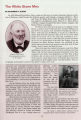
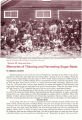
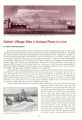
Show ing jobs were prized by those lucky enough to get them. When Belle H. Wilson of American Fork was 16, her father told a sugar company official that she was " capable of doing whatever is needed for weighing and recording" the wagons that came to the beet dump. After a two- day trial, she got the job: " I sat in the little office of the weigh station, on a high stool. Through the large window before me I could see the horses pulling the loaded beet wag-on onto the platform. As soon as the wagon stopped I weighed the load by adjusting the move-able gauges to acquire a balance. This weight in pounds had to be recorded as tons of beets and any extra poundage. This information was recorded on a printed form after first identifying the farmer." While the farmer unloaded his beets a worker re-moved the dirt from a half bushel of beets, weighed the dirt and the beets separately, and calculated the percentage of dirt in each pound. " After I had weighed the returning empty wagon, I subtracted its weight from the original load weight. Then I figured the percentage of dirt on the beets and sub-tracted that ... and came up with the net weight ...." At season's end, the information Wilson recorded was used to pay each farmer. She spent her eam-ings on " a lovely dress and coat which were need-ed for a winter wardrobe for high school." Cleone Fox Ferguson remembered her senior year in high school when she drove a team and wagon to the beet dump about three- quarters of a mile away. She had red hair and freckles and was subjected to catcalls from the men, apparently for her looks and for doing a typically male job. She enjoyed it anyway because it was easier than top-ping beets. After graduation she got a job, but she still took time off in the fall to help with the harvest. Most of those who worked hard as children in the sugar beet fields are glad they had that expe-rience. It shaped their lives in many positive ways. For most, the sour memories of long days, heat in summer and cold and mud in fall, sore muscles and aching backs, nicked legs, and seemingly endless rows of beets were outweighed by the sweetness of work well done, earning spending money, con-tributing to their family's survival, companion-ship, and occasionally fun on the job. Equally important, these workers remain proud of what they accomplished. Mrs. Murphy wishes to thank the more than 60 indi-viduals who shared their memories of the beet fields with her. Their stories will be archived at the Utah State Historical Society. This article has focused on school children who worked in the beet fields. As Utah's sugar industry grew it depended heavily on migrant workers, especially Mexican Americans, Native Americans, and Mexican nationals. That is a different story and one that also needs to be told. BY LINDA THATCHER Visitors to Memory Grove in Salt Lake City wonder about a forlorn looking railroad boxcar tucked into the southeast corner of the park. Why is it there? What is it used for-- an office or a stor-age unit? It seems misplaced, but in reality it is not. It is one of 49 boxcars that arrived in the United States from France on February 3, 1949, crammed with presents for American citizens. The Merci or Gratitude Train, as it was called, was an expression of thanks from the citizens of France to ~ mericafo r aid rendered during and after World War 11. The Merci Train was organized partly in re-sponse to another well- publicized train. In 1947 newspaper columnist Drew Pearson had come up with the idea of an American Friendship Train to collect needed items for European nations that were still struggling to recover from the war. The idea caught fire, and within a few months the Friendship Train had traveled across the country and collected more than 700 carloads of donated food, fuel, and clothing that were sent to Europe. A French rail worker and war veteran named Andre Picard suggested that France reciprocate. He originally suggested that France present the United States with one boxcar filled with gifts representative of his country- wines, lace, per-fumes, clothing, etc. A French veteran's organiza-tion adopted the proposal, and a committee was formed to solicit gifts. The response from French citizens was overwhelming. Despite years of eco-nomic hardship, thousands of French people do-nated items to send to America. As news coverage spread, the project gained national momentum, with hundreds of organizations participating. It soon became apparent that one boxcar would not be enough. Gifts to Fill 49 Boxcars Eventually, the French War Veterans Associ-ation took overihe project and calcu1: cted that they had enough gifts to fill 49 boxcars- one for each of the then 48 states and the one to be split between the District of Columbia and the Territo-ry of Hawaii. ( The District of Columbia got the gifts, and Hawaii, which had donated two carloads of sugar to the American Friendship Train in 1947, received the boxcar, by then containing only straw.) After the French decided to send 49 boxcars instead of one, they began to scour the railroad yards for them. The boxcars were called " Forty and Eights" because during World War I, one box-car was used to carry 40 men or 8 horses. For 3 " " 1 m , Lm FY ,.- -- yG ~ oTI!- ?- - j ' Boxc:~ in r-"-:::::- - --- " Ivierci" fro People of France I I wooden cars after landing in France, the boxcars of the Merci Train had a familiar look. Constructed between 1872 and 1885, the 12- ton, 29- foot rail cars hauled freight before their con-version to troop and animal transport. herican veterans of World War I had mixed feelings about the boxcars. Although they had saved the men time and shoe leather, the boxcars brought back memories of a crowded and uncomfortable ride. In the history of Utah's 145th Field Artillery Regiment, E. W. Crocker wrote: " On September 16th the outfit again entrained for the long trip across France, an unforgettable experience for most of the men, for it meant being cooped up in tiny French boxcars, designed to carry eight horses or forty small Frenchmen. " Another account is given in a poem by Ralph '% Boo Duvall that tells the story of thel45th Field Artillery: Across the blooming Channel we took another ride. They loaded us in cattle cars, a hundred side by side, And clanked along on flat wheels until we almost died! But we never lost a doggone man. We lined up at the railings and drew our pork and beans, Then packed back in the box- cars as tight as canned sardines, And saved up all the Willie cans and used them for latrines, Yet we never lost a doggone man. In the end the French collected 52,000 items for the Merci Train. The assortment of gifts was staggering- ranging from childish drawings, puzzles mounted on cardboard frames, ashtrays made of broken mirrors, worn- down wooden shoes, hand- crocheted doilies, and battered toys to a bust of Benjamin Franklin by a noted French sculptor, a jeweled Legion d'Homeur medal pre-sented to Napoleon, the bugle that signaled the signing of the Armistice ending World War I in 1918, Louis XV's carriage, and the first motor-cycle ever built. By the end of 1948 the 49 boxcars were filled to capacity. The train was assembled in Par-is and pulled to the port of Le Havre for transport to America. As the Merci Train was being loaded on the merchant ship Megellan even more pres-ents from the grateful French arrived. Thousands of gifts had to be left on the docks. " Merci, America" throughout the state. Some will be exhibited in the When the Megellan reached New York City state capitol while others will be shown in various on February 3, 1949, the New York Times reported public buildings and parks." " a welcoming din surpassing that accorded the Blizzard Delayed Train maiden arrival here of an ocean passenger queen." The boxcar was originally scheduled to As the ship steamed into New York harbor- fly- arrive in @ den on Febmary 15, 1949, at 5100 ing a large banner that read " Merci, America"- it a. m.; it would then travel on to Salt Lake City. was greeted by a fleet of small boats and Air Force Plans were made to cheer the car all along the planes flying overhead. Bells rang, whistles blew, route- Unfortunately, things did not work out as sirens sounded, and the fireboats escorting the planned, for the train, which was making its way ship sprayed their nozzles skyward in salute. west, encountered a blizzard in Wyoming. Resi- The ship docked at Weehawken, New Jersey, dents of Rock Springs and Green River, and was unloaded the following day by volun- Wyoming, had planned an '' enthusiastic" wel-teers. President Truman permitted the cargo t~ come for the Merci Train on February 14. Folks in enter duty free. Since the French boxcars did not Green River7 which had set a small town record by fit American standard gauge donating 728 cases of milk, 5,000 tracks, they were hoisted onto flat- pounds of dried beans, 10,000 cars for their overland journey. pounds of macaroni, 100 pounds of Next, the Merci Train was divided mixed groceries, and $ 200 in cash into three sections for routing to to the American Friendship Train in different parts of country- the 1947, were especially eager to South, the West, and New En- receive France's thank you. gland. The New York car was Because of the storm, however, transported to Manhattan where Union Pacific rerouted the train 200,000 New Yorkers gathered to through Colorado, New Mexico, give their little boxcar a ticker tape Arizona, California, and Nevada parade and to shout " You're wel- before sending it on to Utah. The come" to the French people. Salt Lake Tribune reported on Feb- In Utah, the citizens anxious- ruary 12, 1949, that the railroad of-ly awaited their boxcar's arrival. A ficials had stated: " When it will committee to determine the dispo- reach Salt Lake City is anybody's sition of Utah's gifts was named guess." on January 22, 1949, by Governor Finally, officials confirmed J. Bracken Lee. Members of the that the train would arrive sometime committee included Harold M. on Friday, February 18, from McNeil as chair, and committee Barstow, California. The committee members Melvin B. Wright of the made plans for a parade and accep Lions Club, J. F. Fitzpatrick, pub- tance ceremony to be held the fol lisher of the Salt Lake Tribune and lowing week. According to the Feb Telegram, and W. P. Miller of the Dolls were among the Merci ruary 19 Salt Lake Tribune, H. M. Ogden City Schools. Train gifts. Maybe a French McNeil took a National Guard tank The committee began to bisque doll by Jumeau, very carrier to the railroad yards to pick make plans to receive the train, but valuable today, was included. UP the boxcar-final arrangements depended on " They wheeled the big Erie whether a representative of the French govern- flatcar, on which the tiny narrow gauge rode pic-ment would accompany the train. McNeil report- a- back across country, under a giant crane. They ed that a " public reception would be planned if a tied a fat chain around the little 40- et- 8' s tummy. representative accompanies the car to Salt Lake They tugged and they tugged- City." However, " If no official appears, the com- " But the frightened Frenchman just creaked mittee will exhibit the little French World War I and groaned like it used to do when Mr. McNeil boxcar at the corner of South Temple and Main." and his World War I buddies rode to battle fronts The contents of the car would then be unloaded as French railroads guests. . . . and displayed in the windows of the Utah Power and Light Co. building. The Salt Lake Tribune clkiL! w~ e&- @ Urn also reported that " the committee hopes to distrib-ute some of the French gifts to communities P @ . P O ~ @ / Z & . ~ " Mr. McNeil had come to show M. Car to its room in the county shops. They were to complete plans for touring the city, meeting the governor and getting unpacked. But the little boxcar wouldn't budge. " So he will try again Saturday." The celebration was scheduled for Tuesday, February 22-- George Washing-ton's birthday and a national holiday. The program was to include a visit from A. Rousselet, the French vice- consul from San Francisco. Governor Lee would accept the boxcar and its load of gifts for Utah, and Mayor Earl J. Glade would welcome the boxcar to Salt Lake City. Two French war brides, one from each world war, were asked to join the welcoming party. Both women lived in Ogden. Mrs. James H. Brock came to the U. S. after World War I, and Mrs. William E. Sylvester was a World War I1 bride. They were part of the Ogden entourage that included Mayor Harmon W. Peery. The day started with a parade from Salt Lake Post No. 2, American Legion, at 404 South West Temple to the Union Pacific Building at South Temple and Main Street. Participating in the parade were American Legion drum and bu- Ogden Mayor Hamon W Peery. gle corps from Salt Lake City Ogden, and Sugar House; the Bountiful jeep posse; the Utah National Guard; state, city, and Lions Club officials; and mem-bers of the Merci Train greeting committee. The formal presentation and acceptance of the boxcar was held at South Temple and Main Street. Governor Lee received the boxcar from Clinton D. Vernon, Utah's attorney general. French Salt Lake City Mayor Earl J. Glade. Governor J. Bracken Lee. vice- consul ~ dusielet'sp lane had been grounded at Las Vegas by bad weather, and he arrived too late to attend the ceremony. Governor Lee told the audience that the French gift was an expression of " friend-ship and good will." Mayors Glade and Peery thanked the French on behalf of Salt Lake City and Ogden. H. M. NcNeil introduced the two French war brides who expressed their gratitude to America in their na-tive tongue. Entrance to Memory Park, usually referred to as Memory Grove today, at the mouth of City Creek Canyon in Salt Lake City. The Merci Train boxcar is through this entrance on the extreme right. USHS collections. On February 28 the contents of the boxcar were placed on display in the UP & L building at 136 So. Main. For many, the most significant item received was the American flag made by Parisians by candlelight and then paraded up and down the streets of Paris after it was liberated from the Ger-mans. Great Variety of Gifts The boxcar contained books, paintings, vases, war me-mentos, native costumes, a chic white satin Paris wedding dress, sabots ( shoes), a bed warmer, dolls, medals, a set of pink lingerie trimmed in black, wine, crystal, and 1,000 other objects. There were simple gifts from French school children as well, such as stamps of the world arranged in star shapes and embroidered kettle holders. With many of the gifts came personal notes in French, some simply saying Nous vous remercions ( We thank you). A woman from Toulouse wrote: " My daughter has two infants. There was not much milk for them . . . then came your Friendshp train.. . . So I send this doll which I made." Eventually, the gifts would be distributed to Utah communities that had donated items to the Friendship Train for placement in local museums. A campaign was started to find a permanent home for the Merci boxcar. The first choice was Memory Grove be-cause it " held so many memories for the veterans and relatives of veterans of two wars. . . ." There the boxcar could stand " amidst the trees, shrubs and memorial markers . . . as a small monument to the good will that has existed for many years between the people of France and the people of the United States." The officers of the Service Star Legion objected on the grounds that the boxcar would not be in keeping with the at-mosphere of the park. Others worried that the old green box-car might become an eyesore. But after a personal inspection of the car and the site, the Service Star Legion withdrew its protest. Mayor Glade promised to protect the boxcar with var-nish or lacquer. Finally, on March 3 1, the permanent mount-ing of Utah's Merci Train boxcar in Memory Grove was au-thorized by the Salt Lake City Commission, in the southeast corner of the park, an area once used as a dump. According to the Salt Lake Tribune of May 4, 1949, the boxcar made its final trip to " become a shrine to memories and international good will." Workmen hoisted the car onto narrow gauge rails set in a 30- by- 12- foot concrete pad. " For the pint- sized freight car, it is the end of the road, the last lurch on a trail that led through two world wars to honorable rest in a friendly land," the newspaper said. Months later the Tribune reported: " A little French boxcar was welcomed as a ' resident' of Utah at ceremonies Sunday [ September 181 in Memory grove. Madame J. James ( Adrienne) Buck, French consular agent for Utah, spoke on behalf of the French consul general and the people of France. "' The French people put their hearts into this gift, their own way of thanking America and Americans for the " Friend-ship train." This plot of Utah land will remain a representation of the friendship of the people of France,' Madame Buck Madame Adrienne Buck, University of Utah professor of French and Honorary French Consul. Mayor Glade accepted the mon-ument on behalf of the city from Dr. Frank H. Jonas, chairman, United Vet-erans' Council of Salt Lake County. The American Legion promised to maintain the boxcar. And, finally, Clarence C. Neslen, Utah commander of the American Legion stated, " Here we have a tangible symbol of a grand fellow republic and its bond with America. A symbol of the understand-ing between America and France. May it serve to keep alive a love for freedom and a desire to further the principles and perpetuate democracy." Today, its shields covered with a coat of green paint, Utah's Merci box-car remains in the southeast comer of Memory Grove, ignored by the park's hundreds of daily visitors. The gifts distributed throughout the state have most likely been lost or lie unidentified on a museum shelf. Yet, for those who know its hstory, the Merci Train repre-sents a vibrant and momentous gesture of good will from the citizens of France to all Americans. Ms. Thatcher is coordinator of collec-tions at the Utah State Historical Society. said." |