| OCR Text |
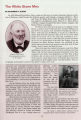
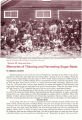
Show the young lady by riding fast toward the train and flagging it down. They marry and live happily ever after. Thank you folks. Don't forget the next movie- a month from now." The lights would come on and someone would grumble: " If I'd knowed it wuz gonna break down I'd a not give that bottle of peaches for gettin' in." But all was forgotten and forgiven by the time Mr. Garr rolled into town again with the big screen tied onto the fender of his car and the back seat piled high with projection equipment, a bed-ding roll, and many items he had accepted along his route for admission to his shows: honey, eggs, bottles of fruit, or whatever the good folks along the way could afford. Money was scarce. There were many other changes in our lives as a result of Mr. Eckersley's electrical power. Electric motors turned the grinding wheels to sharpen axes and mowing machine knives. And some more affluent townspeople even installed electrically driven pumps to bring running water from their cisterns into their houses. Yet our only running water came when I had to go in the dark to fetch a pailful. Mr. Eckersley remained at the helm of the People's Power and Light Company until Decem-ber 1941. Then he sold to the newly established GarKane Power Association for the great sum of $ 35,000- about $ 385,000 in 1990s money. By the time of the sale I had gone through three and a half years of college with my gradua-tion set for June 1942. I had married and was no longer afraid of the dark- just afraid of my new wife. And I had registered for the World War I1 draft. By the fall of 1942 I would be deeply in-volved in Army Signal Corps training. Mr. Eckersley went on to become a real es-tate agent in the Payson, Utah, area and later an owner of a modem dairy in the same vicinity. There in the summer of 1946, after I had come back from the army, I again encountered him. As editor of a state farm magazine, I took pictures of him and his dairy and interviewed him for a fea-ture story. He lived into his nineties, having made a name for himself as a pioneer in electricity, real estate, and dairying. But best of all he would be remembered by all who knew him as a worthy cit-izen, with compassion for his fellow people. When he passed on to the world of tomorrow I suspect that a new star was added to heaven-- one lighted by George Teasdale Eckersley. Mr. Robinson lives in West Jordan, Utah. Provo's Infamous Goddess of Liberty Contest of 1894 BY D. ROBERT CARTER The people of Provo pride themselves on having one of the biggest, most exciting Fourth of July celebrations in the country. America's Freedom Festival at Provo features, among other things, a baby contest, a golf tournament, a beau-ty contest, a children's parade, a historic build-ings tour, several concerts, a picnic in the park, a balloon festival, a Grand Parade, an extensive fireworks display, and a glitzy evening program billed as The Stadium of Fire. Despite this extravagant modern hype and activity, it was an unadorned, old- fashioned Fourth of July celebra-tion in 1894 and its accompanying Goddess of Liberty contest that provided Provo with one of the most intensely interesting and exciting Independence Day celebrations that it has ever witnessed. The 1894 celebration began in the usual way. The city council appointed a general com-mittee that created several subcommittees to plan and carry out each of the day's activities. The hol-iday usually began with the firing of salutes fol-lowed by what would be considered today a rath-er lackluster parade. An orgy of oration in the Tab-ernacle, a picnic lunch, and an afternoon of con-tests and activities held on the West Square ( Pio-neer Park) and at the Provo Lake Resort on Utah Lake normally completed the day's events. The parade subcommittee appointed three prominent women, Ellen Jakeman, Wilmoth White, and Annie Jones Atkin, to oversee the se-lection of the Goddess of Liberty, who customar-ily provided the crowning touch to the elaborate ( for those days) Car of State float. The committee usually selected the woman to portray this model of femininity, but this year, to leave no cause for jealousy, they gave the public the opportunity to vote for this most important of female personages. In making this change the committee unwittingly ignited a drama of operatic proportions To simplify voting, the committee enlisted the help of the press. The women presented their plan to the Daily Enquirer, Provo's Republican voice, which printed an official ballot in its June 22 issue. The next day two of the committee wom-en visited the Evening Dispatch, Provo's Democratic paper. The editor and his staff, miffed that the Enquirer had been allowed to run the bal-lot the day before, questioned the women. The editor asked if the contest was open to the public. The answer was an emphatic, " It is." The news-men suggested that the contest might be less com-plicated if the committee picked ten women and let the public vote for their favorite. The ladies again emphasized that the contest was open to all women except " unknown and objectionable" per-sons. The Dispatch printed the ballot that evening in its June 23 issue The competition would close Saturday, June 30, 1894. People could vote as of-ten as they wanted, but they had to use the ballots published in the two newspapers. The competition got off to a humdrum start. The June 25 Dispatch revealed that five women had received a grand total of 32 votes. The next day, however, the contest suddenly became more interesting. Unsubstantiated rumors began to waft about town that votes had been cast at the Dispatch office for a young woman, Edna Twelves, who did not have the approval of the committee. Its three members claimed she was an " impure woman." By the end of that day an ex-panded field of nine contestants had received 173 votes. Two were nose to nose: May Brown with 5 1 votes and Gertie Thurrnan with 45. Edna Twelves was not far behind with 27 votes. On June 27, J. B. Pemberton called at the Dispatch office " highly indignant that his wife's name should appear as one of the contestants for Goddess of Liberty.'' Even though she had re-ceived votes strictly in accordance with the rules of the contest, her name was withdrawn from the contest with the permission of the committee. Pemberton apparently looked with disfavor upon his wife's name appearing on a list that included the name of a woman of questionable character. Astonishment and shock must have strolled the streets of Provo hand in hand on June 28 when the evening issue of the Dispatch came off the press. Readers likely skipped the front page news in a frenzied search for the latest Goddess of Liberty contest results, and they were not disap-pointed. Edna Twelves, whose wholesomeness was questioned by the committee and the Enquirer, led the other contestants by an astonish-ing number of votes- 1,042; her nearest rival, Gertie Thurman, had a mere 189. It did not take the town long to find the rea-son for this amazing turn of events. Edna's boyfriend was Logan Paul, the feisty, wiry, young cigar maker whose establishment was located in Billy Wilson's saloon and near the Dispatch office on Academy Avenue and whose father was chief of police in Salt Lake City. Paul had submitted several votes for Edna to the Enquirer which the paper had refused to accept. The rather prissy and somewhat self- righteous Enquirer even refused to Turn- of- the- centuryp arade in Provo. The Goddess of Liberty and her attendants, Truth and Justice, may well have ridden in a similar carriage during the July 4 festivities. Photo courtesy of Nanalee Johnson Stratton. list Twelves's name among the contestants. The enraged Paul then ordered 3,000 issues of the rival Dispatch and proceeded to fill in her name and hand in the ballots to that newspaper's office. Apparently, he had only been able to fill in about a thousand ballots the first day. The two rival newspapers were always anx-ious to battle each other, and the contest gave them the chance. The Goddess of Liberty Committee and the Enquirer lurched into offen-sive gear. The next issue of that paper refused to include Twelves's name in the contest. By so doing, it cast doubt on her virtue, assaulted her character, and tarnished her reputation. The paper also admonished the populace to " Vote for the people's choice for Goddess of Liberty, and ignore the saloon candidates." The Enquirel; in effect, had labeled contestants whose names era1 committee refused to abide by the results tab-ulated in either newspaper. It arbitrarily an-nounced that Gertie Thurman would be that year's Goddess of Liberty. Twelves may have lost the contest, but public sentiment seemed to be chang-ing in her favor as indignation mounted against the actions of the committee and the Enquirer. The Dispatch announced, " It now appears that she will come out of the fire of scandalous rumor that has been waged against her unscathed." The Enquirer retaliated by announcing that the com-mittee acted as it did because Twelves was the candidate of saloon men and gamblers. The Enquirer also insulted the committee headed by Mrs. Athn, accusing it of cowardice for discon-tinuing the contest and choosing the goddess without public expression. appeared only in the Dispatch as " saloon can-didates." On Thursday, June 28, Mrs. Atlun visited the Dispatch office again an informed the paper that its name and th date needed to be printed on its ballots At the beginning of the contest th newspapers had not been required t print their names or the date on the ba lots, and by this time several thousand ballots without that information had been used by voters. On Friday the Dispatch received an ambiguously worded card demanding that Twelves be struck from its list of contestants - because she was an objectionable person. It had been signed by many people, including Edna's father, Orson Twelves, who later claimed that his signature had been inadvertent. The paper also received a letter from Edna stating that she was of legal age and could act for herself. She steadfast-ly refused to authorize the withdrawal of her name from the contest. The Dispatch likewise refused to eliminate her as a candidate. The day continued in this combative vein. The committee demanded that the Dispatch remove any notice of the contest from its pages and announced in the Enquirer that no ballot from the Dispatch bearing a date later than June 28 would be counted. Moreover, no vote without a paper's name on it would be accepted. These actions by the committee effectively can-celed most of the votes that had been cast through the Dispatch office. Ignoring the committee's de-mand, the beleaguered paper pugnaciously pub-lished an update on the contest that evening, showing Twelves ahead by the wide margin of 3,054 to Thurman's 192. The contest ended abruptly on Saturday. Because feelings in Provo ran so strong, the gen- Right: James Clove, editor of the Provo Enquirer. From Pictorial Provo ( 1907). Left: Samuel S. Jones, father of Mrs. Annie J. Atkin. LDS Church Historical Department. With the end of the contest, many people expected life in Provo to return to normal, but the fuse on the fireworks had been lit and that Satur-day evening an explosive display began. John Graham, the manager of the Enquire6 and James Clove, its editor, passed in front of the Occidental saloon several times on the way to the post office that sultry day. Logan Paul was at work there manufacturing cigars, and he was still smarting from the way those newspapermen had treated his sweetheart. On one of their trips past the saloon, Paul stepped up to Clove and asked him if he had written the offending articles. Graham said that he was responsible for them, not Clove, and both men moved off rapidly. When Clove and Graham returned from the post office, Paul, who had a slight but solid build, again confronted Clove, a rather robust man, and in a low tone demanded an apology. Again Clove moved off, but this time Paul stayed with him. As the two approached the Dispatch office the news-men inside heard Paul say in a slightly raised voice, " You won't, won't you? Damn you, take that." Paul struck Clove a staggering blow just below the left eye and continued to pummel his face as the much larger man retreated across a ditch. Meanwhile, Graham had moved in behind Paul and lucked him back across the ditch. A crowd of men rushed out of the saloon to watch the melee and support Paul, but at that moment Clove reached into his coat pocket, drew out a revolver, swung it from side to side, and finally fixed his aim on Paul. The crowd ran pellmell back into the saloon. Left alone to face the gun, Paul bravely stood up to Clove and cried out, " Oh, damn your gun. I don't care for it. You are too big a coward to turn it loose any how. Shoot, why don't you?" As torrents of blood streamed over Clove's blackening eye, down his face, and onto his shirt, Graham took him by the arm, and the two journalists reeled toward a safe haven. The final pyrotechnic display took place only a few moments later just a block and a half away. Samuel S. Jones's daughter, Annie Jones Atlun, had served on the committee to select the Goddess of Liberty. Jones, or S. S. as he was com-monly called about town, was an English handcart pioneer of 1856, a survivor of the Martin compa-ny disaster who later became Provo's mayor. He and his daughter were both prominent merchants. Graham's paper, the Enquirer, had printed some uncomplimentary things about Annie and her committee that had riled the proud father. A tense confrontation between Annie Atkin and Graham had occurred earlier that morning in her store, and her father's wrath smoldered. When he read the evening Enquirer; which voiced additional com-plaints about how the goddess contest had been handled, his temper boiled over. He placed a mon-key wrench in his pocket and went loolung for Graham. He found him on First West between the Cosmopolitan Hotel and Hines's drug store. When conversation failed to bring satisfaction, Jones, a rather large man, pulled the wrench from his pocket and took a roundhouse swing at Graham's head. Fortunately he missed or Graham would have been the next subject for a coroner's jury, and the people of Provo would have been looking for another mayoral candidate. City Marshal Knight, who happened to be passing nearby, seized the wrench from Jones's fist just as Graham's hand furtively glided into his coat pock-et. That ended the fireworks for the night. Later the Dispatch summed up the fracas with this prime example of journalistic poetry: We have two journalist (?) in town-- Two pugilists with gall, Who tried to ' do up' Mr. Jones And Mr. Logan Paul. But in that they made an awful muss As in everything else they do, And for their little blunder They right smartly had to rue. Jirnrnie was no match at all. For the man that he picked out; He was so demolished that He didn't know what he was about. One hit from Logan's number five Brought him down just like fun; And the great big coward that he is Had to pull his gun. But then he didn't use it-- He took to the sidewalk; That great big ox is fast becoming The public laughing stock. Logan Paul promptly gave himself up to police officers and pleaded guilty to assault in Commissioner Dudley's court. He paid twenty dollars ( his friends raised the money) for the priv-ilege of reshaping Clove's face into a beefsteak. Graham went to city justice Wedgwood and swore out a complaint on S. S. Jones whose attor-ney appeared before the justice on July 2 and ex-plained that S. S. felt chagrined for letting his tem-per run away with him. Wedgwood imposed a fif-teen dollar fine that Jones promptly paid. In city court Paul preferred a charge against Clove for carrying a concealed weapon. It was later dismissed on a technicality. The 1877 city ordinance headed " Concealed Weapons" did not " Antiques and Horribles" like L. Owen Smoat and Ben Bullock, garbed as a pioneer couple, were a popular parade feature in Provo. Courtesy of Fern Smoot Taylor. The White Stone Men BY BLODWEN P. OLSON In 1880 Edward Lloyd Parry took a claim on 368 acres of oolitic limestone deposits north-east of Ephraim, which became the Ephraim quarry, and formed a company called E. L. Parry and Sons, the White Stone Men. In 1888 the Manti quarry Edward Llovd Parrv. was added to the Ephraim claim. When E. L. Parry died in 1906 the company became Parry Bros. Stone Company with Bernard Parry as manager. In 1882 the first stone from the quarry was shipped to Elias Morris, a dealer in stone in Salt Lake City. George P. Billings was paid $ 30 for the quarry work and $ 20 for hauling the stone to Wales, north and west of Ephraim, to be put on a railroad car. Morris paid $ 1 16 ( 60 cents per cubic foot) for the stone which ranged in size from 157 to 257 cubic feet, according to E. L. Parry's account book. Almost 1,100 cubic feet of stone was donat-ed for use in a special place in the Salt Lake Temple. From this beginning the quarry business became very profitable for the owners and also provided cash income for the men, most of them farmers, hired to quarry and haul the stone. Most of the men who worked at the quarry came from Manti and Ephraim. In later years some of the best workmen came from Wales, Utah. The men stayed at the quarry during the week. They camped in tents until a stone bunkhouse was built. They worked All photographs courtesy ten hours a day, six days a week, for wages ranging from $ 1.25 to of the author. $ 3.00 a day for a man and his team. On Saturday they returned to their homes for fresh supplies and to visit their families. Very ear-ly Monday morning they traveled to the quarry to begin a new week. contain the word " concealed" anywhere in the text and so the judge declared the ordinance null and void. Logan Paul had no such luck. Clove leveled another assault charge against the cigar maker in the city court. Paul was fined again even though his attorney pleaded double jeopardy. Paul paid the fine undaunted. To him it was a small price to pay for humbling a " small- souled, big- bodied man like Clove." On the Monday before the Fourth of July parade the Dispatch released its final official vote tally: Thurman, 9,880; Twelves, 8,239. The edi-tor then added, " This is our count not including Saturday's count which would have footed up a grand total of 28,239 for Miss Twelvesv- an impressive vote total for a town of about 6,000. Miraculously, the parade proceeded without a hitch on Independence Day morning. Its most notable feature was, of course, the magnificent Car of State float featuring Gertie Thurman as the Goddess of Liberty, Stella Knight as Truth, and Mary Wilkns as Justice. However, two moppets nearly stole the show. Little Master Homer and Miss Rawlings dressed as George and Martha Washington rode in a tiny carriage drawn by Shetland ponies. The ladies in the crowd found them " just too sweet for anything.'' Two bands, six other floats, and groups on foot and on horseback also par-ticipated in the pro-cession. The two rival newspapers contin- Gertrude ( Ge rtie) Thu rrnan ued the feud for the left, and her cousin Sarah next two weeks, and Elizabeth Fletcher. Courtesy then things slowly of Alice Jones Adamson. returned to as near normal as they ever got in Provo. The story even-tually came to a happy ending for our would- be goddess and her cigar- rolling sweetheart. On May 14, 1896, slightly less than two years after the con-troversial Goddess of Liberty contest, Logan Paul and Edna Twelves were united as man and wife. Mr. Carter, a retired history instructor, lives in Springville. He has written extensively on local history. |