| OCR Text |
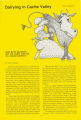
Show Dai, rying in CacPs Valley FARM CHILDREN HAD MAMY JOBS SUCH AS TAKING MILK CANS TO THE CREAMERY EACH DAY. THIS CREAMERY WAS BUILT IN RICHFIELD. SEVJER WUICTTY, IN 1876. Lorenzo Hansen huilt a creamery in WellsviLIe in 1899 he wanted to buy just the milk produced by each caw instead nf mnfing the cow for the season. This separated the care, f~ edinga, nd milking of cows from the making of butter and cheese at a creamery. At first farmers resisted selling milk to Hansen. Farm families still made their own butter and sold any surplus to local stores, But within a few years more and more farmers began sell-ing milk to Hansen at the wholesale price of 80 cents per 100 pounds rrf milk. Another private creamery was built by Samuel McMurdie in Paradise during the 1880s. An immigrant from Scotland, Mc- Murdie bought milk from the local farmers and sold bufter and cheese under the label " Diamond M." His wife, Sarah Anne Kay McMurdie, delivered the butter and cheese in a white- tap buggy to the Logan area where it was marketed. As mare creameries were built, farmers changed their ideas about the family cow. For pmduced by a cow. In a sense the cow's milk became a cash crop. The farmer then had a reason to keep cows other than to produce milk, butter, and cheese for his own family. MiZking practices changed, too. Farmers used to let their cows go dry during the winter months. Winter dairying was nut practiced. But Lorenzo Hansen wanted to run his creamery the year amund. That encouraged farmers to keep their cows producing milk all year. Once commercial creameries were ac-cepted by farmers, the profession of dairying began to grow. DuaI- purpose animals ( milk and beef producers] were not needed in a specialized operation. Purebred dairy stock was introduced in Cache Valley in 1883 by John T. Caine. He brought a highly bred Jer-sey bull to Logan to mate with some grade cows he owned. Dairy farmers bred their caws to develop greater milk producers. By 1900 the first cow- testing association in Utah was organized in Cache valley with the help hth% f is. ltimak p pd Y e milk of the Experiment Station at Utah State A& rn HORSE- DRAWN WAGONS DEUVER MILK CANS BUTTER CHURN OPERATORS AT UTAH CONDENSED TO BORDEN CONDENSED MILK FACTORY IN MILK COMPANY, RICHMOND, CACHE COUNTY, IN 1907. 1912. COURTESY OF SPECIAL COLLECTIONS, COURTESY OF SPECIAL COLLECTIONS, UTAH UTAH STATE UNIVERSITY. STATE UNIVERSITY. ricultural ColIege. Milk was tested for butter-fat content. Another dairying development of the early 1900s was the building of the first condensed milk plant near Richmond. The Sego Milk Company began production at the plant on March 15, 1904. That same year Lorenzo Hansen organized the Cache Valley Condensed Mlk Company with a plant in Logan. These two condenseries eventually closed all the small creameries in the valley. The condenseries could offer a better price to farmers for milk than the creameries. In 1935 three condenseries in Cache Valley paid IocaI - en about $ 1,320,1000. Milk had be-come a major source of income for farmers in the area New technology has brought continuing change to the dairy industry, but dairy farms have changed even more than dairy proces-sing plants. Fewer but larger dairy operations are the present trend. The average number of cows per farm in 1924 was 3.6, Many farms of the 19703 have more than 100 cows, and some more than 900. h places the cooperative idea has returned. Farmers in Minersville recent1 y pooled their cows and now milk more than 1,000 cows in a community miking parlor. And with the organization of the Cache Val-ley Dairy Association in 1942, cheesemaking on a large scaIe returned to the area. Dairying has changed many times in the years since 1847. A family cow no longer bellows in the backyard of most homes. The rich cream products that once were popular on dinner tables have been replaced by low-fat milk and " slim" cottage cheese for diet-conscious Americans. Cooperative summer ranch dairies were replaced by many private creameries which were followed by a few large pra~ essing plants. The smd dairy farmer is gone. Although a few hobby farmers remain, hands that still squirt miIk into an echoing milk pail are truly rare. Mr. Willie is a recent graduate in history from Utah State University. BREEDING COWS TO DEVELOP THE BEST MILKERS LED TO YOUTH GROUPS SUCH AS THE WASATCH COUNTY DAIRY CALF CLUB OF 1925. |