| OCR Text |
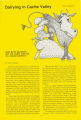
Show ARTIST: JON BURTON Oliver B. Huntington and His Bees BY A. GLEN HUMPHERYS Bees work for free and make honey. The Standing upright inside the box were other source of sweet flavor in Utah Territory wooden frames that had coarse wire in the was expensive sugar. Cane sugar was expen- center. The bees would use their wax to make sive in 1890 because it had to be shipped long honeycombs on the wire frames. Oliver put distances by sea and railroad. So, many Utah metal strips on the corners of the frames to people kept a few hives of bees and traded keep them from breaking when loaded with honey with their neighbors. One of the honey. At the front of the box near the bottom beekeepers who lived in SpringviIle, Utah, were holes for the bees to enter the hive. He was Oliver Boardman Huntington. He was to made his hives so thet warm air could easily help all of Utah produce more sweet honey. flow out near the tap. On hot days the bees As a young boy, Oliver lived in Kirtland, fanned their wings to move the air in the hive Ohio, and in the state of Missouri. As a young and keep the wax honevcombs from melting. man he lived in Nauvoo, Illinois, before he These wood hives were easy to open and re-and his brothers came to Utah. He Iived on a move frames filled with honey. Then Oliver small farm in Springville where he kept a put empty frames in the hive for the bees to cow, put up alfalfa hay, planted a garden, and fill again. kept bees. The German style of beehive used in the Oliver made his own beehives- wooden 1850s was made of waxed rope. ' The rope was boxes with a lid on top that could be removed. coiled on top of the lower layers and waxed in 12 phe until a c0~ 8shaped hive was made. The rope Whine is w d m the edlem of the 3eebive Sate. Whan the honey was removed £ ram the rope hive the bes were kiITd and th~~ fipuea$ rsne, Thm the hamycombs were removed with a hnt knife that melted the wax. Wooden box hives with a lid let frames of honeycomb be remved without killing the bees. This way the hive would keep warking all summer pmducing more honey. As; a beekeeper Oliver Huntiugton not only gathwd honey but also sold swam of bees. In 1888 he lamed six swarms of bees tb Levi Curtis who kept the hives of bees in Holtble Creek Canyon. After four years Curtis returned six swarms of bees as well as half the honey these six swarms had produced. That same spring Christopher WeIcack of Price, Carbon County, purchased six swarms of bees that were shipped to him by milmad expmss. The hives were cafefully mpped in cloth so the bees muld not = cape dwing shipinent. Many people were & ping bes in all parts of the territory. But. a11 beekeepers had problems with a disease that would bath kill an entire hive of bees and spread to other hives. This disease was MU& fauI brood because it killed the young bas while they were still in the comb. A bekeeper cauld stop the ~ Sin aB hive by waiting until after dark when aU the worker bees had re-turned to & e Kive and & en moving the queen bee and ail the workers to a ~ Zmnh ive; If this did not work the infected hives wee burned to prevent the disease horn spreading. AU the beekeepers in t ha~ re a needed to clean up + heir hives at the saw time or the bees would b ~ m wthe diseas~ fr om nearby hives, When aI1 the bees died in a hive other bees would come to the unguarded hive and take both the honey and the disease back ta their own hive. A beekeepers organization was needed to rid aU thohives of the disease. InMarch 1892 Professor A. J. Cook of Michigan Agricultural College and be& eperA. T. Root of Medina, Ohio, came to Salt Lalce City to help salve the disease problem. They organized for the ter-ritory the Utah BeeKeeprs Association. Oliver B, Huntington ivas m e d president and R. T. Rhes became the swretary of the association. The beekeepers association was able to get ther territorial legislature ta pass a bee inspectian law in 1892. This law allawed 13 OUVER B. HUNTINGTON each county to hire inspectors to look at all the beehives and destroy those with the fouI brood disease After the law was passed and before the 1893 season started an important association meeting was held to tell beekeepers about the new law. A notice to beekeepers published in Salt Lake, Ogden, Manti, and Logan news-papers during krch 1893 told of the April 10 meeting in Salt Lakg City. The beekeep~ rs met in the Brick and Stone Masons Hall over the Wedern Union Telegraph Office an Main Sbet. The president, Oliver Huntington, held several sessions of the beekeepers meet-ings on April 10 and 11, 1893. He bid the beekeepers ahout the new inspection law, how to get rid of the disease, and how to sell their honey. Oliver Huntington was hired during the spring of 1893 a8 the bee inspector for central Utah County. For two years he inspected every swarm of hmey bees in Provo, Spring-ville, Mapleton, and Spanish Fork. In 1893 he inspected 3,875 hives and 4estroyed 247 dis-eased hives. In 1854 he inspecfed 1949 sw-, visited 211 owners znd burned 18 hives. Inspection had reduced the disease. In 1896 as bee inspector he took 30 days to in-spect 2,970 hives, He earned as insp- r $ 60 and sold bees and honey for $ 80; his t dca sh income for the year was $ 14~. 00. Money was bad> n getin Utah and people often paid theirbills wit& fqngmd~~ fcredit at a stnm. In 1W- 92 S, T* ~ isahn d & mpm af Chicago, Illinois. bought h o ~ dyf h gdd coins from the beakeepe& ardmd Spring-ville. Samuel J. Chapman hmn EhiP; a@ pafd fur the honey as it was lo& d 3n a r a i h d boxcar at Springville. Qliuar Kwtington supervised & e bading of bath exhackd honey and mmb honey, The b ~ x awra s see? offm NovesnWr 3,1B92, with Z2.0.00 paunds of h e y . After the Fist seasap1 of h e bwp. ectipns the amomit of hahey shippd fioh Spping-ville, Prom, ~ agthn, arid Bmwn in-creased. The m e > Ch icag6 cmnp'fny& & a railtoad car to Sprmgdean & toha 5,1893. Oliver Huatingtan who had jyst m e d 70 years old, ~ ~ ~ p ~ cmmkbahodni~ n ~- ~ the boxcar so t hc~ om b ? ad mtbe bmbq on the ride to Chicago. 5. T. Fsb and Cosn-pany sold the Utah honey on Chicggo market to peqpje in ewtern cities and in Europe, The amount of honey sold i~ l a 3 h mju st m ep art of Utah County W# 34,000 pun& bf whfcb 11, OW pounds was the high- gde comb h ~ n e ~ . Honey was animpmhnt business in U~ during the 4 85th. Although beet sugar even-tuaUy hame the major source of sweets, beekeeping has continued as an indusky in t r e . Clover honey from Utah is widely know as a favofit? honey. And Utah fzmers apprmi9C m& er vital bee service; as h i t trees and see. d crop. lncr& e bes are fn de-mand to pollinate the b1wsbn- t~ I- t twob as if beas will remain important in the Beehive st&. Dr., Humpbesp is a asuIEant for the Salt Lake ComPtp P* eml Rmeatlm mi the deuehpbnt of Wbgekr F- Brm, a m~ m- hk'toricfa mn of 1890- 3910 . The Greek Sheepmen |