| OCR Text |
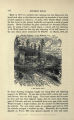
Show PROSPECTING AND MINING. 563 may " pocket. " suddenly in a chamber the size of a keg, barrel, or hogshead. Many a prospector finds his vein at an end for good and all in such a pocket. But we do not, of course, expect much near the surface : all we look for now is good indications. If our seam gains in width on the whole, if it slowly changes towards the perpen-dicular, if denned walls show themselves Avith patches of " slicken-sides," or even if there is a well marked line of division between the vein matter and the enclosing wall- rock, we are encouraged. Many are the alternations of hope and fear: to- day she widens, with a de-nned seam of so- so ore; to- morrow we are in the " cap" or pinch, and our hopes are crushed. We may be in the main vein ; we may be in a mere " gash" or overflow; perhaps we have located on a side outcrop, with the main vein hundreds of feet away ; and, worst of all, we may have fallen on a true fissure and well defined vein, but full of such low- grade ore that the more we have of it the poorer we are. By this time romance has given place to philosophy, and we are cool enough to consider some ugly facts. The first is that not one location in ten is ever sunk to a depth of sixty feet; that of those so far sunk not one in ten proves a valuable mine ; and that of actual mines not one in ten is rich enough to get excited about. The most cu-rious fact, however, is this : the marvelously small proportion which the precious metal bears to the whole mass of the ore, the almost infinite number of chances which determine its presence or absence, and the utter lack of ratio between its chemical, or mechanical, and its com-mercial value. For instance, if gold ore yields $ 40.00 per ton, it is very rich. But what is $ 40.00 per ton? Only two ounces out of 32,000! That is, if the one sixteen- thousandth part of what you hoist out is gold, your mine is very rich. But scores of gold mines are worked with big profits, yielding but $ 10.00 per ton one sixty-four- thousandth part of the mass. Yet a mine in the same place, yielding but $ 8.00 per ton, would not probably pay for working, the $ 2.00 per ton on the output making all the difference between profit and loss. So this formula, TSTGtsts minus J^ TT equals - g^-^, shows all the difference between a mine of some value and one of little or none. In silver the disproportion is not so great, but still rather startling. Thus, in Colorado, fifty ounces per ton makes a valuable mine ; twenty- five ounces, in most localities, is not worth mining for. So you have y^ g- g- of the mass as the real difference be-tween rich and poor ore. Consider how very small this difference is |