| OCR Text |
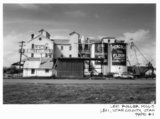
Show NPS Form 10-900-a Utah WordPerfect 5,1 Foimat (Revised Feb. 1903) United States Department of the Interior National Park Service National Register of Historic PBaces Continuation Sheet Section No. 8 Page 5 Roberts, Davis Smith, Thomas Webb, Thaddeus Powell, George Webb, and Mathias Knudsen. The site chosen by the group for the mill was on East Union Pacific Railroad that ran by the sugar factory. Chambersburg, Penn. contracted for the mill machinery double rollers, one washer, two purifiers, two reels, one gyrator, one separator, and one bran duster. Main Street on the spur of the The Wolf Company of which included four sets of one cleaner, one dust roller, The three story original building had machinery powered by a fifty-horsepower motor. After its opening in April 1906, the mill met with such immediate success that one month later the company built its first addition. That summer the company erected a 1.0,000 bushel capacity grain elevator, a similar-looking three-story structure to the north with matching roof, six-over-six windows and monitor. By 1907, the company's name had changed to the Lehi Roller Mills, a business storing and processing virtually all the grain grown in the area. In August 1909, Giles and Giles leased the business and hired William Leffler as miller. George G> Robinson soon assumed the lease and assumed management of the business. Robinson had been in the milling business since he was apprenticed to a miller at the age of 1.6. In 1910, he purchased the mill from the co-op and three years later began an extensive modernization effort through which the mill was enlarged from a milling capacity of 75 to 110 barrels per day. In 1915, Robinson hired the Birrell Engineer Company to construct a 43,000 bushel grain elevator and four concrete silos, 10 feet in diameter, resting on concrete bases 41' 8" square and 6' deep. The bright Turkey Red and Peacock Brand logos painted on the east sides of the silos have been local landmarks for decades. When Robinson died in 1936, his sons Sherman and Raymond Robinson assumed management of the mill. George's grandson, R. Sherman Robinson became manager in 1980. Under his direction, the Lehi Roller Mills again underwent modernization in 1985. As a result production capacity was increased to 60,000 a day. A new warehouse built in 1990 increased storage capacity to 100,000 bushels. In its earlier, more industrial years, several flour and knitting mills operated throughout northern Utah County, ranging in location from the mouth of American Fork Canyon on the east to sites along the Provo River on the west. All of these mills have been destroyed with the exception of the intact Star Flour Mill, a late-.1880s roller mill in neighboring American Fork, and the Lehi Roller Mills, the subject of this nomination. Buildings along Lehi's Main Street Commercial district reflect the period of growth and prosperity between 1880 and 1920. The architectural styles of the brick buildings erected along this street during this three decade era include Victorian and Neoclassical Revival styles, as well as non-styled vernacular designs. |