| OCR Text |
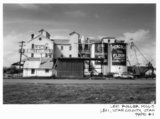
Show RECEIVED 41 NFS form 10-900-a Utah Word Perfect 5.1 Formal (Revised Feb. 1993) United States Department of the Interior National Park Service National Register of Historic Places Continuation Sheet Section No. 7 Page 1 INTERAGENCY RESOURCES DIVISION NATIONAL PARK SERVICE Mi 11^,, lufil]i. ll-|.ah Narrative Description The Lehi Roller Mills is a complex of several structures including the primary mill, a tall brick and frame building on the north side of the east end of Main Street. Supporting grain elevators, mechanical structures, warehouses and offices extend to the north. Typical of this building type, the Lehi Roller Mills has an organic heterogeneous architectural appearance, the result of many additions and changes needed to keep the operation modernized and growing. The expansion of the mil ling facilities from 1905 to the present is apparent from old photographs and Lehi's Sanborn insurance maps which show the regular updating and expanding of the structures, reflecting the corresponding refinement of milling procedures. Each major improvement, beginning with the 1905-06 brick mill, remains in place to document the character-defining evolutionary process of mill construction. Still the centerpiece of the Lehi Roller Mills is the original three-story brick structure with heavy timber, post-and-beam interior framing and a gabled roof. The original two-over-two windows, corbeled cornices and circular gable windows remain, as do the shed roof canopies over the south and east loading docks; the frame, gabled roof monitor, and the north, 14,000-bushel frame crib extension, are all additions made shortly after initial construction. The four 38-foot tall grain elevators, built of six-inch concrete walls in 1914, are intact and painted brightly with historic advertisements of the mill's most popular products, Turkey Red and Peacock flour. Together, these concrete capped, cylindershaped structures have a storage capacity of 45,000 bushels. As described in the history herein, other lesser frame, concrete and metal structures have been either attached to the original mill or built free-standing, among them the one-story, brick, gabled receiving building east of the main building along the D&RGW railroad spur. The last major addition was the three-story frame and gambrel-roofed warehouse built to the west in 1990. Although recent, this later structure is architecturally compatible in type, form, materials and color to other Utah mills generally and the Lehi Roller Mills in particular. Although the mill's machinery has undergone numerous modernizations, the interior architecture of the 1905-06 building, along with some of the original separators, dusters, cleaners and gyrators, remain intact. Their origins are apparent from the old style lettering across the fronts announcing the type, brand, manufacturer and location of each machine. The mill is electrically powered as it has always been, and continues to employ its original roller mill technology for converting wheat to fine flour. The 36-foot tall main mill contains five levels of operations within its three-story shell due to maximizing the basement and gabled attic for machinery spaces. The mill has undergone visual changes but these are not intrusive given that many were made early-on and were essential to maintaining the complex's original and still current use. Each of the improvements and additions have both maintained and enhanced the mill's physical character and function. See continuation sheet |