| OCR Text |
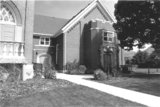
Show United States Department of the Interior National Park Service OMB No. 1024-0018, NFS Form National Register of Historic Places Continuation Sheet Section No. 8 Page 3 American Fork Third Ward Meetinghouse, American Fork, Utah County, UT the original chapel was more than adequate especially since extremely large groups could by accommodated in the Alpine Stake Tabernacle, built between 1909 and 1914. In 1929, with a ward membership of 659, a committee was formed to discuss the building of an amusement hall. During the previous decade the LDS Church had instituted a policy of including all ward auxiliaries and functions under one roof. For example, the Third Ward Relief Society (the ladies' auxiliary) converted an old school house to a Relief Society Hall in which they held meetings for eighteen years. The anticipated construction was postponed; however there appears to have been some minor renovation work in the chapel and basement by contractors of the Chipman Mercantile Company completed in 1929. By 1932, the ward was paid off the debt for this work and began again to consider an addition. In June 1937, the ward approved plans for a new recreation hall and classroom block provided by the church architectural department, and work commenced exactly one year later. The general contractor for the project was again Chipman Mercantile of American Fork. Electrical work awarded to Samuel F. Grant of American Fork, and Utah Fuel Supply of Salt Lake City was awarded the heating contract. Work proceeded so quickly that by October 1938, the building committee was able to report the brickwork was complete and the shingling nearly complete. The building was mostly finished by 1939 and more than double the existing floor space. The recreation hall included a basketball court, stage area, and projection room (movies were a popular ward social event in the 1930s and 1940s). The classroom wing included twelve classrooms, a Relief Society room, bishop's office and kitchen. Other amenities included new restrooms, a cloakroom, and remodeling of the basement. Though the project was not completely finished until 1942, the majority of work took less than a year partly because more paid labor was used than in previous projects. Final cost was about $30,000, with the general church fund providing sixty percent of the cost and the ward financing forty percent. This left the ward with a hefty debt on the building. Several methods of fond raising were used. The ward held benefit banquets, including a January 1939 dinner held for the general public in the basement of the tabernacle. In 1940 the Relief Society raised funds by sewing a quilt featuring the names of all the officers who had served in various ward capacities since 1901. One enthusiastic member issued a challenge to the priesthood that he would match dollar for dollar all funds donated by other ward members. The amount was considerably more than he anticipated, but he came through and paid up. The completion of the new wing raised enthusiasm in the ward. The year 1939 was a banner year for perfect attendance awards. Throughout the first half of the twentieth century, American Fork was a primarily agrarian community. Though only a few residents participated in large-scale agricultural production, most families supplemented their employment by having vegetable gardens, small orchards, and chicken coops on their large lots. Growth in the community was slow, the population of American Fork increased by less than 700 between 1910 and 1940. World War II brought the Geneva Steel Plant and thousands of defense workers to Utah County. Many stayed in the area, and by 1950, the population of American Fork had jumped to 5,126. The large lots within the Third Ward boundaries began to be subdivided to accommodate the post-war housing boom. In January 1950, with a ward membership of 1,022, the Third Ward was divided creating the Eighth Ward whose members lived on the east side of 100 West. The division necessitated staggering meeting times in order to share the building. The Eighth Ward later moved into a new building with the Sixth Ward. |