| OCR Text |
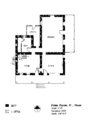
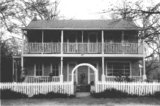
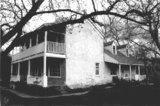
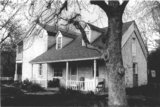
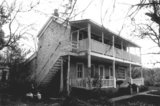
Show 0MB No. 1024-0018, NPS Form United States Department of the Interior National Park Service National Register of Historic Places Continuation Sheet Section No. 8 Page 2 Jepson, James, Jr., House, Virgin, Washington County, UT was discovered not far from the building lot. James engaged the help of his neighbors in cutting, hauling, and laying the stone, which was probably no small task for a building of this size.4 The floor plan Jepson chose for the house, known as a double-cell, was a fairly common house type in the Utah Territory, particularly in the "Dixie" region, where there are several extant examples. There are approximately two hundred and forty known examples of double-cells in the state, but only five in Virgin.5 And the Jepson House is easily the largest and best-preserved example in the town. Double-cell, as the term implies, is a form of domestic architecture with two equally sized rooms arranged axially within the main body of the structure. The rooms are typically square (or nearly square since most early builders did not work with a tape measure). The dividing wall could hold a double fireplace or stove flue with a connection in each room, or the fireplace/stove flue and chimneys could be located on the gable-end walls. The double-cell has a symmetrically balanced fenestration pattern on the front facade, with an even number of openings (commonly four or six across). There may be either a single entry placed to one side of center, or two entries. 6 The Jepson House follows the six-bay format. In this arrangement the double entries are the centermost openings, which provides the effect of a double house. Jepson probably chose the double-cell type for this reason, to allow for two individual dwelling units beneath one roof. The understated vernacular classicism of the design was typical of the region as well. The harsh, remote environment of Utah's Dixie fostered many a hardship, with most settlers living at subsistence level at best and sometimes near death at worst. Most of the architecture from the early settlement period reflected these circumstances, especially in the outlying settlements like Virgin. Classical detailing was common throughout the state, usually in nondescript forms, although the Greek Revival was quite common in more established areas. The Classicism in the Jepson House is implied in the form rather than applied in the details. Classical Georgian ideals are found in the symmetry of design, the rigid, rectangular form, and relatively shallow pitch of the gabled roof. The frieze and cornice of the roofline, and fenestration trim are the only applied classical details. One unusual detail is the two-story, full-width front porch, which is not commonly found on classical architecture in Utah. For these reasons, the size of the house and the uncommon front porch, the Jepson House is a unique example of architecture in the town of Virgin, as well as the surrounding region. Historical Significance Virgin City was settled in 1858 by eight men who set out from Cedar City, approximately forty miles to the northwest, to find additional arable land in a barren country. After ten days of hard labor constructing a road up a five hundred foot fault to the site, they were able to bring in two wagons. Originally called Pocketville (after a Paiute Indian term that described the circuitous route of the Virgin River around the site), the area was chosen because of its ideal conditions for growing cotton.7 Although the land was good here, only a few families 4 David Thayne, "History Surrounding the James Jepson Home," (unpublished manuscript, February 2,1981) p.4. 5 Information for the numbers of buildings was taken from the Utah Historic Computer System (UHCS) database. Data is based on a 1984 survey that has not been updated. Because this is a remote, rural area, little new development has occurred so the numbers remain fairly accurate. 6 Thomas Carter and Peter Goss, Utah's Historic Architecture, 1847-1940: A Guide, (Salt Lake City, UT: University of Utah Graduate School of Architecture and Utah State Historical Society, 1991) pp 18-20. 7 One of the reasons the southwestern portion of Utah was settled was for the year-'round warm climate. This provided a longer growing season for a variety of fruit and produce. The climate also allowed for the production of cotton. Many families were "called" by Brigham Young in the early 1860s to |