| OCR Text |
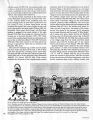
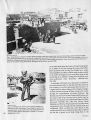
Show 506 Smithsonian, NAA. Fig. 7. Dance of the pakokko 'Navajo kachina'; this is a Zuni rendition of the Navajo Yeibichai, complete with the appropriate Navajo songs. It is performed just before and during Shalako. The participants are members of the Kachina Society but are organized independently of the kiva groups. They are always accompanied by members of the Clown Society (the 2 unmasked men at left); Nava-jos always join the audience (the men in hats on the rooftops). Photograph by Matilda C. Stevenson, before 1898. 9a-pi9ia 9a"siwani 9a'wan tikanne 'Society of Bow Priests', sometimes called patikanne 'Navajo Society' (Kroeber 1916:275) after the enemies its members once fought. Formerly any man who had killed an enemy had to join this society in order to save his life from the ghost, unless he was already a member of the Coyote Society or one of the two war societies mentioned below (Bunzel 1932c:674). The returning veterans of World War II had to be purified before entering the village, but this was done by societies with curing orders rather than by the Bow Priests (Adair 1948:109-110). The Scalp Dance, sponsored by the Bow Priests and the Knife order of Red Ant (Stevenson 1904:579-585; Parsons 1924), was held as recently as 1971, but by that time it had become a regular fall ceremony and was no longer a victory celebration over a new scalp. Two war societies are defunct. One of these, a close ally of the Helix People, is c9u9kina 'Big Shell' (Parsons 1933:80); its members cured bloating and caused enemies to fall dead by blowing on a conch shell trumpet (Benedict 1935,2:159,206-207). The other is the kosi-kwe 'Cactus People', who whipped one another with cactus for pleasure and cured puncture wounds (Stevenson 1904:570-575). In ancient times the 9a-halikwi 'witches', people whose nature it is to plot the deaths of those who arouse their jealousy or resentment, had a clandestine society of their own, the hatikanne 'Witch Society' (Tedlock 1972:189). Today they work as individuals, making their victims ill by working on bits of hair, nails, excrement, or clothing, or by shooting foreign objects into their bodies (Adair 1948:47-74). "Poor" Zunis, those without religious knowledge beyond that of the Kachina Society, often suspect "valuable" Zunis of witchcraft, that is, of using religious knowledge for private ends (Parsons 1917:234; Benedict 1935, 2:86, 153, 160). But these same lay people have the benefit of an annual winter solstice ceremony called "The Good Night," in which all the Societies of the Completed Path hold open meetings and perform free cures for all comers (Bunzel 1932a:531-532). The Zuni rain priesthoods, dedicated primarily to the 9uwanammi, are much smaller bodies than the societies, but their concerns are much broader. Their "children," the people under their care, include all the Zunis, even the witches, and they pray for all the other village-dwelling peoples and for all the raw people as well, even "every dirty bug" (Bunzel 1932c:666-667; Tedlock 1972:32, 142, 152). Their conduct in everyday life sets an example for all the people: it is said that "a really good Zuni will not fight and argue-he is just like a priest" (Smith and Roberts 1954:127). During the summer the rain priests go into seclusion with their sacred bundles to establish direct contact with the 9uwanammi (Stevenson 1904:173-178, 386). When there are questions to settle that affect all the people, they may go into seclusion to divine the answers: it was they who discovered, with the help of the 9ahaywta, the location of the middle of the world (Tedlock 1972:277-280), and with the help of nepayatamu they divined the hiding place of the Corn Mothers during a famine (Benedict 1935, 1:24-43). On lesser occasions they accept private clients who wish to divine the location of lost or stolen objects, and formerly they had clients who wished to know the outcome of gambling games (Stevenson 1904:334, 386-387). The summer retreats of the rain priests, four or eight days apiece, run consecutively from the summer solstice into September. The first six retreats are those of the tek9ohannan 9a'siwani 'Daylight Priests', representing the six directions, and these are followed by eight retreats of the tehkwinan 9a-siwani 'Night Priests' (Kroeber 1919:176). The first four Daylight Priests, representing a clockwise circuit of the four horizontal directions, are the k9akwa-mossi 'House Chiefs': the k9akwemossi 'House Chief proper, whose sacred bundle is kept in a house north pf the main plaza; the End Priest, whose house is at the east end of the village; the Road Priest, beside a road on the south side; and the Backwall Priest, beside the kiva of that name, on the western edge of the village (Parsons 1933:80-81; Kroeber 1919:175, map 8). The fifth Daylight Priest to go into seclusion, representing the zenith, is the pekwinne 'Spokesman' of the House Chiefs, also called k9asima wowe 'Water-Bringing TEDLOCK |