| OCR Text |
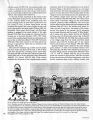
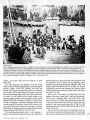
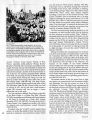
Show Smithsonian, NAA. Fig. 6. Members of the Great Fire order of the Big Fire People, swallowing swords (center foreground) on the fifth day of an initiation ceremony (Stevenson 1904:504-511). They are distinguishable from the Sword People, who also swallow swords, on the basis of their dance kilts and characteristic markings-black face paint streaked with white, and blackened upper arms with white crosses (Stevenson 1904:509, pis. 114, 118). A drummer stands near the doorway at right, while spectators watch from roofs. The seated men at left are musicians for the Sword People, who dance in the plaza in alternation with the Big Fire People; notched sticks with which they will accompany their own dancers rest on the boxes in front of them. Photograph by Matilda C. Stevenson, Jan. or Feb., possibly 1897. surface, and brush them off with bunches of grass (ibid.:529). The most dangerous and difficult of all the curing orders is that of 9icepco 'magicianship', found among the Priestly, Uhuhu, Little Fire, Bedbug, and Red Ant People. The magician, possessed by the bear or mountain lion, is able to see into the body of his patient, and when he locates the foreign object that is the cause of the illness, he draws it to the surface with an eagle feather or by sucking, finally catching with the hand or in the mouth (Bunzel 1932a:528; Stevenson 1904:415,494-501). Other abilities of magicians, sometimes displayed before large crowds, include lifting heavy objects with feathers, turning balls of mush into stones and back again, restoring burnt feathers, and slicing a man in half without hurting him (Stevenson 1904:270-271, 429, 522-527). The remaining specialized orders in the societies of sipa-puli9ma include the Navajo Dance order in Big Fire, which performs a Navajo-style dance for the public, and the payatamu order in Little Fire and Bedbug, which performs on long flutes (Stevenson 1904:485, 549). And finally, there is the Knife order of the Red Ant People, consisting of warriors and counting the 9ahayumta twins and the roadrunner among its patrons (ibid.:528; Benedict 1935, 1:67-68). Each of the 10 societies of sipa-puli9ma has four officers: tika mossi 'society chief, pekwinne 'spokesman', 9akw9a mossi 'medicine chief, and pi9ta siwani 'bow priest' (Parsons 1917:161). These positions are open only to men, but otherwise all 10 societies are open to women, except for the arrow-swallowing order in Big Fire, the payatamu orders in Little Fire and Bedbug, and the Knife order in Red Ant. All the societies remaining to be discussed are associated with war, and all are exclusively male. The principal war society, whose patrons are the 9ahaywta twins, is the Z U N I R E L I G I O N AND W O R L D VIEW |