| OCR Text |
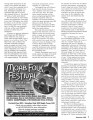
Show strange little instrument in the corner of her house and asked what it was. She explained that it was a mandolin and gave it to him. Derrington stripped and refinished the gift in varnish, then learned to play it. He ended up being a really good player. But he became an even better builder and repairman. Just eight years later, Derrington was hired by Gibson to do all their acoustic instrument repair work. A year later, in 1985, he was presented with one of the most difficult projects a luthier has ever attempted. A person or persons unknown had broken into Bill Monroe's house while he was away at lunch. Most people think it was a jealous lover, and no doubt "Big Mon" had a few of those. The intruder used Bill's fireplace poker to smash the Lloyd Loar mandolin that had been his constant companion since 1945, as well as another Loar mandolin that Monroe had acquired later. The two instruments were delivered to Gibson for repair, along with approximately 150 splinters from both instruments, mixed together in a paper bag. Derrington was not Gibson's best man for the job, because "best" implies more than one. He was their only man. He spent three months sorting out the pieces and gluing together Bill's primary mandolin. Then he turned to the second mandolin, which has gone missing since Bill Monroe's death. But it was Derrington's restoration of Bill's July 9, 1923 side-bound FS mandolin that made history. Bill wept when he played it again for the first time, and continued to play his favorite mandolin on stage and records until his death in 1996. Those who knew the mandolin well said it still sounded very good after the repair. It's now on display at the Country Music Hall of Fame, courtesy of a benefactor who rescued the instrument after another buyer defaulted on the terms of a $1.125 million sale. Charlie Derrington went on to study, repair and copy more golden- era Gibson mandolins than anyone else ever has or ever will. FJsJrln~Jrin;Rm,etl4ra Sloan WaJrnwrlo~rt.;. Q) ·c rnr·tu•"•,. Aiken, Jim Hurst & L: Bob Greenspon, Dove & Corio Kenny White, Melissa Crabtree, Gondolf Murphy & The Slombovion Circus of Dreams '5 ....1 C/) ~ 0 3: Festival Pass $95 • Saturday Only $50 Single Venue $30 ~ co Check out our website, order tickets on-line, a: >. or call 435-260-2488 for more information. .o Ticket & Lodging packages available. ·1s9 Discount for kids (see ticket details). 0 www. moabfolkfestival. com He remade the entire line of Gibson acoustic instruments, restoring the brand's long-lost luster. With the FS Loar copies, he created some of the most valuable new instruments available--as close as anyone has ever come to the originals, and cleaner in fit and finish than the originals. Derrington was always generous with everything he knew about mandolins, and every detail of construction he brought to Gibson products. That is, every detail except one: the varnish materials and methods used on the Master Model and Distressed Master Model mandolins. Because that was a secret. As a marketing guy, I would have completely approved of the "secret varnish" thing. The composition of a varnish--and, just as important, the way it's applied--is impossible to discern in a finished instrument. What better way to differentiate your products in the marketplace? "Sure, we built them in the exact shape of a Loar--lots of builders do that--but it's the secret varnish that makes them sound like a Loar." Violin makers have been saying something like that about their Strad and Guarneri copies for centuries. I would have approved because gaining an advantage and selling at a premium is the name of the game. Who knows what today's secret varnish is? I doubt it's the exact same recipe used in Loar's day, because the Gibson factory burned down and all the records were destroyed. I wouldn't be surprised if it's something available to anyone, off the shelf. But it doesn't really matter. There's no secret to the fact that Charlie Derrington supervised the production of some of the finest fretted instruments ever made, and he was justifiably proud. Almost as soon as the news of his death came out, the ghoulish speculation began as to whether Derrington-signed FSs would increase in value. The man and his instruments had the mojo factor, and that's what drives instrument fetishists wild. But there's nothing magical about it. Charlie Derrington was a fetishist himself, and everything he accomplished was a result of hard work in pursuit of his passion. It's a shame to lose someone like that, at the age of 51. Drive carefully, folks. September 2006 7 |