| OCR Text |
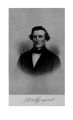
Show Secretary to presidents Brigham Young, John Taylor, and Wilford Woodruff, Nut-tail's diaries provide invaluable information on ecclesiastical and civil history of the Mormons in Utah and before. He was a member of the Council of Fifty and served as territorial superintendent of schools. THE KINGDOM OF GOD, THE COUNCIL OF FIFTY AND THE STATE OF DESERET By James R. Clark? On the subject of the inter-relationship of church and state in America the following statement in a book edited by Henry P. Van Dusen is pertinent: In this democratic America the Church is so embedded in society that it cannot altogether be separated from it. You cannot have a sharp distinction between the group of the Church and the same people who form a more or less controlling element in the State.1 Utah became a territory of the United States in 1850. It was admitted into the Union of the States in 1896. Primarily it was settled by members of one church - the Mormon Church - beginning in 1847. * James R. Clark is assistant professor of religion at Brigham Young University, Provo. The following article was presented as a paper at die Social Science section, Utah Academy of Sciences, Arts, and Letters, held at Utah State University, Logan, Utah, November 9, 1957. 'Henry P. Van Dusen (ed.), Church and State in the Modern World (New York, 1937), 208. 132 UTAH HISTORICAL QUARTERLY Relatively small non-Mormon minority groups have made substantial contributions to Utah's history from its earliest days. Today Utah is cosmopolitan in population, and many of the problems arising in earlier years through clashes in basic religious, political, social, and economic philosophies and ideologies have found satisfactory compromises and adjustments, but not before there were many heated words, and arguments, much action and counteraction affecting all phases of society, which almost tore to shreds the body politic. A word needs to be said about a point of view on pressure and counter-pressure groups that operate in the American democracy. If the attitude is taken that all pressure groups are inherently bad or evil, this viewpoint will likely adversely color the interpretation that is placed on events in American history. If, on the other hand, the view is held that pressure groups are a necessary part of the democratic system, although at times misused, this again will impart a somewhat different interpretation to historical events. The view taken in this study, for purposes of interpretation of the events in Utah's history, follows essentially a point of view expressed by a prominent Utah political scientist, Dean Milton R. Merrill of Utah State University, in the Sixteenth Annual Faculty Research Lecture in 1956. Dean Merrill maintained that in the American democracy an essential element making possible our freedom is the spirit of compromise and accommodation, and that the American way has been for conflicting interests to accept the rather uneasy security of innumerable and transitory compromises because these are better in the long run than resorting to force. The genius of American democracy has been that it has recognized these diverse interests and, recognizing them, has been able to keep any single interest from completely stifling opposition.2 W. H. Cowley, professor of higher education at Stanford University, highlights the importance of pressure or power groups when he states "that social interaction is always the reaction of power to power" and that the power available to any group of people at a specific time will largely determine the nature of its social enterprises.3 In Utah, at least during the territorial period from 1847 to 1896, the formative idea or concept of society so far as the leaders of the major power group were concerned was the Mormon enunciation of the con- 2 Milton R. Merrill, The Political Process. U.S.A.C. Sixteenth Annual Faculty Research Lecture (Logan, Utah, 1956). 3 W. H. Cowley, "Introduction to American Higher Education," Stanford University, Mimeo., 1955, p. 168. THE COUNCIL OF FIFTY 133 cept of the Kingdom of God. Its accompanying corollary was the political theory of legitimacy promulgated by Joseph Smith, Brigham Young, John Taylor, and other early leaders of the Mormon Church. Mormon leaders have repeatedly said that in the philosophy of Mormonism there is no way of separating the spiritual from the temporal, which sometimes may be another way of saying church and society and ultimately the church and state. When the Mormons moved west from Illinois in 1846-47, they not only brought with them their basic philosophy, educational and otherwise, but they had formulated also a political and civil theory of society and of church and state relationships. When they organized the Provisional State of Deseret, before they were accorded territorial status by the United States government, it was not a temporary expedient nor was it an example of American frontier democracy adjusting to a new region. The basic ideas for the government of the State of Deseret were not worked out after the Mormons arrived in Utah, but in meetings of the Council of Fifty in Nauvoo before the westward migration. The State of Deseret was the planned result of the doctrine of the Kingdom of God. The Kingdom of God was a civil-religious form of government. It was, eventually, to spread world wide and to have as its head Jesus Christ, the King. It was the instrument by which He was to govern the entire world. The religio-civil doctrine of the Kingdom of God was formulated and promulgated by Joseph Smith and other Mormon leaders in the East in the period from 1830 to 1846 and then carried westward with the Mormon pioneers to develop and take shape in the territorial period. In 1874 Brigham Young declared publicly that a few months before the death of Joseph Smith in 1844, he, Joseph Smith, had received a revelation setting forth "a full and complete organization to this Kingdom" and that its constitution "was given by revelation." This Kingdom of God was to be a religio-civil government and is not to be confused or identified with the Mormon Church as such, which is a religious organization. However, in current Mormon literature the church is often referred to as the Kingdom, and the distinction between the two terms and the two entities is not now sharp as it was in the territorial period. It can be stated on the basis of Mormon, non-Mormon, and state and federal documents of the territorial period that the insistence of the Mormon leaders on this concept of the Kingdom of God was largely instrumental, along with the practice of polygamy, in delaying statehood for Utah for half a century. A careful consideration of the Kingdom of 134 UTAH HISTORICAL QUARTERLY God concept as the basis for the societal pattern - economic, social, educational, and political - may well cause Utah history, at least for the territorial period, to be re-evaluated and rewritten. The immediate task is to define and outline the concept of the Kingdom of God as a framework for the society which the Mormons were seeking to establish in Utah and to which the non-Mormons so violently objected. This concept is enunciated in the public addresses and papers of the Mormon leadership and was well known to the non- Mormon inhabitants of Utah throughout the territorial period. The theory of the Kingdom of God was developed by revelation and adaptation until it was given its basic organizational structure by Joseph Smith in 1844, fourteen years after the Church of Jesus Christ of Latter-day Saints was organized. The basic authority for the Kingdom of God lay in the authority of the priesthood of the president of the Mormon Church, but the directional control was vested in a council known by a number of names, chief of which were the special council, the Council of Fifty, or more commonly, the General Council. CHARACTERISTICS OF THE KINGDOM OF GOD Certain characteristics of the projected Kingdom of God become clear as one reads the voluminous literature dealing with the concept. These characteristics are: (1) The Kingdom of God was the kingdom predicted by the Old Testament Prophet Daniel. It was the stone cut out of the mountain without hands that was to break in pieces all other kingdoms and consume them. (2) The Kingdom of God was to be the government of God on earth, and as such it was eventually to absorb all other governments. (3) The Kingdom of God was to include as members and as officers non-Mormons as well as Mormons. (4) The Kingdom of God was to protect all peoples in their civil and religious rights, including the right to differ. (5) The Kingdom of God was to rest politically on the doctrine of Legitimacy, expressed succinctly in these words of John Taylor in 1853: Let us now notice our political position in the world. What are we going to do ? We are going to possess the earth. Why ? Because it belongs to Jesus Christ, and he belongs to us, and we to him. We are all one, and will take the kingdom and possess it under the whole heavens, and reign over it forever THE COUNCIL OF FIFTY 135 and ever. Now, ye kings and emperors, help yourselves, if you can. This is the truth, and it may as well be told at this time as at any other.4 (6) The Kingdom of God was a state and a political, social, and economic system which touched all phases of human life. (7) The Kingdom of God had its own revealed constitution. The Constitution of the United States was written, according to Mormon belief, under the inspiration of God. The constitution of the Kingdom of God was given to Joseph Smith in 1844. Copies of this constitution are not at present available, but there is good evidence that it existed from 1844 to at least 1880. (8) The Kingdom of God, though composed of non-Mormons as well as Mormons, was to be presided over in ultimate authority by the Mormon priesthood as representatives of Jesus Christ, the King. (9) The establishment of the Kingdom of God necessitated the gathering of the Saints to form the nucleus of the Kingdom. If membership in the Church of Jesus Christ of Latter-day Saints alone had been involved, the converts could have stayed in their own localities and nations. This ties the Kingdom of God concept definitely to the Mormon doctrine and policy of Zion and the "gathering" discussed in such works as Gustive Larson's Prelude to the Kingdom. NON-MORMON OPPOSITION TO THE KINGDOM OF GOD Eloquent testimony to the tenacity of the Latter-day Saints in their efforts to establish the Kingdom of God in territorial Utah is borne out by the non-Mormon documents in the Martin-Paden collection at Westminster College, Salt Lake City. In 1885 the Salt Lake Tribune published a sixteen-page pamphlet with unsigned authorship entitled: The Mormon Conspiracy to Establish an Independent Empire to be Called the Kingdom of God; The Conspiracy Exposed by the Writings, Sermons and Legislative Acts of the Prophets and Apostles of the Church. The pamphlet impugns the motives of the Mormon leaders and claims that the idea of the Kingdom of God was one of basic disloyalty to the United States. It is perhaps generally conceded now that Mormon leaders have since been cleared of this charge of disloyalty. The pamphlet remains, however, as an interesting documentation to the concept of the Kingdom of God as an influence in Mormon-non-Mormon re- 1 Journal of Discourses (26 vols., Liverpool, 1854-86), I, 230. the Perpetual Emigrating Fund Company in peace and security. WHAT IS THE KINGDOM OF MOD? The Divine Right of the Mormon Priesthood to Rule. In 1848-9 Apostle Orson Pratt published in Liverpool, England, a series of four essays on the Kingdom of G"d. They reveal the Mormon conspiracy more completely than anything else extant. The following extracts from these publications will suffice to give a clear idea of the monstrosity. Pratt says: THE ONLY LEGAL GOVERNMENT. The Kingdom of God Is an order of government established by divine authority. It Is the only legal government that can exist In any part of the universe. All other governments are illegal and unauthorized. God, having made ail beings and worlds, has the supreme right to govern them by His own laws and by officers of His own appointment. Any people attempting to govern themselves by laws of their own making and by officers of their own appointment are Indirect rebellion against the Kingdom of (iod. * * * ' For seventeen hundred years the nations upon the Eastern Hemisphere have been entirely destitute of the Kingdom of Hod-entirely destitute of ii true legal government-entirely destitute of officers legally authorized to rule and govern. All emperors, kings, princes, presidents, lords, nobles and rulers have acted without authority. * » Their authority Is all assumed; It originated In man. Their laws are not trom the Great Law driver, but the production of their own false governments. Their very foundations were laid In rebellion, and the whole superstructure, from first to last, Is a heterogeneous mass of discordant elements, In direct opposition to the Kingdom of God, which Is the only true government which should be recognized on earth or in heaven. THE KINGDOM OF GOD IB a theocracy, and as It Is the only form of government which will redeem and save mankind, It Is necessary that every soul should be rightly and thoroughly Instructed In regard to Its nature and general characteristics. The beauty, glory, power, wisdom and order of the Kingdom of God may be more fully understood by a, careful examination of the following subjects: First-The nature and character of the King. Second-The character and requisite qualifications of the subordinate officers. Third-The nature and character of the laws of adoption, or.the Invariable rule by which aliens are admitted Into the Kingdom as citizens. Fourth-The nature and character of the laws given for the government of all adopted citizens. Fifth-The character, disposition and qualifications necessary for every citizen to possess. Sixth -The rights, privileges and blessings enjoyed by the subjects In this life. Seventh-The lights, privileges and blessings promised to the faithful, obedient subjects In a future life. GOD IS KING. Mr. Pratt proceeds to inform his "dear reader" that God is the King, and then goes on to construct the material God of the Mormons. The same idea he says is applicable to the person of the Son. The Holy Spirit being one part of the Godhead, Is also a material substance, of the same nature and properties In many respects, as the spirits of the Father and Son. It exists In vast, Immeasurable quantities In connection with all material worlds. This » * * * Is what a person gets when he receives the gift of the Holy Spirit. * * * It Is these three all-powerful substances that stand at the head of all legal f;overnments. All governments not estab- Ished by these three will be ere long overthrown. THIS IMCOPHET HIS AOKNT. Second-The diameter and requisite qualifications of the subordinate officers In the Kingdom of (iod are now to be considered. As the persons ol the Father and Son cannot be everywhere present, It Is therefore Impossible for them to attend In iierami to all the multiplied affairs of government among Intelligent beings; therefore, God, In establishing;! government among such beings, has always called persons of their own number to officiate In his name. * * The various officers called of God to administer the affairs of his government are apostles, prophets, bishops, evangelists, elders, pastors, teachers and deacons, (iod has only one way of calling these different officers, and that Is by new revelation. No person was ever authorized to act In the name of the Lord, unless called by tunn revelation." Those gcntiy, the, apostle says, may be known by their claim of having been appointed or callpd by new revelation, and their "power" to confer the gift of the Holy Ghost "by the laying on of hands." THE LAWS OF ADOPTION. Third -The laws of adoption, or the Invariable rule by which aliens are admitted Into the Kingdom of God, are next considered by the Apostle, and briefly stated, this rule consists of faith, repentance and baptism Into the Mormon Church, the gift of the Holy Ghost by the laying on of hands and Initiation Into the Priesthood. OBEDIENCE TO THE LAW. Under the head of the fourth division of this important treatise-the nature and character of the laws given for the government of all adopted citizens, Apostle Pratt lays it down that the subject should obey "strictly all the laws, ordinances, statutes, commands, counsels and words of the Great King." These come to the Saint by " new revelation" as the circumstances of each particular case may require, and "every faithful, upright person in the Church or Kingdom of God enjoys the gift of the Holy Ghost, which is a sure preventative against all deception. * * The revelations given by the Holy Ghost; by the voice of the Lord; by the ministry of angels; by visions and dreams, and by the in- A facsimile of page three from a sixteen-page pamphlet published in the year 1885 by the Salt Lake Tribune in which the motives of the Mormon leaders are impugned by the use of the very words of the leaders themselves. THE COUNCIL OF FIFTY 137 lationships in the territorial period. The Kingdom of God was a dominant influence in Utah society all during the territorial period, an influence against which non-Mormons were constantly fighting in all phases of life - political, economic, social, educational, and religious. AIMS AND IDEALS OF THE KINGDOM OF GOD IN TERRITORIAL UTAH Although perhaps not all-inclusive, the following are some of the main aims and ideals of the Kingdom of God in its attempted establishment in territorial Utah. (1) The ultimate aim of the Kingdom of God was the establishment of a world society based on the justice and equality of the Gospel of Jesus Christ, personally administered by Him. In that society the doctrine of free agency of the individual was to operate. It was to be the hope of this society that all would accept Christ as their King and lawgiver and likewise recognize His legal representatives in the Mormon priesthood. No one, however, was to be coerced. It was recognized that this state of society would not likely be reached until well into the Christian millennium. (2) Short of this ultimate goal there was a secondary and more immediate goal: the building of such a society among the Latter-day Saints and their friends. This society was to perfect itself to the point where the people became one politically, economically, and socially, but without robbing the individual of free agency and individuality. The people were to be one in all things because through a system of education they would become convinced that such unity was for their own best interests. If the Latter-day Saints could thus unite as the nucleus of the Kingdom of God, their success would serve as a pattern for the rest of the world. (3) This society was not to be established separate and apart from the world, but was to function in the world as a leavening agent. Being in the world, the Kingdom was to direct its membership in all phases of life short of final ecclesiastical authority, which was retained by the Church of Jesus Christ of Latter-day Saints. (4) Relative to politics and government, the ultimate aim of the Kingdom recognized only one legitimate government on the earth - the government of God. All other governments were considered to be subordinate and inferior, including the government of the United States, even though its Constitution was held to be divinely inspired. Uniquely, 138 UTAH HISTORICAL QUARTERLY the government of the United States, as provided for in the Constitution of 1789, was recognized as divinely approved in principles and was intended to serve the needs of the people and protect them in their God-given rights until the government of God could be established. (5) Since the government of God, which was to control the Kingdom of God, was revolutionary in many of its principles and practices so far as the governments of men were concerned, it was not to be expected that it could avoid conflicts with established human institutions and governments. This fact was made clear as early as 1834 in a statement of the First Presidency of the Church of Jesus Christ of Latter-day Saints as recorded in the History of the Church? (6) It is pertinent to ask how the Mormons were taught to regard those who were not members of the Mormon Church under the concept of the Kingdom of God. What were to be the policies, the attitudes, the ideals that would allow Mormons and non-Mormons to work in harmony and peace within the Kingdom while still retaining their identity and separate religious affiliations ? The concept of the Kingdom did not anticipate that all of its members would join the Mormon Church, and a partial answer to this question is to be found in a sermon preached by Brigham Young the year before the completion of the transcontinental railroad, which some individuals were saying would end the Mormon "isolation." Brigham Young was quick to point out the historical fact that the Mormons had never been isolated in the Great Basin. He might have gone into considerable detail to point out that: (a) In 1847 the Mormons found a non-Mormon group of settlers near the present site of Ogden. (b) In 1849 the Gold Rush brought a constant stream of non-Mormon migrants through Utah. (c) Several government explorations and surveys, manned by Mormons and non-Mormons working together, were made in Utah before the coming of the railroad. (d) At least three groups of federal military forces, all non-Mormons, were stationed in Utah before 1869. The sermon of Brigham Young in 1868 must be understood, then, as not only a statement of future policy but, as is evident, as a reprimand to the Saints for the past actions and attitudes over the years from 1847 to 1868 toward non-Mormons, whom they were in the habit of calling "Gentiles.'' Brigham Young said: 5 Joseph Smith, History of the Church (7 vols., Salt Lake City, 1948), II, 10-11. THE COUNCIL OF FIFTY 139 I want, now, to say a few words with regard to a term that is frequently used in our midst. I refer to the term "Gentile." I have explained this a great many times to the Elders both in public and in private, and I was surprised at the use made of the term this afternoon. "Gentile," or "gentilism," applies only to those who reject the gospel It does not apply to any only those who are opposed to God and His Kingdom. . . . But it does not apply to this or any other nation, simply because they are not of our faith; . . ,e The distinction which Brigham Young draws here between "Israel" and the "Gentiles" is not couched in terms of blood relationship to ancient Israel or in terms of birth or baptism into the Mormon Church. It is couched in terms of attitudes and actions of people in relation to the purposes of the Kingdom of God. Those who actively oppose the Kingdom of God are "Gentiles" regardless of blood or ancestry. Those who support or join the Kingdom, not the church, necessarily are of the "fold" regardless of blood or ancestry. Brigham Young's further elaboration of the theme seems to make this distinction crystal clear: Remember this, O ye Elders of Israel, and do not apply the term "Gentile" to a man because he is not baptized.... Whoever has been in our Councils [referring in all probability to the presiding or General Council of the Kingdom of God] •- would never make the application of "Gentile" to a man or woman, simply because he or she was not baptized, for that has nothing to do with it one way or the other. I want the brethren to learn this,.. .T THE COUNCIL AS THE GOVERNING BODY OF THE KINGDOM Some indication of the nature and activities of the Council of Fifty, or the General Council, is found in the diaries and letters of men who are known to have been members of it. The minute books of the council which were consulted on March 29, 1880, by Franklin D. Richards and L. John Nuttall are not now available.8 However, entries from the ° Brigham Young, "Gentile or Gentilism,'' address delivered in Salt Lake City, August 16, 1868, see journal of Discourses, XII, 270. 7 Ibid., 270-71. B L. John Nuttall Diaries, II, p. 3, typescript copy in Brigham Young University library. The entry reads, "Went this morning with Elder F. D. Richards at his office and examined the records of the council of 50 or Kingdom of God and made out lists of members now living." 140 UTAH HISTORICAL QUARTERLY diaries of Hosea Stout, John D. Lee, and L. John Nuttall, in addition to those from the daily histories of Joseph Smith and Brigham Young, copies of which are in the libraries of several public institutions, when combined allow a fairly accurate reconstruction of the nature, purposes, and functions of the council. It is on these sources that the ensuing discussion is based. Perhaps the most condensed statement of the nature and purpose of the council is found in the diary of John D. Lee under the date of November, 1848, which was immediately prior to the December meeting of the council in which the State of Deseret was organized. Lee says: This council alluded to is the Municipal department of the Kingdom of God set up in the earth, and from which all law emanates, for the rule, government and control of all Nations, Kingdoms and tongues and People under the whole heavens but not to control the Priesthood, but to council, deliberate and plan for the general good and upbuilding of the Kingdom of God on the Earth.9 On the day of the first organization of the council in Nauvoo, Illinois, March 11, 1844, Brigham Young had recorded in his daily history the following entry: Joseph commenced the organization of the Council for the purpose of taking into consideration the necessary steps to obtain redress for the wrongs which had been inflicted upon us by our persecutors, and also the best manner to settle our people in some distant and unoccupied territory; where we could enjoy our civil and religious rights, without being subject to constant oppression and mobocracy, under the protection of our own laws, subject to the Constitution. The Council was composed of about fifty members, several of whom were not members of the Church. We prepared several memorials to Congress for the redress of our grievances, and used every available means to inform ourselves of the unoccupied territory open to settlers. We held a number of sessions, and investigated the principles upon which our national government is founded; and the true foundation and principles of all governments.10 ' John D. Lee, A Mormon Chronicle: the Diaries of John D. Lee, 1848-1876, Robert G. Cleland and Juanita Brooks, eds. (2 vols., San Marino, California, 1955), I, 80. 10 Brigham Young, "History of Brigham Young," Latter-day Saints' Millennial Star (Liverpool, 1844), XXVI, 328. THE COUNCIL OF FIFTY 141 An entry in Joseph Smith's history under the same date confirms the account given by Brigham Young. He outlines the responsibilities of the council in these words: . . . to take into consideration . . . the best policy for this people to adopt to obtain their rights from the nation and insure protection for themselves and children; and to secure a resting place in the mountains, or some other uninhabited region, where we can enjoy the liberty of conscience guaranteed to us by the Constitution of our country, rendered doubly sacred by the precious blood of our fathers, and denied to us by the present authorities who have smuggled themselves into power in the states and nation.11 Benjamin F. Johnson was a member of the council as originally organized in Nauvoo. He continued as a member in Utah in 1848 and is listed as one of the original members in a list made in 1880. He had a long and continuous membership in the council and a close association with its officers. In 1903, at the age of eighty-five, he wrote of the council as follows: Its settings were always strictly private, and all its rules were carefully and promptly observed . . . I was present at every session, and being about the youngest member of that Council (in Nauvoo) I was deeply impressed with all that transpired, or was taught by the Prophet.12 In territorial Utah the Council of Fifty, or General Council, was the policy-making body of the Kingdom of God. It was the body from which policies for the civil government of men on the earth were to emanate. It was the policy-making body; the legislature of the State of Deseret was the legislative agency required to put these policies into law; and the executive branch, with Brigham Young as governor, was charged with the administration of the laws so formulated. The council was charged with the responsibility of seeing that all men were protected in their God-given rights as individuals and as free men in all phases of life, and with the inauguration and carrying out of such plans of government as would assure co-operation and unity as well as freedom. 11 Joseph Smith, op. cit., VI, 260-61. " Benjamin F. Johnson, letter to Elder George S. Gibbs, pp. 7-9. This letter was written in 1903 at the instance of the First Presidency, and a typescript copy is on file in the Brigham Young University library. 142 UTAH HISTORICAL QUARTERLY In order to carry out these responsibilities properly, the council met in frequent study and business sessions where they were expected to become thoroughly familiar with the Constitution of the United States and with the constitutions of all nations. This knowledge would be necessary if they were to understand the relationship between these laws and the laws of God given by revelation for the temporal governance of men on the earth. This council was not to act solely on revelation apart from human or man-made laws. It was not to set up and operate a system of law functioning "separate and apart" from the world in which men lived. Its sessions were private and guarded by a set of rules designed to insure secrecy. Its meetings were "closed session hearings." Its members were influential men in both church and state. Membership in the Council of Fifty was considered a high honor.13 The following reconstruction of some of the political and civic activities of the council has been made from what sources are available. The evidence is still not complete, and therefore some of the conclusions drawn may later prove to be in error. If the records and minute books of the council were available they might change our understanding of the direction in which the activities of this council eventually moved, but it is doubtful if they would change what has been said of the purposes for which the council was organized originally. POLITICAL AND CIVIL ACTIVITIES OF THE COUNCIL The council initiated and supervised the preparation of memorials to Congress, both for the redress of previous grievances and as petitions for the granting of statehood to the people of Deseret, or Utah. Several of these memorials were prepared by the council while the Mormons were still in Nauvoo. After the Council of Fifty had directed the westward migration of the Mormons in 1847, they met to consider means of government in the new territory. According to the diary of John D. Lee, private secretary to Brigham Young, the council met in Salt Lake City on December 9, 1848, to set up the planned State of Deseret. He says that the council: . . . took into consideration the propriety of petitioning Congress for a Territorial Government, giving them to understand at the same time that we wanted officers of our own nomination . . . "Minutes of the Council of Fifty, April 10, 1880. An entry reads, "Being called into the council appears to me to be one of the greatest steps in my life. F.M.L." This entry is quoted from a typewritten copy in die Brigham Young University library. THE COUNCIL OF FIFTY 143 Prs. B. Young was nominated and voted to be governor of said Territory; Willard Richards, Secretary; Heber C. Kimble, Chief Judge; N. K. Whitney & P. P. Pratt, Associate Judges; Dr. J. M. Burnhisal, Marshal. The Territory to be called Desarett " On January 6, 1849, the council considered a report of a committee which had previously been appointed to set the boundaries of the State of Deseret. On December 27, 1849, a memorial was prepared by the legislative council of the Provisional Government of Deseret praying for admission into the Union as a state, or for a territorial government. On March 28, 1851, the legislature of the State of Deseret passed a formal motion dissolving the State of Deseret. It is generally known to students of Utah history that the State of Deseret and its legislative and executive branches continued to function for at least another twenty years after formal dissolution in 1851. Some have called this the "ghost" government of the "Ghost State of Deseret." In reality the federally established territorial government of Utah was the de jure government; the State of Deseret was the de facto government; and the Council of Fifty or General Council was the policymaking body for the civil government of Utah from 1848 to 1870, if not later. INTERLOCKING MEMBERSHIPS OF THE COUNCIL WITH OTHER GROUPS Up to this point discussion has centered largely on the philosophy and functioning of the Kingdom of God and the Council of Fifty. The more specific question is that of the working relationships between the Council of Fifty and the various civil and political bodies in Utah. Insight into the principle upon which the Council of Fifty operated in its relationship with other governing and policy-making bodies is gained in a rule laid down in a meeting of the Council of Fifty on February 17, 1849. The subject under discussion was the membership of a proposed committee to direct and control the use of the South Farm in Great Salt Lake Valley. President Brigham Young appointed Amasa Lyman to nominate members of this committee. John D. Lee records that Brigham Young voiced no objection to the nominations provided the committee chairman was J. D. Lee. ' John D. Lee, loc. cit. 144 UTAH HISTORICAL QUARTERLY . . . and further said that when a man was taken out of this Council to do business, let that man be the chairman of whatever committy he may belong to, thus the chairman can report to the Council.15 This system of interlocking chairmanships and directorships permitted the Council of Fifty or the General Council to know what each of the various agencies of government - civil, political, economic, or educational - was planning and to influence their decisions without having identical personnel in the governing bodies of all these civil agencies of government. Information given in volume VI of Joseph Smith's History of the Church and in the diary of Hosea Stout allows the compilation of a list of members, admittedly not all-inclusive or official, of the Council of Fifty in Nauvoo. A comparison of this list with a list of school officials in Nauvoo shows that at least ten civic and religious leaders had joint membership on the Council of Fifty and on the roster of school officials. Out of fourteen elected civil officers for the city of Nauvoo in 1845, at least seven were members of the Council of Fifty. A list of members of the Council of Fifty in Salt Lake City in 1848- 49 can be compiled from lists given in the diaries of John D. Lee and Hosea Stout. A comparison of this list with the lists of officers of the State of Deseret on various dates is most enlightening. John D. Lee gives two lists of officers for the State of Deseret, one slate chosen on December 9,1848,16 and the other on March 4,1849.17 The six officers nominated on December 9, 1848, were all members of the Council of Fifty. On March 4, 1849, an enlarged slate of officers was nominated. Of the thirteen men nominated on that date, ten are known to have been members of the Council of Fifty. Neff in his History of Utah is aware of the nominations of "Brigham Young's Council" on March 4 and the election on March 12. He did not seem to have been aware of the actions of the Council of Fifty in the preceding November. Thus the entry in the Lee diary places the actual selection of the first set of officers for the Provisional State of Deseret by the Council of Fifty at a date earlier than has been supposed. When the election was held on March 12, 1849, there were eleven men elected as principal officers of the State of Deseret, all of whom were members of the Council of Fifty. '" Ibid., 90-92. 10 Ibid., 80. 17 Ibid., 98-99, THE COUNCIL OF FIFTY 145 It seems clear from evidence already presented that the Kingdom of God and the Council of Fifty were still strong and active in 1870. A typewritten copy of extracts from the minutes of the Council of Fifty for April, 1880, on file in the Brigham Young University library, when coupled with the entry from the journal of L. John Nuttall for March 29, 1880, previously cited, gives evidence that reorganization, reactivation, and enlargement of the Council of Fifty took place in April, 1880. The extracts from the minutes list thirty-six "old" members and thirteen new members added in 1880. A combination of these lists makes possible certain other comparisons of interlocking memberships of the Council of Fifty and civil officers. It is significant, perhaps, that four out of six of the territorial delegates to Congress from Utah are known to have been members of the Council of Fifty. There is good reason to believe that John T. Caine, a fifth delegate, may also have been a council member. J. F. Kinney, the other territorial delegate, was a former non-Mormon judge who was highly sympathetic to the Mormon cause and who performed admirable service for the Mprmons in Washington. Four out of eight territorial superintendents of public schools are also known to have been members of the Council of Fifty. At least five members of the Council of Fifty were members of the Central Committee of the People's party in 1887. Thirteen out of thirty-four members of the territorial legislature in 1882 were members of the Council of Fifty. The principle enunciated by Brigham Young in 1849, that members of the Council of Fifty should be key members of other civic bodies rather than having the membership rolls identical, becomes more evident later in Utah's territorial history when a wider selection of Mormon leadership was available and as non-Mormon residents began to secure seats on these civil and educational governing bodies. Membership in the presiding councils of the Mormon Church did not bring automatic membership in the Council of Fifty, nor was membership in those councils of the church a prerequisite to membership in the council. Non-Mormons had been members of the Council of Fifty from the time of its organization in Nauvoo. This Council of Fifty was not to direct the organization or activities of the Mormon Church, as George Miller and Alexander Badlam, two members of the council, learned when they made such a suggestion to Brigham Young and other church leaders in Nauvoo following the death of Joseph Smith. 146 UTAH HISTORICAL QUARTERLY CONTINUING ACTIVITIES OF THE COUNCIL OF FIFTY AND THE STATE OF DESERET In January, 1862, the State of Deseret held a Constitutional Convention at which another memorial for statehood was drafted and sent to Congress. On March 9, 1862, Brigham Young in a public address at a religious gathering made it clear that the ideas and principles espoused by the Council of Fifty and the Kingdom of God were still in operation. He said: The kingdom of God has sustained me a good while, and I mean to stick to it. We shall form a State Government, and you need not fear any consequences that may arise from such a course.... .. . When Mr. Fillmore appointed me Governor of Utah, I proclaimed openly that my Priesthood should govern and control that office. I am of the same mind today. We have not received our election returns; but, should I be elected Governor of the State of Deseret, that office shall be sustained and controlled by the power of the eternal Priesthood of the Son of God, or I will walk the office under my feet. Hear it, both Saint and sinner, and send it to the uttermost parts of the earth, that whatever office I hold from any Government on this earth shall honor the Government of heaven, or I will not hold it.18 The next January (1863) as governor of the State of Deseret Brigham Young delivered two messages to the legislature. In the public message he referred to the failure of Congress to grant statehood to Deseret, ascribing the failure to a busy Congress "heavily burdened with duties pertaining to the conduct of the War." On the same day (January 19, 1863) he also delivered a special private message to the General Assembly of the State of Deseret as its de facto governor. This message gives evidence that the concepts of the Kingdom of God and the Council of Fifty were very much alive and in evidence. He clearly outlines the reasons for continuing the government of the State of Deseret despite the fact that Utah had had a territorial government with federally appointed officers since 1850: Many may not be able to tell why we are in this capacity. I do not think you see this thing as it is. Our organization will 18 Brigham Young, "Constitutional Power of the Congress of the United States; Growth of the Kingdom of God," Journal of Discourses, X, 38-42. THE COUNCIL OF FIFTY 147 be kept up. We may not do much at present in this capacity, yet what we have done or will do will have its effect. . . . This body of men will give laws to the nations of the earth. We have met here in our second Annual Legislature. [The State of Deseret was formally dissolved in 1851 - it was evidently formally reorganized in 1861.] . . . We are called the State Legislature, but when the time comes, we shall be called the Kingdom of God . . . the time will come when we will give laws to the nations of the earth. Joseph Smith organized this government before, in Nauvoo, and he said if we did our duty, we should prevail over all our enemies.19 Highly significant is Brigham Young's statement that the State of Deseret in 1863 was the government organized by Joseph Smith in Nauvoo, which would be called the Kingdom of God and give laws to the nations of the earth. This seems to equate the Kingdom of God and the Council of Fifty with the State of Deseret in 1863. The General Assembly of the State of Deseret may have been but another name for the General Council or the Council of Fifty, which by this time may have had an enlarged membership. The existence of this fourth government in Utah was referred to in a letter from Governor James Duane Doty to William H. Seward, Secretary of State of the United States, on January 28,1865: There are three distinct governments in this Territory: The Church, the Military, and the civil. In the exercise of their several powers collisions cannot always be avoided; but I am glad to report that during the past year none have occurred. But the leaders of "the church" . . . in 1861, formed an independent government called the State of Deseret. . . . For the information of the Department I herewith transmit a copy of a paper containing the proceedings of the Governor and Legislature of this embryo State at a session held in this city on the 23rd of this month, by which it will be perceived this fourth government is now fully inaugerated.20 19 Brigham Young, Special Message to the General Assembly of the State of Deseret, in Journal History of the Church of Jesus Christ of Latter-day Saints, entry of January 19, 1863, in Church Historian's Office, Salt Lake City. M Utah Governor (James Duane Doty) Report to Honorable W. H. Seward, Secretary of State, United States Department of State, Territorial Papers, Utah Series, Vol. II, January 28, 1865. 148 UTAH HISTORICAL QUARTERLY SUMMARY The foregoing discussion seems to establish without much doubt that there was organized in Nauvoo, Illinois, on March 11, 1844, a Council of Fifty to serve as the policy-making body of the Kingdom of God which the Latter-day Saints were seeking to establish in preparation for the Second coming of Jesus Christ to reign as King. It seems rather certain from the evidence that it was this Council of Fifty which formulated the policies and handled the relationships with the federal government and which directed the efforts of the Latter-day Saints, and those non-Mormon friends who would join with them, in their political, civil, and educational activities. Although evidence has not been offered in this discussion, there is every reason to believe that the council directed the economic activities of the Kingdom as well. The aims and purposes of this Kingdom and council were not directed primarily to the conversion of the world to Mormonism, as that was the province of the Church of Jesus Christ of Latter-day Saints. The efforts of the council and Kingdom were directed toward the establishment of an equitable form of government that would protect all men in their God-given rights and in their free agency and the establishment of a society in which the freedoms would thrive. So far-reaching into every phase of society in territorial Utah is the concept of the Kingdom of God and its accompanying body of control, the General Council, that it might be stated that a significant history of Utah cannot be written which does not take into consideration the influence of these ideas on both the Mormon and non-Mormon populations of the state. |







![Lake Bonneville, its name and history, by Rufus Wood Leigh]](/dl_thumbs//92/2e/922e6c204b76066141d237c7ee447dea8e212831.jpg "Lake Bonneville, its name and history, by Rufus Wood Leigh]")