| OCR Text |
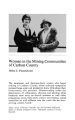
Show Women in the Mining Communities of Carbon County Helen Z. Papanikolas The immigrant and American-born women who began coming to Carbon County when railroad companies initiated large-scale coal production knew little about their forerunners, the pioneers. Homesteading under the deprivations of colonization, plowing and planting while husbands were away on church missions or with other polygamous wives, these early women, nevertheless, tamed somewhat an arid wildness into the rustic life the later-arriving women found.1 Above: Sarah "Killarney" Reynolds, left, and Elizabeth McDermid, leaders in helping immigrant women. Photograph courtesy of Florence Reynolds. Helen Z. Papanikolas Their fate interwoven with railroading and coal mining, these latter women were as hardy and as determined as the first settlers. Their goals were far different: not the propagation of a new religion but escape from poverty. They lived with unrelenting toil and with fears of being forced out of company houses during labor wars, of dying in childbirth, of husbands and fathers being killed from a fall of coal or in explosions. Over all hovered the anxious perplexity of being unwanted aliens. Life was especially difficult for the Mediterranean, Balkan, and Japanese women among them. They were severely restricted by the culture they brought to the new country. The lowly position of Middle East, Near East, and Balkan women can be traced to their countries' falling under the great sweep of the Ottoman Turks for whom women were chattel. Although the Italians were not subjugated by the Turks, their extensive trade with the Moslems influenced them to further women's submission to men.2 The Japanese history of feudalism, constant battling of warlords, and cultural patterns also placed women in a demeaning position. In contrast, the women from Britain and Scandinavia were not so culture-bound that they reserved all their energies for their families' welfare. Into the province that Balkan, Mediterranean, and Japanese women viewed as men's, the better educated British and Scandinavian women entered with zeal. On coming to Helper from Ireland in 1910, Sarah "Killarney" Reynolds transformed the dilapidated wooden Catholic church on a hill east of the railyards; it had no heat, water, or electricity. With pails of water carried up the steep hill, she, Vera Litizzette, and Catherine Verdi, daughters of Italian immigrants, scrubbed, painted, polished, and made the church a parish for the miners of the county. Although native cultures were not left at Castle Garden and Ellis Island, industrial unrest and the American labor movement brought about the right to protest that affected men and women alike in the coal fields. During the 82 Women in the Mining Communities 1903 Carbon County strike, Italian women marched down muddy streets in support of their husbands.3 The men faced blacklisting and jailing as radicals; women were confronted with the horror of raising hungry children in an alien land. Old-country cultures would not permit wives' working outside their houses, but the county was in turmoil over unionization attempts, and the hope of a semblance of security for their families was so great that the women encouraged their men to hold fast. After all, they had come to America for a better life. The women's daring amazed the old-time inhabitants. Caterina Bottino hid the famed labor organizer Mother Jones from authorities. Mother Jones was put on trains, jumped off as they rounded Steamboat Mountain, and walked back to exhort the strikers and their women to go on. "Unionize! Unionize!" was her rallying call and the Italian women heeded. In desperation sheriffs put Mother Jones in a "pest house" under quarantine. Had Caterina Bottino and other women quailed, had they feared the immediate possibility of hunger for their children and chosen instead steady servitude to management, future s t r i k e activity would have been curtailed because immigrants were the largest force in the county. The 1903 strike was unsuccessful, and officials of the United Mine Workers fled the county. The treasurer, Joseph Barboglio, went to Nofinger, Missouri, where he opened a saloon and married Jennie Causer, an immigrant from England, before returning to Utah where he entered banking. The young people were symbols of the vitality immigration brings to a host country. An Italian and his English bride from contrasting cultures worked and prospered. Their daughter Helen recalls the constant dinners her mother prepared for bank examiners and officials. Once she complained of the work. "We have to, Jennie, I learn so much from them," the fledgling banker said.4 The Barboglios left a legacy of Carbon County's early days. When Ralph Thomsen asked his Helper students who 83 Helen Z. Papanikolas Jennie Causer Barboglio (in doorway) and her husband joe (right), who made the cement blocks for their building. Photograph courtesy of Helen Barboglio Leavitt. Women in the Mining Communities the three greatest men in history were, an Italian-American boy answered, "Jesus Christ, Napoleon, and Joe Barboglio." For all her wealth, Jennie Causer Barboglio remained an unassuming immigrant woman, compassionate and spirited in the Helper of twenty-eight ethnic groups. (Danish- American Ralph Thomsen said, "It was a shock for me, a Mormon native of Sanpete, to teach in Helper. I was used to Nordic faces. Instead of students' bringing me apples, they brought me bottles of wine.") The 1903 strike also brought a new immigrant group to Carbon County, the Greeks. Unwittingly they came as strike-breakers, a phenomenon completely unknown in Greece. The first Greek couple in Helper were the John Diamantis. It was highly unusual for Greek women to immigrate in the first years. Balkan and Mediterranean men almost always came alone with the goal of making a little money and returning to their native countries. Much of the hostility toward immigrants in the first two decades of the century stemmed from their continuing native languages and customs and sending money back to their families. Immigrants considered themselves temporary workers who had come to fill the labor needs of the mines, mills, smelters, and railroads of America. They were enticed, even brought over, by company-paid agents for cheap labor. There were not enough American workers available who would work for the low wages management paid immigrants. No one, except the American Federation of Labor, condemned mine and railroad companies for bringing in foreign labor. The immigrants became the victims of the press and demagogues. In Utah the immigrants were more important as unskilled laborers than elsewhere; early Mormon church leaders had consistently warned their people to stay away from industry.5 Why John Diamanti brought his young wife with him is lost in the past, but soon they became the patriarch and matriarch of the growing community known as "Greek Town," west of the Helper grade school. Barba Yianni ("Uncle John"), Greek-immigrant children called John 85 Helen Z. Papanikolas Diamanti. He was a man of charisma, a folk healer, an interpreter of dreams, and a foreteller of the sex of unborn children. Each Easter he examined the shoulder blade of the paschal lamb and told what the following year would bring.6 The Greek Town children called Uncle John's wife Thitsa ("Little Aunt"). Their elders called her Yiannina, the genitive of her husband's name. She seldom smiled; the responsibilities Greek culture placed on her were enormous. No one gave her role much thought: she was merely a woman doing woman's work. The Greek bachelors were constant guests. As the matriarch she was in charge of weddings and baptisms. Each Saturday she had the Greek water boys of railroads and mines come down from their tents and shacks and line up to take their turn at having her wash their hair. No child went without shoes or food if she knew about it, and it did not matter if they were the children of immigrants or Americans. People remembered that she would set out with Uncle John's bootleg money in her purse to buy her sons clothing; it was gone by the time she reached town. On the way she saw a child with worn-out overalls, another with ripped-off shoe soles.7 When Chris Jouflas, future mayor of Helper, was orphaned, she raised him along with her eight children until his father married again. Yiannina remains a symbol of all overworked, duty-bound immigrant women for whom living was continual anxiety. The immigrant inspector's and coal mine inspector's reports of those years contain page after page with stark details of deaths and maimings in the mines. From 1892, when record-keeping began, to 1929, Utah had one of the worst records in the nation. From 1914 to 1929 Utah's number of fatalities in relation to hours worked and tons mined was almost twice the national average.8 When strikers in 1903 were blacklisted, many of the Italians began to farm on the banks of the Price River. Others who had worked on railroad gangs and were sympathetic to the strikers turned to farming and building. 86 Women in the Mining Communities Frank and Teresa Mangone, Castle Gate, November 10, 1913. Photo, labeled "Papa 1st Payday," was taken to assure the bride's parents of their daughter's well-being. Carbon County Historical Society collections. Most immigrants came without a trade as unskilled laborers, but several Italians were builders and, particularly, stonemasons. Their superior craft can still be seen in rock houses and mine portals. Joe Bonacci, a former railroad foreman, built several white frame houses on the road leading to Main Street in Helper. Across the tracks he worked a small farm where he later built several houses. Before his railroad and building days, he farmed near Wellington where his third wife raised a large family in complete isolation. He was often gone days at a time to sell his produce in Price and in mining camps. His wife's reminiscences of her profound loneliness resemble those of pioneer women in the Midwest on homesteads fifty wagon miles apart who often succumbed to mental illness. Josephine Bonacci was eventually saved, not by her pleadings but by admonitions of her husband's friends that his wife and daughters could be vulnerable during his absences to passing cowboys and sheepherders.9 87 Helen Z. Papanikolas Joe Bonacci then established a boardinghouse in Price, and although his wife worked even harder, being among people was a relief and a comfort. Living on farms at a great distance from others was alien to immigrants. In their native countries farm plots were on the outskirts of villages, often miles away, but villagers returned to their houses after the day's work. In the evening men met in taverns or coffeehouses and the women visited with neighbors. Running boardinghouses was a common experience for immigrant women, besides their raising large families, washing clothes by hand, cooking, mending, ironing, baking bread in outdoor earth ovens, and tending gardens. There were thousands of young unmarried workers for whom management felt no special responsibility to provide boardinghouses and hotels. At the outset managers opened one mine after another, indifferent to where the men would eat and sleep. Men lived in tents and shacks without water and privies and slept on cots or on dirt floors. When women began coming as picture brides, each took in relatives or village friends of her husband as boarders. There were not enough women to supply room and board for all the men, but they washed their clothes and cooked for them. A woman who came from Crete in 1911 to the southern Colorado coal fields and then to Carbon County said: When the men brought me their clothes to wash on their way to work, I had them drop them by the fence, then I would lift them up with a long stick and drop them into a tub of boiling water over a fire in the yard-because they were crawling with lice.10 Helen Koulouris and her sister-in-law boarded forty men. She said: They came in the morning for breakfast, and while they were eating, we filled their lunch buckets. In the evening they came for the big meal. We had to get our water from the river to cook and wash. We didn't complain. We didn't know any better.11 Women in the Mining Communities Some women didn't complain because keeping boardinghouses was a means of accumulating money to help their husbands enter business or become sheepmen. The women became matriarchs in their ethnic communities, and the young men who boarded with them were provided with the attentions that their mothers and sisters would have given them on their name day celebrations, Easter, Christmas, and other religious observances. Pictures were taken to send back to the old country so that families could see their sons were well dressed, could afford liqueurs to celebrate, and a lone woman was present to care for them. It was a life of slave labor. When the restrictive immigration legislation of 1921 and 1924 drastically reduced, or for Japanese completely cut off, the numbers entering the country, the women were relieved. South Slav (Yugoslavian) women worked toward the boardinghouse system's dying out.12 For some immigrant women America was more than a salvation from poverty, it was a refuge. The customs of native countries were inflexible and could lead to tragedy. Second cousins Suga and Eiji Iwamoto came to America because their marriage in Japan was unthinkable. Classes did not intermarry and Suga's family were samurai, her husband's farmers. In Latuda, Carbon County, Eiji Iwamoto became a camp boss. His wife awoke at 4:30 each morning to light the coal stove, prepare breakfast, and fill lunch buckets for her boarders. When the men returned from their mine shift, she scrubbed their backs while they bathed in a large wooden tub in a rear bathhouse. Japanese were not allowed to use company showers in the early days.13 America gave hundreds of thousands, perhaps millions of women, the opportunity to marry. Without dowries they would have remained unmarried in their own countries. The author's mother was one of those women. She at least saw the man she was to marry before the wedding. Most immigrant women came as picture brides, and often the men who met them at the Helper and Price Denver & Rio Grande Western depots were very unlike the photographs 89 Helen Z. Papanikolas they held in their hands. Often, too, the men were shocked at the brides sent them, demurred, and had to be reminded that their honor required taking the marriage vows. A Greek was chased from one sheep camp to another before he capitulated. After the restrictive immigration legislation of the early 1920s, immigrant men were forced to travel to Canada, Cuba, or Mexico to marry their picture brides. Immigrant women had no say as to the man they were to marry; the male members of their families made the decisions. Sophia Gazel's father saw John Mose Howa get off a train and decided he would become his daughter's husband. The Gazels and Howas were among the tenacious Lebanese immigrants who survived and flourished in Utah. Many Lebanese were vigorous merchants who made a circuit of the mining camps with hand-worked tablecloths, colorful bedspreads, and notions. The men found that their Lebanese immigrants John Mose and Sophia Gazel Howa in their wedding attire. Photograph courtesy of John Howa. 90 Women in the Mining Communities Slovenian immigrants Magdalena and Tony Skriner on their wedding day. Photograph courtesy of Frances Skriner Perri. women were invited into houses easier than they, and the Lebanese women became accomplished business partners. The arrival of their well-stocked wagons and cars in ethnic neighborhoods brought excited calls: "The Aravi! The Aravi! ['Arabs'] are here!" and women rushed out of their houses. When the 1930s depression brought mines and business to near ruin, Sophia Gazel's sisters opened the Madame Queen ice cream stand in Helper and weathered the stultifying years.14 Immigrant women were used to scrambling for survival; their existence in their native countries was, as the Yugoslavs described it, "the daily struggle for bread." The self-sufficiency of the old countries was practiced in Utah. In ethnic neighborhoods called "Greek Towns," "Wop Towns," and "Bohunk Towns" by the "Americans," were washhouses, chicken coops, rabbit hutches, pigeon roosts, wood and coal sheds, and always a garden. The women reveled in the marvel of American irrigation. In contrast, 91 Helen Z. Papanikolas the houses of poor Americans who lived nearby were devoid of grass, gardens, and chicken coops. One of the self-sufficient and expansively hospitable women was a young widow whose first husband had died of pneumonia following an attempt to retrieve a sheep from a flood of the Price River. Left with a small daughter, she later married a widower, Peter Jouflas, who had a young son, Chris. Not long afterwards, her second husband became ill. Together they kept washing machines and mangle irons going for the laundry of Greek hotels, butcher shops, and restaurants in Helper. Sheepherders took for granted that they could sleep on the cots kept handy in the washhouse when they came to town. Always visitors arrived; Helen Jouflas turned off the mangle irons and immediately set about cooking. When George and Emily Zeese moved to Cameron (later Rolapp, then Royal) in 1917, she walked the four miles to greet Emily, carrying a newborn son, George Jouflas. Immigrant women also brought the fear of death in childbirth with them. Maternal and infant deaths in America were almost as great as in their native countries. Although company doctors were employed as mines opened, both American-born and immigrant women were wary of having them deliver their babies. Because of custom and feelings of impropriety, the women turned to each other for help. Besides midwifery, women took on the additional burden of cooking and tending their neighbor's children when babies were born. This was especially true of immigrant families because fathers were totally ignorant of women's work. If women could not nurse their newborns, other women nursed them along with their own. American women were paid for this but not immigrant women. Their cultures gave a holy significance to giving milk to sustain a baby. The crusading of Esther Frakes, a Danish immigrant and wife of a Helper railroad engineer, brought eagerly sought medical help to the women. After many childless years, Esther Frakes had given birth to a premature infant 92 Women in the Mining Communities and experienced the drastic lack of medical facilities. She brought her mother, a midwife, from Oklahoma, and together they spent their Carbon County years helping women in childbirth.15 An important midwife in Helper was a native of Italy, Teresina DeLuca. Besides delivering babies, she used folk cures and dispelled the evil eye. Her neighbor Helen Jouflas regularly brought sickly, colicky Greek babies to have the rites of exorcism performed. Two Greek women called Grammatikina and Kisamitakina were also well known for their evil-eye ministrations. When the sons of immigrants returned to Carbon County with medical diplomas, professional services were tentatively, then widely, accepted by immigrant women. Drs. Ruggeri, Gianotti, Columbo, Demman, Dalpiaz (a dentist), Gorishek, and Orphanakis were immigrant sons. The first of these, Dr. Charles Ruggeri, kept the women in anxious fear that he would discover their using folk cures along with his prescriptions. In contrast, there were women in the mining towns and camps who were not touched by drudgery and anxieties, the wives of company doctors and mine managers. They lived lives of comfort. Managers could demand contributions from immigrants for automobiles for themselves and fur coats and diamond rings for their wives. James Galanis, who later owned the Golden Rule Store in Helper, was fired from the Kenilworth mine because he refused to donate toward a diamond ring for the manager's wife.16 Yet, the wife of Dr. Claude McDermid is remembered as a humanitarian. She brought food and clothing to mining families in the days before unionization and before welfare. The McDermids were Irish Catholics, and this brought them into close contact with Irish railroaders, Italian and South Slav miners. The Irish railroaders knew firsthand the sufferings of mining families through their runs from the coal camps to the Helper railyards.17 They had been successful, along with non-Catholic railroad men Harry 93 Helen Z. Papanikolas Clark, Julius Holmes, Frank Porter, and others in establishing the Brotherhood of Railroad Workers in the early years of the century. In both the 1922 and 1933 coal strikes they refused to ship coal mined by scabs. Getting out of the coal mines was a goal for most immigrants and especially for their wives who feared the scream of mine whistles at odd times. Increasingly, after the First World War, immigrants left the mines to become businessmen. Others, notably the French, Basques, and Greeks, returned to the ancient sheep raising of their ancestors. Their wives became modern-day nomads, piling their children and supplies into cars for the summer trek to mountain sheep camps, "Out to sheep" they called it. There the mothers cooked for sheep hands, bottled a mountain of tomatoes and fruit to last the winter, and raised children. In September, as sheep were driven to winter on deserts, mothers and children returned for school. Life was ruled by lambing, shearing, and shipping. One late snowstorm could freeze thousands of sheep, a family's livelihood. Families were conscious of their behavior being scrutinized when fathers were away, and immigrant cultures put many restrictions on mothers and daughters at those times. Some immigrants never left the coal mines, foremost, Frank Bonacci, organizer for the United Mine Workers of America. He had married a young woman above his class in Italy, and ostracism led to their coming to America. After several years in the Northwest timber camps, they came to Carbon County. Time and again Bonacci was fired from mines because of his union activities and hired after he signed yellow-dog contracts, trading work in mines to keep his children from being hungry. With another miner he began the Carbon County strike of 1922 by demanding of the Kenilworth manager why wages were cut when the price of coal remained steady.18 Mine guards carried the Bonacci furniture from the company house onto the snow, and strikers moved the family to an abandoned shack on the outskirts of town. The house had neither water nor electricity. Each time Bonacci 94 Women in the Mining Communities tried to reach his family, National Guard soldiers trained machine guns on him. Several days later Ann Dolinski defied the guard and walked to the house with a basket of food. The younger children could not keep down the omelet she brought after their long hunger. The oldest child, Marion Lupo, said, "My mother was never the same after this experience. She was silent and withdrawn."19 During the strike the wife of Charles Bikakis had gone into labor in her Sunnyside company house. While the pains were increasing and coming closer, she heard the company guards going from one house to another to remove strikers' families and furniture. Screams, shouts, weepings came to her as she struggled to give birth. Dr. Andrew Dowd, the autocrat of the Utah Fuel Company, stood on the porch with a shotgun and told the guards if they dared enter the house he would shoot them.20 Nick and Mae Pappas Bikakis were united in one of the first second-generation Greek weddings, 1930, at the Price Greek Orthodox church. Photograph courtesy of Vangie Bikakis Robertson. 95 Helen Z. Papanikolas The strike activity of the immigrants brought antialien campaigns in Utah as well as throughout the nation. The Castle Gate explosion of 1924 momentarily halted the hysteria. One hundred seventy-two miners were killed. While the brown-helmeted disaster team searched in the rubble, women ran to the site with canaries. The birds died at the slightest trace of gas, and rescue work was delayed until canaries lived. While the wives and children waited and wept, Killarney Reynolds, Elizabeth McDermid, Vera Litizzette, Catherine Verdi, Jenny Floyd, Jennie Lyn Crane Clark, and others collected blankets, cooked over open fires, heated canned milk for babies, boiled water, and sterilized instruments for the doctors. They worked hand-operated respirators for hours hoping to revive gassed miners.21 It took ten days to recover all of the bodies. Fifty of the men were Greeks. From the company houses came the ancient keening for the dead-high-pitched, eerie laments that are traced back to antiquity. Soon after the March 8 explosion the threat of violence toward Catholics and immigrants escalated. By summer the Ku Klux Klan was burning crosses. The author remembers standing at the kitchen window and gazing at a cross burning on a Helper mountainside. Across the valley the Catholics burned a circle for the word naught, a message to the Klan that they were nothing and their organization would come to nothing. For her husband's leadership in the fight against the Klan, Killarney Reynolds found a cross burning in her yard.22 The railroaders were sharply divided on the Klan, Catholics on one side and almost all Mormon and Protestant men on the other. A few Mormons worked against the Klan, principally the Harry Clarks. To show the Klan their solidarity and determination to do battle, Roger Reynolds and other Catholics drove to Salt Lake City to ask for a Knights of Columbus charter. Many Knights of Columbus from Salt Lake City came to Helper to establish the chapter. Irish Catholic, Croat, Slovene, Italian, and a few Mexican Catholic women prepared communal dinners for them. 96 Women in the Mining Communities From top left: Jennie Lyn Crane Clark, piano teacher to two generations of Helper students, photograph courtesy of Woodrow Clark; Esther Frakes and her midwife mother brought much-needed medical assistance to women in childbirth, photograph courtesy of Florence Reynolds; from bottom left: English immigrant Jennie Causer married Joseph Barboglio who became the immigrants' banker, photograph courtesy of Helen Barboglio Leavitt; Filomena Bonacci was the wife of a labor leader and later a stale legislator, photograph courtesy of Marion Bonacci Lupo; Josephine Bonacci came from southern Italy to become a prominent matriarch as the wife of foe Bonacci, photograph courtesy of Geneva Bonacci Black. Harry Clark's wife was in the forefront cooking and serving. Jennie Lyn Crane Clark was born in Salina, Utah. She graduated from Brigham Young Academy in 1913, taught in Salina, and then drove a horse and buggy to Aurora, three miles away, to teach school. After marrying in Helper, she began giving piano lessons to support her two sons. Her husband had developed asthma and was told by Dr. 97 Helen Z. Papanikolas McDermid to leave town during the summer months or he would die. Many nights Jennie Clark called Killarney Reynolds for help and with Dr. McDermid used a respirator to keep her husband breathing.23 Jennie Clark brought a touch of culture to the children of Helper and surrounding towns. Like the women who taught Greek school, Jennie Clark influenced lives beyond her home. A salutary influence on the children of immigrants also were the women associated with the YMCA's nondenomi-national Sunday School. Children who were neither Mormon nor Catholic received their only Bible learning from them. Especially active among the young was Olive Holmes, a native of Norway. During the bootleg era of the 1920s and 1930s, she kept open house on Saturday nights, served cake and punch, and provided books, magazines, and phonograph music for dancing on linoleum floors. Many young people would, she feared, otherwise have spent their Saturdays parked in cars behind the Rainbow Gardens or at roadhouses. Bootlegging was an important business in Carbon County, usually as an adjunct to a regular job. Neither immigrants nor the American-born could take Prohibition seriously. Elected officials were as prone to involvement with illegal liquor as were ordinary citizens. Women participated with their husbands, sometimes willingly because of the immense profits, often unwillingly. Sheepmen's wives were especially susceptible to arrest while stills worked in their cellars and husbands were at sheep camps. Eluding the "feds" developed ingenuity, and Carbon County has a repertory of successful foils. Zelpha Vuksinick recalls one that took place during the strike of 1922 when her father rented part of their Sunnyside house to the Yankovich family. Utah National Guard soldiers were ordered to search each house for whiskey stills. As two soldiers approached the house, the Yankovich's daughter ran out clutching the cap of a still, her long brown hair flying. Realizing she had a piece of necessary evidence, the 98 Women in the Mining Communities soldiers ran after her, but she disappeared. She had climbed a tree next to the Menotti store. Down below people were congregated, talking about the incident. The girl remained in the tree until a wagon came by and she was able to jump into it and hide. Later, at home, Zelpha Vuksinick's father cut the girl's hair. It was dyed red, and she was never caught.24 The depression years of the 1930s were stagnant, desperate ones for Carbon County; the mines were closed or working half-shift. "We never went visiting in those years," Athena Pallios said, "without taking something with us, a few baby chicks, a rabbit, never empty-handed." It was in Carbon County that she and Argyro Georgelas, who dropped lice-ridden clothes into boiling water, learned to read and write their native Greek. In 1933 the National Miners Union and the UMWA fought for the miners' membership, and in the ensuing strike the women, particularly the Yugoslavians, carried on in the tradition of Mother Jones. They paraded in the front ranks to give men the opportunity to escape when guards and deputy sheriffs descended on them. They cooked for imprisoned strikers, slaughtered pigs, lambs, and chickens they had intended for their hard-pressed families, heckled deputies to exasperation, and defied martial law edicts. A mine manager was caught by "six big Austrian women" who threw him to the ground, took his revolver, and "peed on" him.25 The strike was lost. The blacklisted National Miners Union men were eventually taken back to the mines, but the women's role in the strike has not been forgotten. A short movie by J. Bracken Lee recorded the march of the strikers, their wives, and children down Price Main Street where a full force of water from a fire hose was turned on them. As the daughters of immigrant women reached adulthood, many realized America's opportunities. Irene Holmes, Jennie Clark's most talented student, had played the piano for silent movies in the Liberty Hall and at the Strand Theater, for weddings, funerals, and Fourth of July 99 Helen Z. Papanikolas celebrations. Later, she graduated from the Chicago Conservatory of Music. Florence Reynolds held high positions with the United Nations, the National Institutes of Health, the State Department, and the Department of Agriculture. As deputy secretary of agriculture she established food programs for countries devastated by World War II. Italian, Greek, and Yugoslav daughters attended the Holy Cross School of Nursing under the watchful eyes of nuns; some became schoolteachers. Assimilation is now complete in Carbon County. Wedding pictures are graphic evidence: from old-country priests in robes and tall black cylindrical hats, American and native flags symbolizing the ambivalence of their love for their native country and the land that gave them their "daily bread," to a Buddhist ceremony, the bride in American finery, the groom in tails. For the third generation more A second-generation Japanese wedding: Fred Uataru Taniguchi and Ferry Hiroko Okura. Photograph courtesy of Nancy Jacobus Taniguchi. 100 Women in the Mining Communities marriages are outside the immigrant culture than within it. The women of Carbon County mining towns deserve more than this brief sketch. Without them the almost fifty-year struggle for unionization of the mines would have been abandoned early. Their descendants are scattered worldwide; they hold high positions in the armed forces, in the professions, in business, and in government. Some remain in Carbon County, close to their heritage. One hopes that memories of family matriarchs are still unfaded, that they are more than old photographs in picture albums. NOTES Mrs. Papanikolas, a native of Carbon County, is a Fellow of the Utah State Historical Society and a member of the Board of State History. •Thursey Jessen Reynolds, ed., Centennial Echoes from Carbon County ([Price?]: Daughters of Utah Pioneers of Carbon County, 1948). 2Phyllis H. Williams, South Italian folkways in Europe and America (New Haven: Yale University Press, 1938), p. 8. Helen Z. Papanikolas, "Ethnicity in Mormondom: A Comparison of Immigrant and Mormon Cultures," ed. Thomas G. Alexander, Soul-butter and Hog Wash and Other Essays on the American West, Charles Redd Monographs in Western History, no. 8 (Provo, Utah: Brigham Young University Press, 1978). 3For an account of the strike see Allan Kent Powell, "The 'Foreign Element' and the 1903-4 Carbon County Coal Miners' Strike," Utah Historical Quarterly 43 (1975):125-54. 4Helen Barboglio Leavitt, "The biography of Joseph Barboglio," MS, Utah State Historical Society Library, Salt Lake City. 5For a short history of the later immigrants see Helen Z. Papanikolas, "The New Immigrants" in Utah's History, ed. Richard D. Poll et al. (Provo, Utah: Brigham Young University Press, 1979). 6 Helen Z. Papanikolas, "Greek Folklore of Carbon County" in Lore of Faith and Folly, ed. Thomas E. Cheney (Salt Lake City: University of Utah Press, 1971), pp. 72-73. 'Reminiscences of Emily Zeese, Penelope Koulouris, and Mary Pappas Lines in author's possession. 8C.A. Allen, "Safety in the Mines of Carbon County," New West Magazine 11 (February 1920): 36-37, covers the years 1914-17; U.S., Department of Commerce, Bureau of Mines, Coal Mine Fatalities, 1930 (I.C. 6530), by A.L. Murray and D. Harrington (Washington, D.C., 1931), table 3, shows average U.S. fatalities as 3.151 per million tons mined. Utah had 7.98 fatalities per million tons mined during the years 1918-29. 'Interview with Mrs. Joe Bonacci, September 12, 1975. '"Interview with Mrs. Pete Georgelas, September 8, 1974. "Interview with Mrs. James Koulouris, June 16, 1971. i2joseph Stipanovich, "Falcons in Flight: The Yugoslavs'" in The Peoples of Utah, ed. Helen Z. Papanikolas (Salt Lake City: Utah State Historical Society, 1976), pp. 376-77. "Helen Z. Papanikolas and Alice Kasai, "Japanese Life in Utah" in The Peoples of Utah, p. 342. "Interview with John Howa, April 10, 1980. 15Interview with Florence Reynolds, March 28, 1980. 101 Helen Z. Papanikolas 16Autobiographical sketch, Greek Archives, Special Collections, Marriott Library, University of Utah. 17Reynolds interview 18Allan Kent Powell, "A History of Labor Union Activity in the Eastern Utah Coal Fields: 1900-1934" (Ph.D. diss., University of Utah, 1976), chap. 2. "Interview with Marion Bonacci Lupo, May 22, 1972, American West Center, University of Utah, Salt Lake City. "Interview with Helen Bikakis Zoolakis, June 10, 1977. "Reynolds interview. "Ibid. "Ibid. "Interview with Zelpha Vuksinick, April 2, 1980. 25For an account of the strike see Helen Z. Papanikolas, "Unionism, Communism, and the Great Depression: The Carbon County Strike of 1933," Utah Historical Quarterly 41 (1975): 254-300; Rolla E. West, typescript of the Carbon County strike of 1933, American West Center. 102 |