| OCR Text |
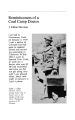
Show Reminiscences of a Coal Camp Doctor J. EldonDorman I arrived in Consumers, Utah, on January 3, 1937. I was a native of Colorado but had gone to medical school and served my internship in California. In July 1936 I went to Spanish Fork, Utah, to work for a doctor who was ill. He had recovered, and since we did not get along very well I was pleased when, about midnight on January 2, I got a phone Right: }. Eldon Dorman, M.D., making house calls al Sweets mine in the Gordon Creek area, 1938. Photograph courtesy of Dr. Dorman. j . Eldon Dorman The day shift leaves mine of Blue Blaze Coal Company at Consumers ca. 1936. Dorothea Lange photograph in USHS collections. call from Terry McGowan, then superintendent of the Blue Blaze Coal Company at Consumers. He offered me a job as the doctor for the coal camps of Consumers, Sweets, and National and asked that I report to work "for sure" at noon of the following day. I did not quite make it by noon. As a flat-land driver I failed to negotiate the snow-packed curve just west of old Tucker and clobbered my car when it ended up in the creek. So I entered Carbon County riding in the back of a flat-bed coal truck, clutching my medical bag and rubbing my contusions from the accident. I found patients waiting for me. I saw several sick people and handled some injuries. Before midnight I delivered a baby boy. I received the surprise of my life when the father pressed a twenty dollar bill in my hand shortly after I severed the umbilical cord. Never in my previous practice had I been paid so promptly. I had learned to settle many of my bills by barter-a sack of spuds, a box of apples, 46 Coal Camp Doctor or perhaps some eggs, butter, or chickens. That crisp new bill in my otherwise empty pocket made me think I had come to the right place, and indeed I had. I spent three of the most pleasant and enjoyable years of my life in the coal camps of Carbon County. I was called Doctor, Doc, or Mr. Doc;* most frequently, however, I was "Little Mr. Doc" since I tipped the scales in those days at less than 130 pounds. The Medical Association and the Company Doctor Consumers, Sweets, and National were the three coal mines in the Gordon Creek area located about twenty miles west and a little north of Price, Utah. In the early 1930s these three camps formed a Medical Association. This association was not dominated by the coal company as were most of the other coal camp medical associations in Carbon County. A committee made up equally of company and union personnel administered the association. The company representatives were the superintendents of each mine. The presidents of each union represented the miners. In 1937 this committee consisted of Terry McGowan and Charles Semken from Consumers, Lloyd Quinn and Ted Gentry from Sweets, plus Harry Elkins and Joe Matich from National. I attended the meetings but had no vote. I never had any problems with this group. The association charged $1.50 per month for a man with a family and $1.00 per month for a single man. Money was collected by the check-off system; it was automatically taken out of the miners' wages by the company and deposited to the association which then paid the doctor, nurse, medical bills, office expenses, and hospital rent. All medicines were covered, as were office calls and house calls for any type of illness. Coverage did not extend to some surgical items; deliveries were $35.00 extra, tonsillectomies, $15.00, appendectomies, $125.00, and simple fractures, *"Mr." preceding the title Doc or Doctor was the way an Austrian or Italian coal miner expressed his special respect. 47 /. Eldon Dorman $15.00. Treatment for venereal diseases was also not included. All the Gordon Creek companies carried industrial insurance or were self-insured. My salary was $300.00 per month. There was a doctor's living quarters and office at Consumers. A small five-bed hospital equipped with x-ray, microscope, and other clinical laboratory facilities, besides a well-stocked drug room, were all operated by the doctor. Daily office hours were held, plus house calls to all three camps and visits to the Price hospital where the most seriously injured patients were hospitalized except in emergencies. During the winter the roads were often closed by snow. The coal camp doctor helped to contribute to the morale of the miner and his family. He often made the difference in the success or failure of a mining operation. The men wanted someone at the portals when they were hurt. This insistence was why I got my job, although I did not know it until after I arrived in Consumers. The previous doctor had left during the Christmas vacation without telling anyone his destination. He was gone for a week instead of a couple of days. While he was gone, there was a serious accident at the mine. The doctor was fired upon his return. Physical Examinations for Miners As the winter progressed, the demand for coal increased. My office was flooded with men waiting to be examined so they could go to work. The age limit was forty-five years. Strange as it may seem, I "never" had a patient who was over forty-five years of age. They would actually hide their canes and crutches outside my office. There were no preemployment x-rays of chest or back. Anything was legal to fool the doctor. The physical examination was just a rough screening test. But welfare was not yet a way of life. All a coal miner asked for was a chance to work-to dig the coal to pay off his debts, feed and clothe his family, and perhaps send his son to school. He never missed a shift. Often he fought in line to get an extra shift or doubled back 48 Coal Camp Doctor to work overtime without extra pay. I hold a personal respect for the old-time Austrian, Italian, Greek, or Welsh coal miner. I still recall their nicknames-Flat Nose Mike, Fat Mary, Tony Bolony, and Mexican Joe. Each camp had several men known as Big John. The nicknames were always appropriate. A man called Buffalo came into my office one day. His incredible size prompted me to ask him the size of his pants. "Well, Mr. Doc," he replied, "these are fifty-six, but they're getting a bit snug." One Mistake I Made I had a mine telephone in my office and in my home. If an accident happened in the mine I was notified by phone and was frequently requested to meet the more seriously injured at the portal of the mine. It was quite an uphill walk, so I started driving my car. No road existed but I could drive almost to the mine entrance. The entrance, however, stood in view of the entire town and every woman in camp recognized my car. Soon each was standing on her front or back porch, wringing her hands on her apron and wondering if her husband or son was hurt or killed. I only drove up there twice. The ever-present fear of death in mine accidents, explosions, or afterdamp already haunted the families enough. Medicines The practice of medicine was different in those times. No sulfa drugs or antibiotics were available. At Consumers we had a new oxygen tent. It was portable and extremely useful for treating pneumonia. There were various types of cough medicines. Syrup wild cherry was the most popular. It cost $2.00 per gallon and I used to buy it in ten-gallon lots. One day I was over helping Dr. Ira Cummings in Standardville and I mentioned the popularity of this syrup. He set me straight in a hurry. "You're stupid," he said. "Do you realize that a good portion 49 /. Eldon Dorman of that syrup goes on these people's pancakes?" His statement was literally true. I watched for it and saw it happen. So, I thought I would stop this practice. I bought syrup white pine tar. This syrup had essentially the same ingredients but it tasted terrible. The patients put up a fuss when I tried to switch. Elixir cheracol was another cough medicine used for pancakes. Elixir terpin hydrate with codeine (TH&C) cost $8.00 a gallon then. It contained 40 percent alcohol, which is equal to eighty proof vodka, and almost two grains of codeine. TH&C was a popular medicine. It cured a lot of things besides a cough. The five kinds of aspirin came in different colors. The white and the green worked best for me. The pink and the orange did not seem very popular. Dr. Orson Spencer found it best to use the variegated color. Mail Order Nurse When I first went to Consumers I was unable to find a nurse to assist me. I finally phoned California and by offering $125.00 per month was able to hire a registered nurse away from her $85.00-a-month job. Over the years I continued to have nursing problems. One Catholic R.N. quit when I asked her to set up a tray for a male sterilization operation. It was simple: she said, "If you are going to do that kind of surgery, I quit." She walked out the door, literally leaving me with my patient's pants down. In those days there were various correspondence schools offering nurses training. At least one woman in camp took such a course. She was a young married woman and I used her a lot both in the hospital under the supervision of the R.N. and to help me out with home deliveries. She was pleasant, willing, and a hard worker. I was glad to have her with me when I experienced a problem home delivery. This particular patient was in her early thirties. She had one child, a boy, about eleven years old. Eight previous, more or less full-term pregnancies had ended in stillbirths. She had come to me in about her fourth month of pregnancy. I had found her Wasserman to be a 4+, 50 Coal Camp Doctor had treated her with mapharsen, and had hopes of getting a live baby. But when I next saw her, there was a new problem. My nurse and I found that the baby was well on its way with the head partially exposed, but the patient's labor pains had stopped. I was afraid that the baby might start to breath and choke to death in the birth canal. So I handed my nurse a 10-cc vial of pituitrin and a 2-cc syringe and said: "give her 2 minums right away." I thought I would have a few minutes for this drug to act, so I rushed into opening the sterile O.B. bundle and getting out sterile sheets, my sterile gown, gloves, and other necessary items. Somehow I chanced to look up just as the nurse injected the medication into the patient's arm. I stood spellbound with my mouth open but unable to say a word as I saw 2 cc instead of 2 minums, or sixteen times the amount I had asked for, being injected. I did not get my gloves or gown on but caught the baby in my open arms against my chest as it shot out of the birth canal like a shot from a cannon. It was alive and apparently healthy. The baby's cord Wasserman was negative, but the people soon moved away, so I had no real follow-up. I do not think I even scolded my nurse. It was my fault for not checking whether or not she knew hypodermic dosages. I continued to use her when she was needed and appreciated her help. Measles and Mumps The acute infectious diseases were a great menace in the coal camps. If one child showed up with the measles after a weekend visit to friends or relatives in Castle Valley, the disease spread like a plague to all the children of the three camps. Otitis media, a middle ear infection, was an almost certain complication of the measles in those days. I carried a myringotomy knife in my medical bag and opened many bulging eardrums as I made house calls. The adults did not escape the childhood diseases. I vividly remember an epidemic of mumps that swept the area like wildfire and 51 /. Eldon Dorman resulted in the tragic illness of two young adult males that certainly changed their life-style. Active immunization clinics were held each year for diphtheria, whooping cough, tetanus, typhoid, paratyphoid, and smallpox. In general, the response to these clinics was good. "One Night with Venus . . ." The venereal diseases also posed a problem in the coal camps. The per capita rate of VD, however, was probably as great in Salt Lake City as in the coal camps. The biggest problem, of course, was that we did not have the proper medicines to handle these diseases. Gonorrhea often had to be treated for a year or more to effect a cure. Lues, or syphilis, was more serious. It was treated by various arsenicals such as "606" or mapharsen. Injections of mercury were often used in the chronic stages, which led to the well-worn medical cliche of the 1930s: "One night with Venus and the rest of your life with Mercury." Each new case of venereal disease that showed up in the camp afforded considerable interest to the camp doctor. By simple observation and deduction he was able to trace its progress and to discover, often with surprise and amazement, who was doing what and to whom. Any coal camp doctor could have been a blackmail expert. For me, however, keeping the medical and social secrets of the camp was part of the fun of being a camp doctor. Pool Table Surgery I never dared to leave camp on Saturday nights. These towns really cooked on weekends. Parties, fights, brawls- you name it, they did it with enthusiasm. I was a new doctor in the Gordon Creek area when I received a midnight call on Saturday night to rush to the beer parlor at Sweets. This beer joint was something special. Its floor was covered with several inches of sawdust hiding 52 Coal Camp Doctor the blood and gore of previous Saturday nights. I found an older man sitting in a chair against the wall with his head hanging down against his blood-covered chest. When I spoke to him he raised his head and revealed a cut on his throat from ear to ear. To my amazement I discovered that it was a superficial cut through the skin that exposed but did not damage the major blood vessels of the neck. It gaped open an inch or more. I also noted that my patient was drunk. I was disgusted since I had already patched up several bloody noses and left quite a mess back at my office. There would be a problem in transporting a drunk and bleeding patient, probably in my car, to the office to sew him up. Since there was a pool table in the saloon, I decided to work there. I took out a couple of small sterile towels and the necessary instruments and proceeded to sew him up. This, despite the helpful and sometimes critical audience, did not take too long. The thump of the juke box never died and the The Sweets mining camp lay in this narrow canyon, 1937. Dorman collection, courtesy of Clyde Stevenson. 53 ) . Eldon Dorman drinking, smoking, and revelry only paused momentarily to inspect my stitches. As I did my barroom surgery I heard most of the story. I was surprised and chagrined to learn that my patient was the assistant mine foreman. He loved to drink and he loved to play poker. He had been doing plenty of both. At the same time the juke box was pounding polka after polka. Many of the Austrian men were dancing with each other due to the chronic shortage of females in the Sweets beer joint. One Austrian fellow kept asking the mine foreman to dance with him and made quite a nuisance of himself. Finally, the foreman, more interested in poker and booze, cursed and told the fellow to leave him alone in no uncertain terms. The Austrian left but soon returned with an open clasp knife, stood behind the foreman's chair, and proceeded to cut his throat from left to right. I had finished my throat repair job and was patching up the hand of Osby Martin who had grasped the open blade of the assailant's knife as he wrestled it away from him, when somebody suggested: "Maybe you had better go see Sam," the knife wielder. Then I found out the rest of the story. When business was good, the right-hand end of the bar contained an open case of warm beer. The bartender, when he removed a cold beer from the cooler, could replace it with a warm beer from the top of the bar. In the excitement of the knife episode the bar patrons had proceeded to break thirteen full bottles of beer over Sam's head without knocking him out. One fellow told me that he grasped a bottle by the neck, swung it with all his might on top of Sam's head. All that happened was that the warm beer spouted and foamed clear to the ceiling. Sure enough, the floor was covered by broken glass and bottlenecks and the ceiling was flecked with foam. I found Sam at the bunkhouse squatting in a galvanized tub of water and holding a bloody washcloth to his bleeding, macerated scalp. I asked him how he felt. He looked up and said: "I feel pretty good, but I do got a leetle bit headache!" I spent the next few hours picking glass out 54 Coal Camp Doctor of his bald head. I got back to my bed in Consumers just in time to hear the celebrants next door at the boarding house greet the dawn with loud but discordant verses of "It's Only a Shanty in Old Shanty Town." Osby Martin Osby Martin was quite a character. He was a bachelor who lived in one of the rooms in the Sweets mine bunkhouse. Stories were told that he had killed a man and served time in the penitentiary at Canon City, Colorado. He was also alleged to have been an exhibition shooter for the Winchester Repeating Arms Company. Everyone in Sweets was scared of Osby and he constantly attempted to enhance his tough past and present prowess. On occasion he would take his .30-.30 Winchester 94 rifle, stand in the main street in front of his bunkhouse, toss ordinary glass marbles in the air, and break them one by one. Many heated arguments in Sweets came to an end when Osby threatened to get his "Turty-Turty." Osby had quite a racket going. In those days horses were still used in the mine at Sweets. The main line used electric motors for haulage, but the dispensing and gathering of the coal cars to and from the various working entries was done by horses. Osby Martin was one of the drivers who dispensed the cars. The miners at Sweets were paid fifty-five cents per ton for loading coal, but without coal cars they could not load the coal. If Osby failed to get his proper "cut" on payday, the miners failed to get the cars they needed. Eventually the situation became tense and a union meeting was called. The problem, however, was resolved outside the meeting. The Sweets union hall was reached by a narrow footbridge five or six feet above the small drainage creek that went through the bottom of the canyon. This creek or ditch was fed by the kitchen sinks, dishpans, and slop jars of the cabins that lined its banks. It contained several inches of slimy gray dishwater with a generous sprinkling of potato peelings garnished by an 55 /. Eldon Dorman occasional orange peel. Beneath the semifluid contents of this drainage ditch was what might best be described as a one-foot-deep malodorous primeval ooze that not even a trilobite could live in. The unanswered problems of the union hall came to a boil on the footbridge. A little five-foot six-inch, 135-pound miner named Elmer Brinley confronted the brawny Osby. He landed a haymaker on Osby's chin that staggered him back against the flimsy railing. When the railing gave away, Osby sailed through the air and landed flat on his back in the mess of dishwater, ooze, and slime. Then the miners sent for me. I never understood why they called me in these situations. They never called the sheriff, the mine superintendent, or the mine foreman. They called the camp doctor. Perhaps they thought my services were about to be needed and that I should be handy. When I drove into Sweets at early dusk I found an armed camp. A man standing behind the corner of his house with a six-shooter in his hand waved me up the road. The closer I approached the bunkhouse the more belligerent the situation looked with a shotgun here, a deer rifle there, and an automatic pistol or two in the hands of determined coal miners. I was flagged to a stop by a couple of the armed men who were shielded by a building. They told me that Osby was in his room. I was the logical one to go in and talk to him, they explained, since he might have been hurt in his fall from the bridge. So I pounded on his door. There was no answer, so I pounded again and said, "It's Doc." The door was unlocked and opened. Osby replaced the .30-.30 by the doorjamb. He had just finished taking a bath in a galvanized washtub. I hastened to sympathize with, and even magnify, his leg and chest injuries. I convinced him to go over to the hospital at Consumers for x-rays and other first aid treatment. We did not see a soul as we drove through and out of Sweets with the .30-.30 upright between Osby's legs. I x-rayed him and bound up his wounds. When he complained of pain, I gave him some "pain" pills well laced with sleeping pills. It was now dark outside. I let him get a 56 Coal Camp Doctor little drowsy, and he forgot about his .30-.30 which I had placed out of sight. I delivered him back to his room and tucked him in. I took his gun back to him after a couple of days. I was told that this episode finished Osby's days of extortion at Sweets. No one feared Osby Martin anymore and Elmer B. was the unsung hero of the camp. Father Ruel's Request In 1937 the Catholic priest at Price was Father William A. Ruel. His assistant at that time was Father Jerome Stoffel who was just out of the seminary. These two priests came to Consumers to see a sick patient for whom I had given up all hope and thought was soon to die. When the young six-month- pregnant woman had become seriouslly ill with pneumonia the community was snowbound. I had her carried by stretcher to the small emergency mine hospital where I could put her in an oxygen tent. Without penicillin or other antibiotics, my only hope for this patient was oxygen. But, in spite of this treatment, she had gone steadily downhill. The roads to town were cleared, but because of the seriousness of her illness it seemed unwise to move her to the Price hospital. In reality, Price had nothing more to offer than the oxygen that she was already getting. I suppose her family sent for the priest. Quite early one cold snowy morning Fathers Ruel and Stoffel showed up at the hospital and administered the last rites to my patient. But about this time another complication came up: the patient had gone into rather active premature labor. I explained the situation to Father Ruel and his quiet, somewhat shy, young assistant. It looked as if the mother was sure to die; she might, while breathing her last, give birth to a premature infant who might live but a short time. I became busy with my other tasks of the day, but paused frequently to check my patient as the seriousness of her pneumonia and her premature labor problem progressed. At dusk I answered a somewhat demanding knock in my office which adjoined the hospital. It was 57 /. Eldon Dorman Father Ruel. He explained that he noted the poor condition of my patient and needed to talk with me about a matter of great importance. He indicated that he, too, was a busy man and many duties required his presence back in Price. He told me that he and his assistant had spent the entire day in the coal camps of Consumers, Sweets, and National waiting for the baby to be born in order to baptize him a Catholic. But they could wait no longer. They must leave at once. Therefore, he wanted me to perform a duty for him by baptizing the new baby into the Catholic church if he was born alive. Since I had been raised under a rigid family and educational Protestant regime, my face must have indicated some question. Father Ruel hastened to assure me that this procedure was an ethical and honorable practice. He had me memorize the magic words that would save a tiny soul from purgatory. I was further concerned when I thought I discerned a hint of skepticism in the eye of Father Stoffel as if he, as surely I did, doubted my ability to say the proper words at the proper time and in the proper sequence. Perhaps someone up above was skeptical as well. In any event, within a few hours the premature labor pains stopped, and the patient went on to a rapid recovery from her pneumonia and eventually a normal full-term delivery. Dental Practice I was routed out of my bed early one Sunday morning by a man with a toothache. He was an older Austrian fellow who was still somewhat inebriated from a Saturday night party. But now he held his lower right jaw in both hands and swung his head back and forth and up and down as he moaned and groaned. He could not stand still but paced my office floor in agony, swinging his head in rhythm with his steps. I offered him pills or even a shot of morphine for his pain, but he had brought his own painkiller and proceeded to gulp at frequent intervals from a bottle of Old Crow. He demanded in no uncertain terms that I pull the offending tooth. I explained that I was not a dentist and that he should visit a dentist in Price or Helper. He objected 58 Coal Camp Doctor strongly and pointed out to me several dental forceps in my glass-enclosed instrument case that stood in a corner. He also informed me that a previous doctor had pulled a tooth for him with no problem. I argued against playing dentist while he took turns pleading and berating my ability. Finally, I reluctantly selected a formidable forcep as he pointed out the offending second molar with his forefinger. I thought his selection was questionable since several other teeth looked worse. He insisted, however, so I applied the forceps and started to pull, twist, and yank. I gradually backed the patient and chair against the wall, put my knee on his chest, and, eventually, ended up with the tusk. The patient spat out a mouthful of blood in my wastebasket, took another slug of booze, and thanked me profusely as he backed out the door. When I saw the patient on the street the next day he ignored me completely. The following day the same thing happened. I wondered if he had been too intoxicated to remember what had happened. I could no longer endure his ungratefulness, so I asked him if he did not appreciate what I had done. He let forth a tirade of blasphemy, shook his fist under my nose, and said he had gone to see Dr. Joe Dalpiaz in Helper because I had pulled the wrong tooth! Dr. Claude McDermid Recent medical school graduates often came to Carbon County to work for mine companies with the intention of staying just long enough to accumulate enough money to return to the East and open up a practice. One of these young doctors, Claude McDermid, arrived in Sunnyside in 1911 to assist Dr. Andrew Dowd. After the financial difficulties he had experienced during his schooling he intended to stay only long enough to buy another blue serge suit. He stayed. After a year in Sunnyside, he became the Castle Gate company doctor and won the respect of miners. Florence Reynolds recalls waiting in his office when a new manager, bent on economizing, stormed in. It was a cold day in 59 /. Eldon Dorman Claude Edward McDermid, M.D., went from medical school to Sunnyside in 1911 and later practiced in Winter Quarters and Castle Gate. Photograph courtesy of Florence Reynolds. ,¥ r& JQ| • ' ^M ^^r M 73^m _^gv^HP"Vl ^r winter. The manager warned Dr. McDermid that he was going to turn off the electricity in the miners' company houses. Andrew Dowd, M.D., in Sunnyside, 1915. Photograph courtesy of Florence Reynolds. 60 Coal Camp Doctor "You are not," said Dr. McDermid. "I am," the manager answered. "They don't need it and don't deserve it." Whereupon Dr. McDermid rose to his full six-foot six, hit the manager with his fist, and sent him sprawling. Dr. McDermid practiced in Carbon County twenty-eight years. He was the Castle Gate company doctor at the time of the tragic 1924 explosion. Dr. McDermid and his three sons were left with rheumatic hearts from a bacterial epidemic. He died soon after leaving Carbon County. I did not have the physique or the ability to be as aggressive as Dr. McDermid, but this story illustrates how many of the early doctors were willing to jeopardize their jobs with the company that hired them in defense of the coal miner and his family. Immigrant Sons Helen Papanikolas points out that " . . . insults to the miners' dignity were commonplace." But the browbeaten first-generation immigrant could attain instant status and respect if he educated his son to be a doctor. One reason this was true, I believe, was because the camp doctor was one of the most respected people in the community. A large number of Carbon County immigrant sons became medical doctors or dentists. Often two sons in one family entered the respected professions. Second-generation Italian-American Charles Ruggeri, Jr., became an ophthalmologist, while his brother James practiced dentistry. A. R. and John Demman were another pair of Italian immigrant sons who practiced medicine. Drs. Nick and Mike Orfanakis were sons of a Greek immigrant. The Austrian Gorishek brothers, William and Frank, opened their practices in Carbon County. Today a number of second- and third-generation sons continue to contribute to the professions. Resume Two hundred miners died in the explosion at the 61 /. Eldon Dorman Pleasant Valley Coal Company mine at Winter Quarters in 1900; another 172 men died at Castle Gate in 1924, not to mention dozens of smaller life-taking disasters and countless amputated arms and legs, shattered bones, and broken backs. Life was cheap. Workmen's Compensation did not exist. After the Winter Quarters catastrophe, families received $500.00 for the loss of each life. The amputation of an arm or leg sometimes brought $300.00 to $500.00 if the company decided to pay. It has been said that in the early days of coal mining the life of a miner approximated the value of a prize mine mule. These conditions no longer exist, but they are still part of the coal miners' heritage and must not be forgotten. Today we are living in boom times, but not too long ago Carbon County was the Appalachia of Utah, the unwanted child. But without its coal, Utah's industries and power plants would grind to an abrupt halt. Carbon County is also Utah's melting pot. At one time its immigrants outnumbered the "native" Americans. Thirty-two nationalities are recorded as having lived in Helper during the early part of this century. Due to its polyglot population-refined and tempered in the melting process-Carbon County supports a broader, more tolerant, cosmopolitan life-style that sets it apart from the rest of Utah. The Greek, the Austrian, the Italian, the Welshman, the Finlander, the Japanese, the Chicano, and the native American have all left their imprint on its rough, often cruel, yet proud heritage. I am glad and proud that I had a chance to participate in the formation of this heritage. I am glad and proud that I live and work in Carbon County. Dr. Dorman is an ophthalmologist in Price and a member of the Utah Historic and Cultural Sites Review Committee. 62 |