| OCR Text |
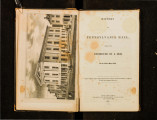
Show 182 APPENDIX. The Pennsylvania Hall was opened on Monday the 14th of May, and it appears that the only application made to the poli1:e for assistance at. the opening, consi5ted in p• ivatcly e ngaging the services of two of the Rtlent watch, l\fessrs. Samuel Barry and Gershom Craft, who were at once permitted to go to the Hall, with the assumnce to the Managers, thai. the whole police force of the cily would be lent to them ij required. The Mayor had summoned the whole of his force to be at the State llunse, on the afternoon of that day; but the Managers having requested that these two police ofll.~e.rs should be excused, (ace Appendix ll,) the Mayor readily assent.ed to tt. Their letlerof the 14th has appeared to this Committee important, 111asmuch as it reques trd "permission for these two men to remain at the I-I all, to keep the boys from making a noise by running in and out of the H all during the exercises." This seems to have been the only annoyance th en apprehended by the Managers, and it appears that they considf'red these two men as affording th em sufficient protection against it.* These men are represented to the Commillee as faithful and vigil:.1nt in the discharge of their duties. They had probably been selected by the Managers from their well known friendly feeling to the cause of abolition. They remained constantly at the Hall ; and neither they nor the Managers, nor any other person, intimated to any of the city authorities for three days, that there was any cause of alarm at the Hall. 1L was only latet in the evening of the 16th, ( \Ved-the shout tlmt a black man was walking with two" pt'(•tty while gil'ls. •• A white person seizrd a awecp by the wnn, and li:wced him to wulk arm in :u·m, in ft'Oill of the I !:ill. Othet· similor casea might be mentioned. The editm· of one of our cit)' papet·s, in rom:u·king on this JXll'lion of the'' llepm·t1" says: "lt will thus be seen tlml the Committee of the Councils of l'hil:ulclphi:t, lmve gone (]own into the kcnuels of socieLy-tuul t·aked the dtlrkest and vilest purlieus of licentiousnesa and pollution, for insinuations nnd slnndct·ous reJ)Qrts ng:tinst the frientls of Emancipation. Sbame on the men who could embody these v•le and wicket! slnmlet·s--this low ami '·ulgat· shmg of the enemies of order and mot·nlity-the \lAtch words and countct·signs of the mob-in a gt·nve •·eport of the Councils of our city. " ' hat h:~d they to do with these in·esponsible, indefinite sho.ndea·s, floating 'Jn the bt·eath of the mob! Unsuppt.wted by 11 sh:HIO\\ of pt'Oof, why nre tltey tlll'ust Ul)Qil the public, under the sanction and anthot·ity of a l'C()QI't of this chot•actct•? \Vhat othet• oLject can thdt• repetition in this documcut SUbSCI'\'e, th:m that of }::\,CUSING TIU: 1\lOII FOil TIU:llt l'AST CO.NIJUC'.r A~O ll!t· VITINO SIMILA.II OUTIIAO~:s ~·ou TIU: FUTOitE? \\1hnt is it but tJwowing the t'eill freely UpOll the neck of thc disordcdy-' ct·ying havoc, and letting slip the dogs of Wilt'?' " Did not thcsc men know that the felons and t'Obbet·s engnged in the riot at Pcnnsylvtmia Hall, would a·egard the 1 HcpOt'l' ns a tt•iumphant jnstificalion of theit• out1-:tgc-tlwt it would win opplauses in the <lens of midnight dcbnuchct·y-at the t11hle of the gamestt'r-l'l.nd at·ouutlthe filthy reecptnclca of litjuid poiso11? They have left it fo1· the mob to decide when ond how the 'morul sense of the community ' is outt-nged; and where and how they at·e to 11ppea•· as the oonsCt'VlHors of 'the cstabli~:~hed orders of society.' Jt is 'the winking of :mthol'ity ' at the open Yiolation of law-1m apology fo1· atrocious ct·ime-a dcclnrntion undea· the sign manuRI of the swot·n guat'fiians of the public peace, that lhe past outrages :we cxcus:lble, and that future ones may be pe1·petrated with impunity." .,. lt is tt·ue, they did not suppose it possible that, in this city, with its worthy citizens, most of " 'hom are the ft·icnds of m·tler nml of Law, with its )fllyot·, and his one hundred and sixty police men, the fit·st 11nd only temple of Libet·ty in the natiou, would be " pel'lnitted '' to be alhtcked by a rabble fi'Om other p11rts, m· destt'Oyed by inccndht~·ica from other states. t The fact is, the mob asscmLicd c111'1y in the C\'cning, and did uot dis("Jt:I'Seuntil after 10 o'clock. The moment a demonstration of thcit· inteution was made, the Mayo•· was sent for. The Police Committee say, the .iliayor wa.t abunt at the time, :•s if thaJ was a sufficient justification for a vigilant officer, who nlthough he hcm·d of it, as soon as be could be found, did not ]II'OCCed towards the scene of action, till all wcu again quiet, und the mob ha.d dispersed, so that fot· nearly two hours, mot·e than two thouSRnd respectable women were exposed to the insults of a lawleu mob, and the lives and pt'Qperty of citizens in danger, and yet the Mayor was not in his office; he "wa1 not to be fouud." J\lay we, aa citizens eonl!'ibuting towarclt his salary, ask where he wa• r REl'ORT OF THE l'OLlCE COi'll lHJTTElo:, 183 ne~day,) that notice was sent to the Mayor's office, that his presence was~reqtured to quell a disturbance at the door. The Mayor was not at his office, but as soon as !te could be found, and !ttard of it, he was proceeding to it '\hen he ascertained that all was again quiet; the assembl"ge harl dispersrd. He was informed that !!Hones had been thrown at the building, and that the people assembled th ere were much excited. T he Commillec have heard, (but not having been able to trace the report to any responsible source, they refraitl from repeating the expressions,) that those who were in the bllildiniT made 11se of very indbtcreet and intemperate language, greatly calculc:leci to increase the irritation. The person to whom this is chielly ascribed, is one of those strangers, who, unconnected with our city and its institutions, came here merely for the purpose of participating in this dedication. It appears from a letter adJressed to the Mayor, (see Appendix I.) by the President of the Board of Managers, that while "the Female Ant i-Slavery Society were holding a public meeting.'' and" whilst Angelina E. GrimkC Weld, of South Carolina, was addressing t/~e meeting," the ~<house was assanltcd by a. ruthless mob, who broke the wmdows, alarmed the women, and disturbed the meeting very much by yelling, ~tamping, and throwing brickhats and other missiles through the windows." But the disturbance did not last/on~; the crowd soon dispersed, and all was again quiet. I t appears that the Mayor being a~sent, and the police for~e .being at. that time extremef.tf weak there,• (as no dtsturbance had been anltctpated,) 1t was thought expedient by the City Solicitor to suggest to the police officers not to make arrests of persons at that time, as an attempt to carry away the prisoners might lead to a suc· cessful rescue, and would, even if this did not occur, so weaken the police force on the ground, as to prevent their checking the teudency to a riot, as they succeeded in doing. The ]}fayor was absent at the time, and the advice of the City Solicitor was not only well meant, but has been considered by many who were on the spot, to have been the most judicious measure which, ~nder ex i:Stin~ ~ircums.ta~lces, could be adopted to prevent greater des tructiOn to the bUJldtng, or Injury to the large crowd which was assembl~ d in it; ~any of whom. we~e colored peopl ~, indiscriminateJ.y seated wtth the wlnte, and whose lives It was a great ob;ect to secure from the via. lence or the mob. On the m?rning of the 17th, an intervie'y took place between the Mayor and a commtttee of the Managers, who delivered to him the letter marked I: In that letter, and in the interview, the Committee expressed the intentiOn or the Managers to hold meetings, morning, noon, and evening, of the "Female Convention of American Women," of the" Free Produce Convention," of the" Methodist Anti-Slavery Society," and of the State Anti~ Slavery Society," and to continue to meet in their building from time to time as occasion may require, and they add: ' "And we tall upon thee, a~ Chief Magistrate of the city, to protect us and our proper~y, m the exer~1se of our Constittllional rights, peaceably to assemble and dtscuss any subjeCt of general interest." This interview led to no sati.sfactory result. Both the parties that met, had no doubt the same ~rent Object at .h~art, that. the peace of the city should not be broken; but thetr mode of arnvmg at tlus result was different· the Co~~ittee wished their meetings to continue uninterrupted; and the M~yor, bel~e~mg th~t those meetings were thP. cause8 of the past as well as the anltctpate~ chsturban~es , was anxio~s to dissuade them from further adding to the exCitement wh1ch already ex1sted; and he was particularly desirous that they should forego their evening meetings. He told them that the po- '"' Shame, shame, |