| OCR Text |
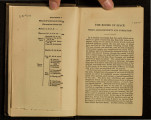
Show .26 THE EARTH FORMED • ater at reater depths; so tha_t t~e e~tire mass of a gre 1 1 b g should be of a gravtty Infinitely exceedtng ~00 ~~ :half times the weight of water. The ~mly al-our a. "tion is that the central matenals are ternattve supposi ·f.r d b some means. and bv greatly expanded or di use y d d b t by heat ' In- h t ans could they be so expan e u . . w a ~bee existence of this centL·al h~at, a residuum of f~e~\vhich kept all matter in a vaponform chaos ~t first~ . a t lid discoveries of modern scienc.e, ts arnongst the tmosh_cs~ it gives to I-Ierschel's explanation and the suppor w 1 . · t t w hall of the formation of worlds IS most tmporf an . et. s of h t ear to be traces o an opera wn he:eafter see w ah apstrface of the earth in very reJ?ote tth. is h.e aant eufpfeocn t ht oew ever' wht"ch has loneor passedd entfiir elyd Imes ' The ce~tral heat has, for ag~s, reache a xe away. . . ·n . bably remain for ever, as the point, atdwchtit.cnhg Iqt :aiityP~? the cool crust absolutely pre-non- con u . · t· Yents it from suffering any dtmtnu ton. THE EARTH FORMED-ERA OF THE PRIMARY ROCKS. the earth has not been actually penetrated ALTH~UG; th than three thousand feet,_ the nat~re to a grea er ep . man instances be Inferred lOr of it substance can, ·It by ~ther mean~ of observation. the depth of manr llll es d of a particular substance, \V: e see a mountain ~1~f~:~~ rock, lying against its sloped wtth strata, or beds. infer that the substance of ~he sides: _-we,. of couise~der the strata which we see lytng mo~ntai.n dtps away ~hat we walk away from the mounagainst It. Supposed dcres of the stratified rocks, and t, in aero s the t~rne up e {i nue to ass over other strathat for many IDll.es we C?n :he samr WflY, till by and bye tified rock ' all dispos~d ·~n we becrin to cross the opposite we come to a place \V ~~after which we pass over these edge" of t~le satn~ bed.s ~r till \Ve come to another extenrocks all In ~evet e Oid d ~f similar material to the first, ive mou~tain compo d~r the strata in the satne w~y. We and h lvlng.a';ay ~t t the stratified rocks occupied a bashould then Inter, la d cted chiefly by the ,. The researches on tl u· 8 subiect were con u · ea J t to the Academy of Selene . , . . perpetual secre ary 18·22 1ate Banm F onr:lel, . . a i t"qw1 de la Chaleur, · · of Paris See hls Tlleo1 'e ., ... na y ' • ERA OF THE PRIMARY ROCKS. 27 sin formed by the rock of these two mountains, and by calculating the thickness right through these strata, eould be able to say to what depth the rock of the mountain extended below. By such means, the kind of rock existing many miles below the surface can often be infer1·ed with considerable confidence. The interior of the globe has now been inspected in this way in many places, and a tolerably distinct noti~n of its general arrangements has consequently been .trnved at. It appears that the basis rock of the earth, as it may be called, is of hard texture, and crystalline in its constitution. Of this rock granite may be said to be the type, though it runs into many varieties. Over this, except in the comparitively few places where it projects above the general level in rnountains, other rocks are disposed in sheets or strata, with the appearance of having been deposited originally from water; but these last rock~ have nowhere been allowed to rest in their original arrangement. Uneasy movements from below have broken them up in great inclined masses, while in many cases there has been projected through the rents rocky matter more or less resembling the great inferior crystalline mass. This rocky rnatter must have been in a state of fusion· at the time of its projection, for it is often found to have run into and filled up lateral chinks in these rents. There are even instances where it has been rent again, and a newer melted matter of the same character sent through the opening. Finally, in the crust as tl1us arranged there are, in many places, chinks containing veins of metal. Thus, there is first a great inferior mass, composed of crystalline rock, and probably resting immediately on the fused and expanded matter of the interior: next, layer or strata of aqueous origin ; next, irregular masses of melted inferior rock that have been sent up volcanically and confusedly dt various times amongst the aqueous rocks, breaking up these into masses, and tossing them out of their original levels. This is an outline of the arrangem.ents of the crust of the earth, as far as we can observe it. It i~, at first sight, a most confused scene; but after some careful observation, we readily detect in it a regularity and order ft·om which much instruction in the history of our globe is to be derived. The deposition of the aqueous rocks, and the projection of the yolcanic, have unquestionably taken place since the |