| OCR Text |
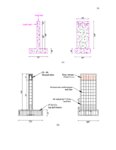
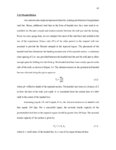
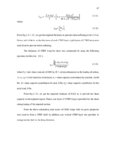
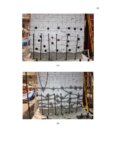
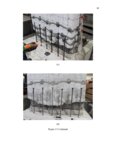
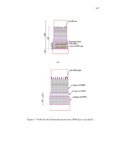
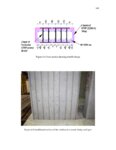
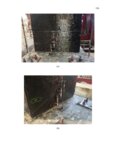
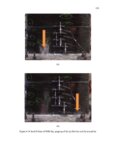
Show 122 away from the edge (Kim et al. 2011; Moran et al. 2019). Therefore, to mitigate this problem and to increase the efficiency of the CFRP jacket, CFRP horizontal anchors were provided. The horizontal anchors divide the wall cross section into multiple equal cross sections, increasing the confinement as well as helping in facilitating the load transfer for the wall pier bars lapped away from a corner. The compressive force provided by the CFRP anchors on the shear plane to avoid bond-splitting failure during strong earthquakes is given using the shear friction principle by (Hantouche et al. 2015); μ Fl =1.85 ns Ab fy (4.3) where μ = coefficient of friction for anchors embedded in concrete, taken as 0.6; Fl = Compression force in the given section ; ns = Number of spliced bars at the given strip, 14; Ab = area of one spliced bar, 0.11 sq.in. ; fy =yield strength of the splice bar, 60 ksi. Using Eq. (4.3), we get Fl. The diameter of the CFRP horizontal anchors was obtained by using the following equation (Hantouche et al. 2015): 4 LF Fa . da =[ π φa Fya (4.4) where da = diameter of CFRP anchor ; Fa = applied pretension force per anchor , 28.5 kips; LF= load factor, 1.3 ; Fya =Tensile strength of CFRP anchor, 121 ksi; φa = resistance factor for axial tension, 0.9. Using Eq. (2), we get, da = Diameter of CFRP anchor as 0.66 in. Ten horizontal CFRP anchors of diameter 0.66 in. were needed. Ten horizontal anchors of a 0.75 in. diameter was provided in two rows with five anchors in each row, at the height of 6 in. and 18 in. from the top of the footing. The two rows of horizontal anchors |