| OCR Text |
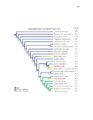
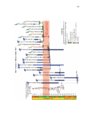
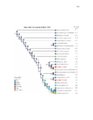
Show 277 disperses into New Mexico. The ancestral branch leading up to node N31 in model MS7 has an ancestral area of Montana and Wyoming and continues to be present in both localities on the branch leading to Ankylosaurus, which also then expands its range further northward, into Canada. The lineage to Ziapelta is ancestrally present in Utah prior to dispersing into New Mexico. The sixteen analyzed models showed no incongruences among inter- or intracontinental dispersal patterns between the continental and regional geographical analyses for Ankylosauridae. The large differences in likelihood values between the continental- (MC0-MC7) and local-sized (MS0-MS7) models are due to geographic scale issues, therefore continental models cannot be directly compared to local models in terms of biogeographic plausibility using these likelihood values. However, when considering the biogeography of the Ankylosauridae, the continental-sized models (MC0-MC7) are preferred because they provide a coarser distribution of taxa in a given geographical distribution, and are therefore less sensitive to sampling failure. This is critical because ankylosaurids can display poorly sampled records throughout Asian and Laramidian strata, and thus sampling sensitivity becomes more acute at the regional scale compared to a continental scale. Therefore, models MS0-MS7 should be interpreted with greater caution because they are based on ankylosaurid taxa that often suffer from occurrence within limited geographic ranges (often a single taxon per basin) and very few specimens per taxon (e.g. Scolosaurus cutleri, Dyoplosaurus acutosquameus, Anodontosaurus lambei, Oohkotokia horneri, and Ankylosaurus magniventris). The ancestral ranges and their biogeographic inferences that resulted from the sixteen Lagrange experiments are shown in Appendix E. The best strict temporal |