| OCR Text |
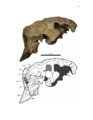
Show 47 obscured. In contrast to such ankylosaurids as Euoplocephalus, Anodontosaurus, and Saichania, the buccal emargination in UMNH VP 21000 appears strongly reduced, and the anterior curvature suggests minimal extension beyond the nares. The ventral side of the palatal region of the premaxilla shows a very shallow depression, a condition that is usually much deeper in other ankylosaurids, including Euoplocephalus, Ankylosaurus, Minotaurasaurus, and Saichania. In addition, UMNH VP 21000 does not appear to have a deeply inverted U-shaped premaxilla that is characteristic for many ankylosaurids; instead, it is anteroposteriorly short, similar to Anodontosaurus. A medially positioned extension of the premaxilla forms the internarial septum that would accommodate the vomers. However, the vomers did not preserve. Normally, the vomers fuse onto the internarial bar sagitally as seen in Tsagentegia and Pinacosaurus grangeri (Vickaryous et al., 2004), but in UMNH VP it shows no evidence of fusion. Instead, the surface of the internarial bar that contacts the vomers is smooth and appears more like an articular surface rather than a fused surface. In ventral view, the premaxillary tomium encompasses nearly 50% of the laterally deflected maxilla-premaxilla tomial crest. In lateral view, ventral to the lacrimal and loreal osteoderms, and dorsal to the tomial crest, the premaxilla thickens slightly mediolaterally and shows some rugose surface texture that continues onto the maxilla. Maxilla A large portion of the right maxilla is preserved; anteriorly it meets the premaxilla and posteriorly contacts the jugal (Fig. 2.6). The maxilla contains the posterior terminus of the tomial crest, which is present in ventral view and encompasses the remaining 50% of the entire crest. Most of the anterior portion of the palatal process that contacts with |