| OCR Text |
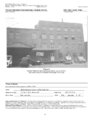
Show United States Department of the Interior National Park Service / National Register of Historic Places Registration Form NPS Form 10-900 OMB No. 1024-0018 (Expires 5/31/2012) Western Macaroni Manufacturing Company Factory Salt Lake County, Utah Name of Property County and State Statement of Significance Summary Paragraph (Provide a summary paragraph that includes level of significance and applicable criteria.) The Western Macaroni Manufacturing Company Factory, built in 1900 and expanded in 1915, is locally significant under Criterion A in the areas of Commerce and Ethnic Heritage. The period of significance is defined by the use of the building by the Western Macaroni Company between 1905 and 1942. In 1905, the Western Macaroni Company began leasing the modest three-story brick factory within Salt Lake City's emerging industrial district. By 1915 when the company expanded the building with a four-story addition, the Western Macaroni Company was the largest producer and distributor of pasta in the Intermountain West. Under Criterion A, the building is significant in the area of Commerce for its contributions to the economic output of Utah during this period. Despite its modest size, the Western Macaroni Company produced up to six tons of pasta per day and shipped product throughout the western United States and Canada. In the area of Ethnic Heritage, the Western Macaroni Company was founded by Italian immigrants and became one of the most successful Italian-American businesses in Utah. During its nearly forty years of operation, the Western Macaroni Company was praised as an example of both the successful assimilation of immigrants into the American economic system and the widespread dissemination of an immigrant food product, primarily macaroni and spaghetti, into mainstream American consumption. The Western Macaroni Company produced forty-five varieties of pasta, not only for the Italian community, but specialized products for other immigrant groups. The building is being nominated as part of the Salt Lake City Business District Multiple Resource Area context. The Western Macaroni Manufacturing Company Factory is the only extant historic pasta factory building in Salt Lake City and is a contributing historic resource in the city's west-side commercial and industrial business district. ________________________________________________________________________________________________________________________ Narrative Statement of Significance (Provide at least one paragraph for each area of significance.) History of the Western Macaroni Manufacturing Company Factory Salt Lake City was founded in 1847 by members of the Church of Jesus Christ of Latter-day Saints (LDS or Mormon Church). Within a few years, the city had assumed the characteristics of a Mormon village: a grid of ten-acre blocks divided by wide streets with blocks set aside for communal purposes. Historians generally agree that the completion of the transcontinental railroad on May 10, 1869, was a benchmark in Utah's history: the official end of the pioneer era in Utah. In January of 1870, the Mormon church-sponsored Utah Central Railroad completed a line connecting Salt Lake City to the Union Pacific line at Ogden. In 1872, Union Pacific acquired control of the Utah Central, as well as interests in another Mormon-owned railroad, the Utah Southern, which ran south from Salt Lake to Provo. The 400 West corridor provided the best grade and location for the tracks, and within a few years, a warehouse district had developed next to the city's central business district. The coming of the railroad had a direct effect on the neighborhoods west of the track for even one track created a barrier to east-west movement. By the time of the 1889 Sanborn map, the Utah Central-Union Pacific Railroad had laid six lines of track near 500 West, and the Denver & Rio Grande Railway, which had completed its Salt Lake to Denver line in 1883, had a track running north to south along 700 West. The 1898 Sanborn map shows that in the decade before the turn of the century, the Oregon Short Line Railroad (incorporated by Union Pacific/UP) had laid seventeen sets of track (through lines and sidings) near 500 West and North Temple separating the west side of town from the rest of the city. While many early residents moved away from the city's west side after the coming of the railroad, many others stayed and made a living from the commercial and industrial growth around them. One example was Susannah Alston Chamberlain, on whose property the Western Macaroni Factory was built. The Chamberlain family lived in an adobe house on Lot 8, Block 63, Salt Lake City survey Plat A (230 S. 500 West, demolished). As a widow, Susannah Chamberlain took in lodgers and eventually became a landlady. She built two brick houses on her lot by 1898 and a brick duplex by 1910 (248, 258, and 262 S. 500 West, demolished). The census enumerations indicate her renters worked primarily for the railroad and other west side businesses. She sold the west half of her lot in 1899 to the Mountain Ice Company. She lived 6 |