| OCR Text |
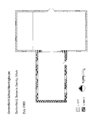
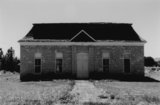
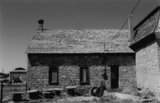
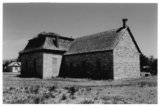
Show 0MB No. 1024-0018, NPS Form United States Department of the Interior National Park Service National Register of Historic Places Continuation Sheet Section No. 7 Page 5 Centerfield School and Meetinghouse, Centerfield, Sanpete County, UT Narrative Description The Centerfield School and Meetinghouse, constructed c. 1886-87 is a one-story oolitic limestone building. The mansard roof on the east portion of the building, added in 1897, defines its Second Empire style. Facing east onto Main Street, the school/meetinghouse has "T" shaped plan. The older portion is to the west and the stem of the "T." This portion of the building has a gable roof and was likely a temple form Classical structure. 1897 Wing (East) The 1897 part of the building is centered on the gable end of the 1887 building, (see floor plan) The primary (east) facade is symmetrical with five bays, four aouble-hung one-over-one windows, 1 and a central doorway. The gablet on the roof over the door was likely added when the frame entry tower was removed. Historic photos show a VA story frame tower that was on the front of the building and served as a vestibule. The tower was removed sometime during the historic perioc and its removal does not diminish the integrity of the building. The set of double doors and all the windows have arched openings with painted transoms and wood sills. The top rail of each transom is decoratively carved and the entry is faced with raised wood panels. The stonework is coursed rock faced limestone with hard projecting mortar. Two square piers flank the door. The north and south sides of the east wing have two ays each. There is a chimney on the south side. Both of the rear (west) windows have been filled, one with stone, the other with brick. Two newer chimneys rise from the west side. The concave-sided mansard roof, arched openings, and wide cornice are all characteristics of the Second Empire style.2 1886-7 Wing (West) The earlier portion of the building is more Classical in form and detailing. The windows have flat wood lintels and nine small lights. The roof is a fairly steep gable that runs east to west (perpendicular to the street) and has no cornice. There are three openings symmetrically placed on each side (north and south) of the building, and no openings on the rear (west). All are windows except for a door on the south side, east end. The door was likely once a window that was converted to a door when the front portion of the building was added. A brick chimney projects from the west end of the roof. The stonework is coursed limestone with little visible mortar. It is severely eroded and was likely a mud-based mortar. Interior and Site The east building is a large open space with a raised platform on the north end. The walls are about ten inches thick, and the window jambs are slightly splayed inward. The ceiling is flat and the floor is wood. 1 1n historic photos, these were once four-over-four windows. 2 Thomas Carter and Peter Goss, Utah's Historic Architecture, 1847-1940, (Salt Lake City, UT: University of Utah Graduate School of Architecture and Utah State Historical Society, 1991), 108. |