| OCR Text |
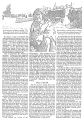
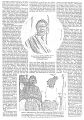
Show only through the fireplace. '1 he council sat Indian-fashion against the wall on the floor, two ranks deep. Crowded between the men were ancient ceremonial vases. Above their heads were dim yellow paintings of the sun, the eagle and the moon. From one to another moved the community tobacco sack and the community lighting stick; they Tolled their cigarets from corn-husks piled at the center of the room. The smoke rose densely and half-hid the ceiling, whose beams were walnut-hued from the tobacco smoke of hundreds of years. On the ceiling-beams, startling in their whiteness, were paintings of outstretched human hands. The room was quadrangular. At its far end a mural painting held my eyes all through the meeting-a serpent six feet long, painted in green with absolute mastery of design. It hung, it floated, it moved above the old men's heads through the milky air, lighting and darkening with the flickering fire. T he messenger from Taos pueblo told his story in Spanish, the interpreter rolling it into a Keresian of deeper accent. They talked for two hours, round and round. Here, as generally in the pueblos, there was neither chairman nor record-keeper nor speaker's gavel. None interrupted; all paid attention; every- one spoke, from the young interpreter who has visited Washington to the old cacique or religious chief, who lives in a world white men know little of. At last the verdict came back: "This is life or death. It is more than just one bad law. It concerns all Indians-ever}' pueblo. We will call a Council of all the Pueblos." Later, at Islcta pueblo, this plan was developed further into a project of sustained action and permanent union-a little new League of Nations, prospectively more interesting than the famous Iroquois League. An Appeal to America Cochiti called the meeting; Santo Domingo was the host. All the pueblos were represented. 1 he 121 delegates were sent by the pueblo councils, or, as in the case of Jemes pueblo, by great town-meetings of all the men. They came on horseback, in wagons, in Ford automobiles and on trains-it is 300 miles from the easternmost pueblo, Taos, to the westernmost, Zuni. They met in almost uninterrupted session from a Saturday afternoon till sundown on M una ay. 1 he meeting U5i.u four interpreters, who put every word used into English, Spanish1 and three •Indian languages. For about half the time they worked without a chairman. There occurred not a single deadlock. '1 here were extreme contests of opinion, but these contests related to methods, not aims. Every one spoke and two never spoke at the same time. From beginning to end there was much joking, and speakers needed to raise their voices above the forest-like rustle and roar of corn-husks being rolled into cigarets. At the end, when business was finished, the oldest men rose one by one, speaking only in Indian, pledging their pueblos' support. And every one of these old men gave thanks and pledged the future in the name of God-the God above all lesser gods of rain, of sun, of plenteous crops. Idolatrous savages, these! They framed an appeal to the people of the United States. Each delegate signed it with thumb-print or written name. It was strictly an Indian-made document. I have not space to quote it in full. Here are some sentences from the appeal: "We have studied this bill and found that the bill will deprive us of our happy life by taking away our lands and water and will destroy our pueblo government and our customs which we have enjoyed for hundreds of years and through which we have been able to be self-supporting and happy down to this day. "We can not understand why the Indian office and the lawyers who are paid by the Government to defend our interests, and the Secretary of the Interior, have deserted us and failed to protect us at this time. The Pueblo officials have tried many times to obtain an explanation of this bill from officials of the Indian office and the attorneys of the Government, and have always been put oft and even insulted. Knowing that the bill was being framed a delegation from Laguna, the largest pueblo, waited eleven hours for a chance to discuss it with the Commissioner of Indian Affairs at Albuquerque. At the end of this time, the Commissioner granted ten minutes, in which he answered no question the Pueblos had come to ask. "We have kept our old customs and lived in harmony with each other and with our fellow-Americans. 1 his bill will everything" which we hold dear-our lands, our customs, our traditions. "Arc the American people willing to see this happen?" To every reader this question is a personal challenge. Are you willing to see this happen? If you arc not, if you want to see remedied the misdeeds of'what Charles I*. Lummis calls a "Century of Dishonor," let your representatives in Congress know your sentiments. 1 hey will listen. The Bursum bill has opened up an issue that may well be a factor in the rise or fall of great political Parties. The fight is going beyond the ndian problem. The Conservation policy. is being dragged in. A vast area of public domain, called Indian country, with wealth not of a billion dollars but of unknown billions -the Navaho rcservarion alone has fortv-eigbt billion tons of coal and a great oilfield- is in the hands of that same public official who has directed the onslaught against the Pueblos. He-the Secretary of the Interior-has a power over the Indian country which the President has not got over the national forests: the power to break it up when he wants to, without asking anybody's consent and largely without public notification of what he is going to do or is already doing. The method is to allot the land in pan to the Indians who have no wish for individual ownership of land and who seO it for a shoestring, and to dispose of the remainder by sale to white men or corporations. No man should have such : power; Congress alone should have it and Congress has authority to take bad that power which it never should havt surrendered. A tremendous issue of the conservation of natural resources and d the public domain is involved, and ever if the reader of this article thinks the las interesting Indian died with Fenimc^ Cooper, he is still mightily concerned wit* the material question here stated. For these two reasons the preset-dramatic struggle of the Pueblos to kerr their life and their land needs to be ful* told. A few facts given in the Januar number of SUNSET have been stated ag?" in the course of this- article. This is the fifth of a series of artici dealing with the Indian problem. The jii' will appear in an early issue.-The Editu" Ihe Parental Mind some importance was to be decided. In a private talk with a faculty member one of the more thoughtful girls said that she did not approve of the general attitude of the student body and gave her reasons. There really was a moral issue involved, which the girl saw fairly and clearly. The teacher urged her to stand for what she felt was just and she promised to do so. When the matter was brought up for decision, she not only failed to express her opinion, but voted with the majority. 1 he teacher with whom she had discussed the matter asked her later why she had (Continued from page 4A changed. She replied: "Oh, I talked it over with my mother, and she urged me not to do it, because she was afraid it would make me unpopular." If a student went home from school and reported that a teacher advised doing what was politic rather than what was right, there would be immediate protest against that teacher. But the teacher can not honorably protest against the parents' attitude. It is one of the unwritten laws of the school that a child's confidence in bis parents must be maintained ur_'. ingly. It's a little hard to do it in rr-r cases. Another characteristic of'the Pare Mind is its absolute inability to bel-evil of Our child. Recently 1 heardc well organized gang of shoplifters as the seventh and eighth grade boysi-neighboring city. The children comer what are called "good families." Tear and victims have brought the matt. the attention of the parents repeat: Some of them have taken it serious!;, arc helping to overcome it in ever)- |