| OCR Text |
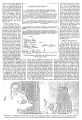
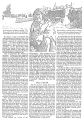
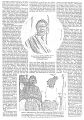
Show Ihe Pueblos Last Stand {Continued from page 22) Gallup, thirty-eight miles away, between breakfast and noon. Like the Navabos, they are at once the masters and the companions of wild horses. 'I hey paint and weave, make marvelous pottery, sing and dance and enact ritual dramas in piant masks, as terrible and beautiful as the ancient Greek drama. Like all the Pueblos they support themselves and ask no rations or subsidy. It is not weakness, but a superior moral ideal, a deeper ttrcngth of soul, which keep them from hating and which keep them merry in the face of doom. I quote a document which has just come from Acoma. The romance of all the Pueblos has its climax at Acoma, the thousand-year-old town hanging like a cloud at the summit of a mesa, hundreds of feet above the steep cliffs. No automobile or wagon has ever entered Acoma. L'p the precipitous trail for hundreds of years the women have carried water in patterned vases on their heads. The great church is built of adobe clay which the men carried up by hand. Standing in Acoma one looks across to the Enchanted Mesa, dealt with by Charles F. Lummis in a children's story which will be a classic as long as the English language is read. That was Acoma's earlier home. No foot has trod its heights for century after century, while the old city has melted away like a dead rose, the way adobe ruins melt away. A cloudburst destroyed the only approach, a ladder-like trail or doping ledge mounting to the ancient Acoma. Most of the tribe was below in the fields. The few who had remained home were marooned on the heights and died there, and the present Acoma was built on its new craggy site. All this was long ago. But Acoma today is still, in essentials, the wild, sweet community it was when the Spaniards first came. The document was sent by the Governor of Acoma and is signed by all the ex-governors and elected officers. It [ives the spirit of the Pueblos. It is vritten in English, laboriously, on •cratch-paper, and most of the signatures arc thumb-prints. "The Acomas held here, this 13th of November, 1922, at Acomita, a meeting: there met the Chief of Acoma and all His principal men and his officers. Willingly will we stand to fight against the h'ursum bill which by this time we have discovered and understood. "Our white brothers and sisters: this b:Il is against us, to break our customs, *hich we have enjoyed, living on in our Happy life. "It is very much sad indeed to bear, and to know, and to lose our every custom <-f the Indians in this world of men. 'Therefore we are willing fully to join ta the other pueblos our pueblo, where we say beat out the Bursum bill for the benefit of our children and of our old ,**ople and of all our future. "We have held a meeting, assembling mterday in the schoolhouse all day long. The meeting was very good. Every person • as sworn and each did say that he is •ailing to help right along from now on. "Yes, Sirs, we are glad to do sol To help through the name of our great God and to help those who are trying to stand by us, our American honorable people. "This is all very much appreciated, and thanks for the help, and signed with all our names; we, the Chief of said Acomas." At .Santo Domingo pueblo, north of Albuquerque, there gathered on November 5th a meeting which will be historic. This was the first formal council of all the Pueblos ever held in historic times. Many thousands of years ago, it may be supposed, these Pueblos were one stock, spoke one language and lived by a uniform type of social organization. Or perhaps, instead, thousands of years ago there were scores of disconnected tribes, and slowly there filtered influences from one to the others, while elements of the culture of Old Mexico drifted northward and imbued them all. In either case, pueblos have been built and lived in for centuries and abandoned; tribes have been numerous, powerful, and have vanished through some great starvation or epidemic, or through the onset of Comanches, Utes, Navahos or Spaniards. When a pueblo man visits another pueblo he is loaded, with gifts. In war the Pueblos have been united, as when the)' hurled the Spaniards out of New Mexico in 1680. But never before has the Pueblo unity been expressed through a formal gathering in peace-time or through a permanent cooperative league such as has now been formed. The Greek historian Thucydides, wrote a tremendous and a true thought: "A nation knows itself only in dying!" Faced by death thrust on them from without, the Pueblos have awakened to know themselves as one people, one nation. The place where this thought of unity took origin remains as the strangest spot I have ever visited. It was worthy the adjectives used by the Commissioner of Indian Affairs in his 1900 report: "Purely Indian . . . Their hair grows long savages, with all the gaud of feathers, naked bodies, hideous dancing, and other evidences of savagery!" Let me reassure the reader, however. The Pueblo Indian is the most modest being I have ever known, also monogamous and conventionally moral. Cochiti pueblo, south of Santa Fe, is immune from telephones, railways and automobiles because of the Rio Grande river. There is no bridge. To plant their eastward fields in springtime the Cochiris must travel 36 miles, though the fields are only a mile away. The Bursum bill would relieve them of this labor, as it would take bodily from them all their east-of-the-river land. Even on the west bank the trespassers have gained foothold; there is a sort of Mexican ghetto inside the Pueblo village. Looming beyond Cochiti are the Jemes mountains with the famed Canon des Frijolcs-the Bandelier National Monument, long-ago home of this group of Pueblo Indians. The meeting took place inside the estufa, or secret ceremonial chamber. A windowless vestibule led into the estufa through a low and narrow doorway. 1 he estufa also was windowless, ventilated >=; >.£ T v Yt-A*AA?:>. .• tt A v (AAAA^AAmM CAAAAAm \XrA T." •>-'- ~z«~AZA A^A^xXKli{(u ' !l' -A.A-The ^^^^•-^r^ Lure ifpy'^t yyy:"/) of t*%*§^ijM Hawaii" and Tan Jar """THE delicious fragrance •*• of fresh Hawaiian pineapple is somehow caughr. in Tan Jar. Hawaii sends us her favorite fruit - and in turn we send Tan Jar-her favorite chocolates. A fit confection for the discriminating- for inTanJar the choice tidbits of the four corners of the earth are assembled for your taste. If your dealer can not supply you. we will send a full pound pAckanc of Tan Jar, prepaid, to any address in the United States for $1.50. Vogan Candy Co. Portland. Orevon A\ 6r-?^onCh=rnes il^A- % Fruil-fi Nuts f •\\ Brazil bhit.s .•'.'/ -','F'- |