| OCR Text |
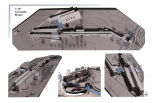
Show He, like many others, feels the " problem is overblown, and even if it isn't, it will surely be solved through human ingenuity and technological advances in the future" ( Villiers, 13). He claims that humans seem to respond to looming crises sufficiently to preclude their arrival. " There is," says Stakhiv, " some degree of optimism that well- managed resource systems can withstand [ most] climate change scenarios," and that vulnerability can be " stabilized at current levels, or reduced in most cases" ( Villiers, 82). Supporting his claim is the empirical data of past failures to accurately predict time frames for catastrophic events ( including exhaustion of fossil fuels, melting ice caps, overpopulation, and water shortages). The dates of exhaustion come and go almost without notice. As a rebuttal to the doomsayers, Stakhiv asserts that " technological changes and inventions" are never extrapolated into the future along with the threats which may affect future water supply. " Technological advances can mitigate problems," he said ( Villiers, 83). Stakhiv provides hope in technology. Regardless, however, of when we may or may not run out of water, the finite supply of water cannot continue to be divisible by a greater and greater number without a reduction in the per- capita supply. Conclusion The regional and area water risks are intensifying. Only recently have local, area, and regional leadership begun to address current and future water needs through a more sustainable approach. However, the general public is failing to internalize these risks, being blinded by the politicizing of water use from extreme regional subcultures or by simply divorcing themselves from responsibility as they are swept into the homogenizing modern society of placelessness. Regardless of the individual reasons, the lack of a collective resolve toward water conservation and scientific innovation poses the biggest immediate threat to our evaporating water. Mitigation: What is the solution? Marq De Villiers, author of Water: The Fate of our Most Precious Resource states: " If you're short of water, the choices are stark: conservation, technological invention, or the politics of violence" ( 275). Assuming violence to be a last resort, the remaining options are conservation and technological invention. Though neither can provide the complete answer to the regional and local water shortage, together they appear promising. - Conservation The potential for conservation is great, especially in the Salt Lake Valley, where individuals consume water at one of the nation's highest rates ( Wiley, 150). Within the valley only 40 percent of water use goes to residential and municipal uses with the remainder falling to less essential uses including lawn watering. Though the potential benefits are great, existing barriers to conservation are also deeply entrenched in this area where there is not a great propensity to save water. In addition to a lack of financial motivation, the barriers to widespread conservation are political and ideological in nature. Recent historical events in Salt Lake City, including the 2002 Winter Olympics, show that although there is widely divided subculture, there is a common appreciation for the city's historical past. This shared appreciation for historical past, coupled with a love and attachment to place are requirements for community and precursors to conservation ( Alexander, 11). Although an individual sense of place and its aridity have eroded as a result of growth and modernization, a reconnection with place can and must be made to preserve our desert water. Peter Calthorpe elaborates: " Understanding the qualities of nature in each place, expressing it in the design of communities, integrating it within our towns and respecting its balance are critical to making the human place sustainable and spiritually nourishing" ( 13). Architecture can provide a setting for reconnection; a framework for restoring a sense of place to the mundane fabric of anonymity. The divided subcultures in the valley can come together on specific issues related to the public good and welfare. Such union requires education and frank discussion of risks, divorced of politically clouded associations. A place of discourse would allow self referential reflexivity in which the environment can become the object of social reflection Environmental goals could then be disassociated with an established value system or an ontological order and become part of a social process within which goals are defined and redefined ... based on values" ( Cohen, 229). This place of discourse could provide the framework for self- education and risk internalization preparatory to behavioral change. - Technological Invention Research into technological invention is also necessary for a completely sustainable solution to future water shortages. A variety of research areas would be beneficial to our region and specific area. Dew or fog collectors have shown signs of success for arid climates. Drip and low- pressure spray irrigation systems have a great potential in our valley. Wind- trap funnels for moisture control and cloud seeding are also in initial stages of research. " Closed- cycle hydrocultures" of recycled evaporation is also intriguing ( Villiers, 297). Most key to our area, however, seems to be the reuse of waste water... a practice that is very common in Arizona and Los Angeles but foreign to Salt Lake City. A change in public policy which would allow waste water reuse systems ( gray water systems) is contingent upon resolving issues related to perceived and actual water quality and salinity. - Combination Salt Lake City could use a water research and education facility. A place conducive to mediation and discourse. A place wherein dividing subcultures may come together to regain an appreciation of our unifying past, internalize our regional water risks, and discover the necessity of both human technology and ecology in sustaining our desert water. 6 |