| Title |
Lee S. Manwill, Salt Lake City, Utah: an interview by Luke Kelly, July 11, 2001: Saving the legacy tape no. 267 |
| Alternative Title |
Lee S. Manwill, Saving the legacy: an oral history of Utah's World War II veterans, ACCN 2070, American West Center, University of Utah |
| Creator |
Manwill, Lee S., 1916-2008 |
| Contributor |
Kelly, Luke; University of Utah. American West Center |
| Publisher |
Digitized by J. Willard Marriott Library, University of Utah |
| Date |
2001-07-11 |
| Date Digital |
2015-09-16 |
| Access Rights |
I acknowledge and agree that all information I obtain as a result of accessing any oral history provided by the University of Utah's Marriott Library shall be used only for historical or scholarly or academic research purposes, and not for commercial purposes. I understand that any other use of the materials is not authorized by the University of Utah and may exceed the scope of permission granted to the University of Utah by the interviewer or interviewee. I may request permission for other uses, in writing to Special Collections at the Marriott Library, which the University of Utah may choose grant, in its sole discretion. I agree to defend, indemnify and hold the University of Utah and its Marriott Library harmless for and against any actions or claims that relate to my improper use of materials provided by the University of Utah. |
| Spatial Coverage |
England, United Kingdom; New York City, New York, United States; Virginia, United States; North Carolina, United States; Rupert, Minidoka County, Idaho, United States; Salt Lake City, Salt Lake County, Utah, United States |
| Subject |
Manwill, Lee S., 1916-2008--Interviews; World War, 1939-1945--Personal narratives, American; Veterans--Utah--Biography; Radio operators--Biography |
| Keywords |
radio operator; Governor's Island; Officer Candidate School; Army Air Corps |
| Description |
Transcript (30 pages) of an interview by Luke Kelly with Lee S. Manwill on July 11, 2001. This is from tape number 267 in the "Saving the Legacy Oral History Project |
| Collection Number and Name |
Accn2070, Saving the Legacy oral history project, 2001-2010 |
| Abstract |
Lee Manwill (b. 1916) ran movie projectors and served an LDS mission to England before being drafted into the Army in 1941. He served as a radio operator at Governor's Island, New York, before completing Officer Candidate School and joining the Army Air Corps. He then served in Virginia and North Carolina, retiring in 1945 as a Captain. 30 pages. |
| Type |
Text |
| Genre |
oral histories (literary works) |
| Format |
application/pdf |
| Extent |
30 pages |
| Language |
eng |
| Rights |
 |
| Scanning Technician |
Mazi Rakhsha |
| Conversion Specifications |
Original scanned with Kirtas 2400 and saved as 400 ppi uncompressed TIFF. PDF generated by Adobe Acrobat Pro X for CONTENTdm display |
| ARK |
ark:/87278/s6z91bnb |
| Topic |
Personal narratives--American; Veterans; World War (1939-1945); Radio operators |
| Setname |
uum_slohp |
| ID |
1025075 |
| Reference URL |
https://collections.lib.utah.edu/ark:/87278/s6z91bnb |
| Title |
Page 12 |
| Format |
application/pdf |
| Setname |
uum_slohp |
| ID |
1025054 |
| OCR Text |
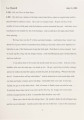
Show Lee Manwill Jul ll 2001 were whole families traveling on freight trains. I rem mber part f th coal car. They called them gondolas. The hobos of those days call d th m gond la . There was one whole family in one end of that coal car, and w wer in th ther nd. But then, later on, we came through the Royal Gorge on the train and we switched to a flatcar which was hauling a big tractor and some machinery. It was all anchored down with a flatcar. We got kind of under the machinery to protect us a little bit from the wind, and it started to rain. And we got cold, and we got hungry. And we each had a couple of cans of vegetable beef soup, and we had a can opener. I remember opening that can of vegetable beef soup. It was concentrated, and we didn't have anything to 1nix it with. But eating that out of that can, it tasted better than any food I'd ever had in my life. We were that hungry. As we rode along through Royal Gorge we went under the big suspension bridge. We could see it up above and it was quite a sight. We got to Denver and spent two or three days there. Like I say, it was the heart of the Great Depression. We'd go up to a restaurant in Denver and say, "Have you got some work we could do for a meal?" Nine times out often they'd say, "Well, we don't have any work to do, but sit down, we'll feed you, and they'd give us a meal. And we got by that way. And I won't go into a lot more detail. But when we got back to Salt Lake-rode the freight trains back to Salt Lake-I still had $1.50 left in my pocket. I don't know what I spent the dollar for that we had when we left. That was quite an experience. Later on, I went to school at the University of Utah. I started in there. And I 10 |
| Reference URL |
https://collections.lib.utah.edu/ark:/87278/s6z91bnb/1025054 |