| OCR Text |
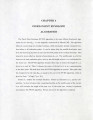
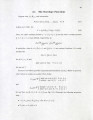
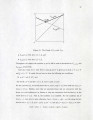
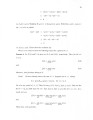
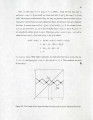
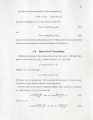
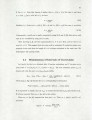
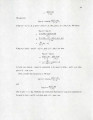
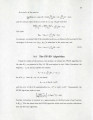
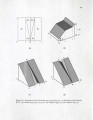
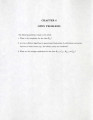
Show CHAPTER 5 NONCONTRACTIVE FUNCTIONS Recall that c;~ 1 contains noncontractive functions that transform the n-dimensional unit cube into itself. We shall establish in this chapter the following complexity results: (5.1) and (5 .2) for c: < 0.5 and any n ~ 2. Throughout the chapter c: is assumed to be less than 0.5. The proofs for both cases are similar. For the univariate case, given any information N with card(N) < m(Cp~ 1 ,c:), we construct g, hE Cp?_l such that N(g) = N(h) and jjg* - h*ll > 2£. This yields that no algorithms using such N can compute €-approximations of fixed points for the class Cp~I· Since the bisection algorithm needs exactly b(c:) = m(Cp?_l, c:) function evaluations to compute €-approximations for the class Cp~l, it is an optimal algorithm, and the complexity for the class Cp~I is given by (5 .1). In addition, we shall show that the FP-EN algorithm, when adapted for the class Cp~l, is also optimal. For the multivariate case, we first show that (5.2) holds for the class c;=t· That is, given any information N, we construct g, hE c;=I such that N(g) = N(h) and llg*- h*ll = 1. Consequently no algorithms using N can compute €-approximations for the class c;=l whenever c: < 0.5. This means m(c;=1,c:) = oo. Then, we adapt the construction of g and h any class c;~ 1 with n ~ 2 and p ~ 1 to establish (5 .2) . Section 5.1 proves (5.1). Section 5.2 demonstrates that the FP-EN algorithm is also optimal. Section 5.3 constructs g and h for the class c;=I as mentioned above. Section 5.4 shows that g and h indeed belong to c;=t· By this, we complete the proof of (5 .2) |