| Title |
Harold Carroll, Salt Lake City, Utah: an interview by Winston Erickson, August 7, 2001: Saving the legacy tape no. 299 |
| Alternative Title |
Harold Carroll, Saving the legacy: an oral history of Utah's World War II veterans, ACCN 2070, American West Center, University of Utah |
| Creator |
Carroll, Harold, 1919-2008 |
| Contributor |
Erickson, Winston P., 1943-; University of Utah. American West Center |
| Publisher |
Digitized by J. Willard Marriott Library, University of Utah |
| Date |
2001-08-07 |
| Date Digital |
2015-09-16 |
| Access Rights |
I acknowledge and agree that all information I obtain as a result of accessing any oral history provided by the University of Utah's Marriott Library shall be used only for historical or scholarly or academic research purposes, and not for commercial purposes. I understand that any other use of the materials is not authorized by the University of Utah and may exceed the scope of permission granted to the University of Utah by the interviewer or interviewee. I may request permission for other uses, in writing to Special Collections at the Marriott Library, which the University of Utah may choose grant, in its sole discretion. I agree to defend, indemnify and hold the University of Utah and its Marriott Library harmless for and against any actions or claims that relate to my improper use of materials provided by the University of Utah. |
| Spatial Coverage |
India; Burma; China |
| Subject |
Carroll, Harold, 1919-2008--Interviews; World War, 1939-1945--Personal narratives, American; Veterans--Utah--Biography; World War, 1939-1945--Military operations, American; World War, 1939-1945--Campaigns--Southeast Asia |
| Keywords |
Signal corps; New Orleans; Chittagong; Luzhou, China |
| Description |
Transcript (41 pages) of an interview by Winston P. Erickson with Harold Carroll on August 7, 2001. This is from tape number 299 in the "Saving the Legacy Oral History Project |
| Collection Number and Name |
Accn2070, Saving the Legacy oral history project, 2001-2010 |
| Abstract |
Carroll (b. 1919) recalls growing up in Utah, being drafted in October 1941, going through basic training, and being assigned to the signal corps stationed in New Orleans before going to India. He was in Chittagong before being sent to Burma, where he recalls hunting a tiger. Later sent to Luzhou, China, he remained there until the war ended. He concludes with his recollections of being a mechanic and working at various car dealerships in Salt Lake County. 41 pages. |
| Type |
Text |
| Genre |
oral histories (literary works) |
| Format |
application/pdf |
| Extent |
41 pages |
| Language |
eng |
| Rights |
 |
| Scanning Technician |
Mazi Rakhsha |
| Conversion Specifications |
Original scanned with Kirtas 2400 and saved as 400 ppi uncompressed TIFF. PDF generated by Adobe Acrobat Pro X for CONTENTdm display |
| ARK |
ark:/87278/s65q6v9z |
| Topic |
Personal narratives--American; Veterans; World War (1939-1945) |
| Setname |
uum_slohp |
| ID |
1023266 |
| Reference URL |
https://collections.lib.utah.edu/ark:/87278/s65q6v9z |
| Title |
Page 7 |
| Format |
application/pdf |
| Setname |
uum_slohp |
| ID |
1023228 |
| OCR Text |
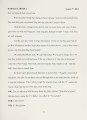
Show OLDC RROL u u t 7th 2 1 had to go over the Huey P. Long Bridge and all that stuff tog t down ther . And as we were driving along in Alabama the one fellow that was th driv r - I was just supposed to be the helper - they kind of stopped and this guy hit the truck in front of him. Immediately, the commander come up and chewed the day-lights out of him. Pulled him out and said, "Can you drive the truck?" And I said, "Sure, I can drive the truck." So I drove the truck from then on to Buras, Louisiana. And when we got down to Buras, Louisiana, they set up a radar. This was- we were part of the- air warning setup, checking for aircraft coming in near the shore and stuff like that. And so we'd run this radar, and of course we run the radio signal into New Orleans (where they had the plotting boards and all that stuff), and if they had an airplane that they couldn't tell what it was, they immediately then would alert the air corps and they'd go out and take care of it. And we were there I guess a year or more, I don't know how long. I never did keep track of how long - where I was, or what I was doing - but after a while, then they moved us back and forth. Some of us would be in New Orleans, and some of us would be in Buras, Louisiana. We were in a school house there. And I guess come fall they had to have the school house to put the kids in school, so they moved us out to the end of the Mississippi, where there was an Island. They called it Burwood Island. And we were out there for 5 |
| Reference URL |
https://collections.lib.utah.edu/ark:/87278/s65q6v9z/1023228 |