| OCR Text |
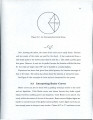
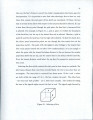
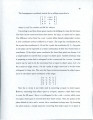
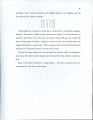
Show 5 then placed in a coherent 3D topology. New features must be built upon older ones to maintain the relations. For instance, the user might start sketching three orthogonal lines. The system then realizes that these three lines could be interpreted as a cube and completes it. The user could then draw a circle on top of the box, and it will be interpreted with 3D coordinates that place it on top of the box. The user might next draw a line extending out from the circle. A cylinder could be recognized from the circle and line; the line indicating the height of the cylinder. This cylinder would be placed on top of the box. This seems like a revolutionary breakthrough. It gives us an idea of what the engineer would like to use. However, there are a few limitations with this system. It will only recognize a limited set library of features. The coordinate system that is used is fixed and specified by the system. To visualize the object from a different vantage point, the user must down-load and convert the object and then use a different package to view it. It is also not clear how the user would sketch features on the back or hidden sides of the model. The user must also add parts "on top of" existing parts. The authors plan to add constraints in the future to aid in the refinement of the design and help fulfill functional requirements. 2.2 Viking In the paper "Designing Solid Objects Using Interactive Sketch Interpretation (Viking)," David Pugh [10) presents another sketch-based design system. This system lets the user sketch a whole line drawing of an object in 2D and then tries to interpret it into 3D. This modeler uses hints like shading of nonvisible lines and previous interpretations of the object to guide the interpretation. Additionally, the user can specify constraints on the objects. Sketched segments are automatically aligned, where appropriate, making input easier. The object can be viewed from any vantage point, and the user can make modifications to any side of the object. |