| OCR Text |
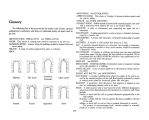
Show Glossary The following list of terms provides the reader with a basic, general architectural vocabulary and does not elaborate solely on terms used in the text. ARCHITECTURAL TERRA-COTTA (see TERRA-COTTA) ADOBE Clay bricks of varying sizes cured by exposure to air and sun. ALUMINUM SIDING Exterior siding for buildings molded to imitate horizontal wood siding. ARCADE A range of arches supported by piers or columns. ARCH '^w^M%LU'' l /-"SETTS?-" -.v»syv'« Elliptical -•mt.. Flat (jack) Horseshoe (Moorish) Ogee (ogive) Pointed Round Segmental Tudor ARCHITRAVE (see ENTABLATURE) ASBESTOS SIDING Thin sheets or "shingles" of pressed asbestos cement used for exterior siding. ASHLAR (see STONE MASONRY) ASPHALT SIDING Rolled asphalt impressed with mineral granules, also available in embossed brick patterns for use as an exterior siding. BALUSTER A plain or ornamented post supporting the upper rail of a balustrade. BALUSTRADE A railing supported by a series of posts or balusters and sometimes by a bottom rail. BARGEBOARD A board, often decorated, covering the sloping edge of a gable roof. BATTERED A column or wall surface that slopes as it rises. BAY A regularly repeated element on a structure. For example, a house having three openings, a window, a door, and a window, would be considered a "three-bay" house. BAY WINDOW A window or windows projecting from the outer wall that extend floor space. On the exterior, the bay extends to the ground. Not to be confused with an ORIEL WINDOW, which is a bay cantilevered or corbeled from the wall above the ground. BELLCAST (see ROOFS) BELTCOURSE (STRINGCOURSE) A horizontal course of masonry running across the elevation of a building. BLIND ARCADE A row of arches applied to a wall surface to create a decorative effect. BOARD AND BATTEN (see WOODSIDING) BOX FRAME A wooden building frame where the weight of the roof is carried by the vertical members of the wall. Box framing customarily consists of vertical posts joined by horizontal plates, sills, and girts. BRACKET A projection, often decorative, that supports or appears to support an overhanging element such as an eave. BRICK A solid masonry unit of clay burned in a kiln. Different designations are given to bricks depending upon their positions in a masonry wall. These include: Header-a brick laid flat with its greatest dimension perpendicular to the wall surface Stretcher-a brick laid flat with its greatest dimension parallel to the face of the wall Soldier-a brick laid on end so that its greatest dimension is vertical The process of manufacturing brick, whether molded or extruded, results in a variety of sizes and finishes. 179 180 BRICK BONDS Stretcher (running). Courses of stretchers only Common (American). Courses of stretchers with each sixth course of headers English. Alternating courses of headers and stretchers Flemish. Alternating headers and stretchers in each course ~3Zr~~rnr~~or~^c Stacked. Brick is laid with vertical joints aligned Dogtooth Brick Coursing. A brick course laid with its corners projecting from the wall surface. BRICK MASONRY (see BRICK BONDS) \KV>KSXS rt^JTaTMitiBi 3\~rTT" „ ' T ' - L - i r J ! - i r J ° T J-i II Glossary BRICK PATTERNS: Basketweave Herringbone BROKEN PEDIMENT (see PEDIMENT) BUILDERS' HANDBOOKS Books intended to provide builders with specific technical information on such things as laying out complex geometric figures, reproducing the classical orders, and building stairs. CAPITAL The decorative top of a column or pilaster (see orders). CASEMENT WINDOW A window hinged on the side. CAST IRON Molten iron poured into molds. Used as both a decorative and structural element in the late nineteenth century. Strong in compressive strength and weak in tensile strength. CAVETTO CORNICE A concave molding at least a quarter round. CERAMIC VENEER (see TERRA-COTTA) CLAPBOARD (see WOODSIDING) CLINKER BRICK A brick whose shape has been distorted during the burning process because of its proximity to the fire. CLIPPED GABLE ROOF (see ROOFS) COBBLESTONE A naturally rounded stone used for walls, foundations, and columns. Also referred to as a creek stone. COMPOSITE (see ORDERS) CONCRETE A combination of cement, large and small aggregate, and water placed in its liquid state in forms until set. Lime concrete and mud concrete refer to an indigenous form of concrete containing specific proportions of lime and/or mud. Reinforced concrete contains some form of reinforcement such as metal bars. CONCRETE BLOCK Concrete molded into the form of a hollow or solid unit and used like brick or stone as a masonry building material. Incorrectly referred to as a cement block. COPING A protective layer or cap to a wall of masonry constructed of stone, wood, metal, etc., and often angled or double-beveled to prevent water from penetrating the wall. Glossary 181 CORBEL A projection, usually in a masonry wall, either of masonry or another material structurally supporting something or used in a decorative manner. CORINTHIAN (see ORDERS) CORNER BOARD A vertical board placed at the corner of a wood-frame building. CORNICE (see ENTABLATURE) CORNICE RETURN The continuation of a cornice in a different direction. CORNICE RETURN COURSE (see BRICK BONDS AND STONE MASONRY) CRENELLATION A parapet with alternating openings (crenels) and solid parts, originally designed for defense but later used as a decorative motif. CRESTING A continuous wooden or metal ornament situated on the ridge line of a roof. CROSS SECTION An architectural drawing illustrating a vertical cut through a building to indicate relationships within the interior space. DENTIL One of a band of small blocks forming a teeth-like molding characteristic of classical entablatures. DISTYLE IN ANTIS Two columns set between pilasters or side walls. DOGTOOTH BRICK COURSING (see BRICK BONDS) DORIC (see ORDERS) DORMER A projection from the slope of a roof, usually containing a window or louver. DOUBLE-CANTILEVERED CORNER WINDOW A window that wraps around an angle in the wall surface and is unsupported at the corner. DOUBLE-HUNG WINDOW A window containing two or more sashes that can be operated by moving the sash up or down. Also referred to as a guillotine window. DROP SIDING (see WOODSIDING) EAVE The projecting edge of a roof. EGG AND DART MOLDING A molding common to classical architecture and represented by an alternating pattern of an egg shape and a dart-like motif. ELEVATION The vertical plane of one exterior side of a building, often represented in an architectural drawing. ELL A secondary wing or extension to a building usually placed to the rear at a right angle to the primary structure. ELLIPTICAL ARCH (see ARCH) ENTABLATURE The top or beam member of a classical order carried on columns and composed of three parts: architrave, the lowest zone; frieze, the middle zone; and the cornice, or uppermost zone. Each is treated in a manner characteristic of a particular order. ENTABLATURE FACADE The front or main elevation of a building. The "principal facade" is the side facing the major thoroughfare. FANLIGHT A semi-elliptical window set above a doorway with radiating muntins. 182 Glossary FINIAL (see also HIP KNOB) A terminal, decorative element atop a tower, pinnacle, gable, or spire. FLAT ARCH (see ARCH) FLUTING Grooves or channels, usually semicircular in section and often used decoratively on the shafts of columns. FRIEZE (see ENTABLATURE) GABLE ROOF (see ROOFS) GAMBREL ROOF (see ROOFS) GARLAND A sculpted ornament of leaves or flowers in a wreathlike form. HALFTIMBERrNG A form of construction dating from the medieval period using wood framing with the intervening spaces filled with masonry. HEADER (see BRICK) HIPROOF (see ROOFS) HIP KNOB Afinial. HOODMOLDING A drip molding which projects over a doorway or window. HORSESHOE ARCH (see ARCH) INGLENOOK An area, sometimes recessed, with a fireplace and built-in seating. IONIC (see ORDERS) JACK ARCH (see ARCH) KEYSTONE A wedge-shaped stone located at the apex of an arch. KING POST TRUSS A triangular frame formed by two inclined members rising from a central strut or post. LANCET WINDOW A narrow window culminating in a pointed gothic arch. LEADED GLASS Sash in which the panes are held together with lead cames or strips. LIGHT A single pane of glass in a window. LINTEL A beam placed over an opening such as a doorway or window and supporting the weight of the wall above it. LOG NOTCHES Tongue Lap joint Butt joint Glossary 183 LOGGIA A passage or gallery with an arcade on one or both sides attached to or incorporated into a building. MANSARD ROOF (see ROOFS) MOLDING A continuous band usually projecting from the wall surface for the purpose of accenting or decorating a surface. MOORISH ARCH (see ARCH) MORTAR JOINTS Troweled Flush Struck Weathered Tooled Raked Scribed In combination with some of the above Beaded Skintled Mortar is allowed to ooze out between the bricks creating an irregular surface appearance MULLION A vertical element such as a column or pier separating windows, doorways, or wall openings. MUNTIN The bars separating panes in a window or glazed door. NOTCH (see LOG NOTCHES) OCULUS A circular opening or window. OGEE (OGIVE) (see ARCH) ORDERS In classical architecture an order refers to a specific type of column and entablature depending upon its style. These include the Doric, Ionic, Corinthian, Composite and Tuscan. Orders are most easily identifiable by their distinctive capitals. T" 7 m Doric Ionic Corinthian Composite Tuscan ORIEL WINDOW A bay with windows cantilevered or corbelled from the wall surface above the ground (see also BAY WINDOW). PALLADIAN WINDOW A window opening consisting of three parts: a large round-headed window in the center flanked by two smaller, rectangular windows. PARAPET A low wall at the edge of a roof. PARTY WALL A wall used jointly by two parties; a common wall. PASSAGE A hallway or walkway. PATTERN BOOK A type of architectural mail-order catalog containing plans for specific building designs. PEDIMENT In classical architecture the triangular gable created by the slope of the roof and the cornice of the entablature (see drawings). Pedimented doorways are a common decorative motif in the Neoclassical and Colonial Revival styles. Angular Segmental Broken nninii Swan's Neck PEDIMENTED WINDOW HEAD The upper horizontal cross member of a window in the shape of a triangle. 184 Glossary PENDANT A hanging ornament. PILASTER An engaged pier projecting from a wall. PLASTER/STUCCO VENEER A mixture of lime, cement, sand, and water applied to the surface of a building. POLYCHROMY Architectural materials in more than one color. PORTE COCHERE A covered passageway for vehicles connected to a building near its entrance; also referred to as a carriage porch. PORTICO An entrance porch supported by columns. PRESSED METAL Sheet metal embossed with various decorative patterns and used to cover exterior and interior walls and ceilings. PURLIN A horizontal framing member resting upon the roof trusses, principal rafters, and/or the end walls of a building to suppport the common rafters atop which roofing is laid. PYRAMIDAL ROOF (see ROOFS) QUATREFOIL A four-lobed figure often employed as a decorative element. QUOINS Emphasized cornerstones in a wall. Traditionally incorporated into the masonry to strengthen the corners, they are often employed as decorative, non-load-bearing elements. RAFTER A wooden frame member stretching from the ridge to the eave of the roof. RAKING CORNICE The cornice that follows the slope of the roof (see also PEDIMENT). REINFORCED CONCRETE' (see CONCRETE) RIDGE The highest point in a sloped roof. The ridge beam is the horizontal beam to which the rafters are affixed. ROCK-FACED STONE (see STONE MASONRY) ROOFS Gable Mansard Clipped gable Truncated hip Gambrel Conical Shed Pyramidal Pyramidal/hip Gablet with projecting bays RUSTICATED (see STONE MASONRY) SASH A frame for windows, either fixed or movable. SCROLLWORK Wood ornamentation in scroll-like patterns, often cut with a scroll saw. SEGMENTAL ARCH (see ARCH) SHINGLE PATTERNS (WOOD) These patterns are most often used on vertical surfaces. ^ E CLUJX: X-LU-LX. J^JJJw Square, butt Sawtooth Octagon KAAMAJ vAAAAAy vl UZJ. _ _ JJ. JJJJUJ. JJJJJ^ 1 1 1 1 Diamond Fishscale Chisel SIDELIGHT A fixed window flanking the side(s) of a door. SILL The main framing member above the foundation to which the wall members are fastened. Glossary 185 SINGLEWALL CONSTRUCTION A building method that uses single walls without the frame typically used in balloon-frame construction. In Utah this form of construction was most often undertaken without the aid of a foundation. STONE MASONRY Random rubble. Stones of irregular size and shape Coursed rubble. Stones of irregular size and shape laid in approximate horizontal courses Random ashlar. Cut stone in square and/or rectangular shapes without continuous vertical or horizontal joints X Coursed ashlar. Square and/or rectangular-cut stone of equal height laid in courses (WW ipit^r Rock-faced ashlar. Square and/or rectangular-cut stone in which the face is made to appear in a natural or quarried state •t B- Rusticated. Stones of various face types that have emphasized recessed joints sH.V. Hs.k.H SKINTLED BRICK (see MORTAR JOINTS) Aberdeen bond. A manner of arranging stones in a wall following a pattern indigenous to Scotland 186 Glossary STRETCHER (see BRICK) STRINGCOURSE A horizontal band of masonry, flush or projecting, running across the facade of a building. STUCCO (see PLASTER) STUD One of a series of upright posts or supports in a wall or partition. STYLEBOOK Popular architectural books of the mid-nineteenth century introducing new building styles. These books contained treatises on taste and romanticized drawings of buildings intended to convince prospective buyers of the attractiveness of the new designs. SURROUND A border, such as a molding or trim, framing an opening in a wall. SWAG A decoration in relief resembling garlands or gathered drapery. SWAN'S NECK PEDIMENT (see PEDIMENT) TERRA-COTTA Also referred to as architectural terra-cotta or ceramic veneer; it is a burned clay product with a glazed or unglazed surface used in building construction for fireproofing, roof tiles, or exterior decoration on buildings. TRACERY Mullions and branch-like window bars most common to the upper portion of a gothic window. TRANSOM OR TRANSOM LIGHT A window, either fixed or movable, positioned above an opening in a wall. TUDOR ARCH (see ARCH) TURRET A small tower corbeled from the corner of a building. TUSCAN (see ORDERS) VERANDA A covered porch running along the exterior of a building. VIGA A roof beam, often in the form of a log, projecting from the wall. Common to the Native American architecture of the Southwest. WAINSCOT A material, such as wood paneling, applied to the lower portion of an interior wall. WALL DORMER A dormer that intersects both the wall of a building and the pitch of the roof. WATER TABLE A projecting ledge near the base of a building, usually covered with a drip molding or beveled course to throw off water and frequently marking the transition between the basement and the first story. WOODSIDING Horizontal Drop or novelty Shiplap Clapboard Vertical Board and batten. The narrow battens cover the joints between boards to make them weatherproof. Plank |