| OCR Text |
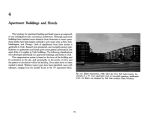
Show Apartment Buildings and Hotels This typology for apartment building and hotel types is an outgrowth of our investigations into commercial architecture. Although apartment buildings have received some attention from historians in recent years, those studies have been largely confined to such major cities as New York, Washington, and Chicago. Little of significance from these studies is applicable to Utah. Research into nineteenth- and twentieth-century publications on apartments and hotels gives some general information, but again little of it applies to Utah buildings. The following classifications were developed specifically for apartment buildings and hotels in Utah. This categorization system is based on the form of the building and its orientation to the site, and secondarily on the points of entry and the pattern of circulation within the building. Floor plans have not been studied in detail. Thirteen major types have been identified, most with subtypes, ranging from the double house to the "H" apartment block. Fig. 110: Elaine Apartments, 1928, Salt Lake City, Salt Lake County. An example of a "U" court apartment with an unusually spacious, landscaped court, the Elaine was designed by Salt Lake architect Slack Winburn. 74 Apartment Buildings and Hotel Types 75 Double House: A This type was referred to as the "double cottage" in pre-Civil War architectural works and as the "double residence" or "pair of houses" after the Civil War. It consists of two living units under one roof. The building is similar in scale and appearance to a single-family house. The two units usually have separate entries and may be either one or two stories high. Fig. I l l : Double-house bungalow, c. 1910, Salt Lake City, Salt Lake County. In this example the privacy of the two units is reinforced by a brick wall that projects onto the front porch, which is supported by under-scaled columns of the Ionic order. Fig. 112: Double house, c. 1915, Salt Lake City, Salt Lake County. Separate gabled entries project from this double house, built in the style of a California bungalow with low pitched roofs, exposed rafters, and stucco over wood frame construction. 76 Apartment Buildings and Hotel Types Fig. 113: Two-story double house, c. 1918, Salt Lake City, Salt Lake County. Much larger than the single-story version of the double house, this building is hard to confuse with a single-family residence due to the symmetrical facade and double entries. Apartment Buildings and Hotel Types 77 Double House: B Version B of the double house is a horizontally divided building containing one flat or apartment per floor. Unlike A, type B often has a flat roof and is more urban in character. This type may have either a single common entry for both units or separate entries. Adding a mirror image of the facade of this building-in effect doubling it-creates the four-unit block, below. Fig. 114: Two-story flat with single entry, 1908, Salt Lake City, Salt Lake County. Fig. 115: Two-story flat with double entries, 1908, Salt Lake City, Salt Lake County. William Asper built this apartment house for bookkeeper K. Brothers and his wife, who occupied one of the flats until the 1930s. 78 Apartment Buildings and Hotel Types n D Double House: C Type C includes buildings of one, one and a half, or two stories joined together at one end (literally a double house) creating a self-contained unit. This type includes flat-roof examples. More than two such units constitute row housing (see row house, below). Fig. 116: Double house, c. 1868, Beaver, Beaver County. This stuccoed adobe structure in the Georgian style was owned and occupied by Sidney Tanner, a freighter, and his brother. Fig. 117: Double house, c. 1895, Ogden, Weber County. This is a Victorian Eclectic example of the double house with a symmetrical facade. The single, central portico contains separate entries for each half of the building. Apartment Buildings and Hotel Types 79 Fig. 118: Double house, c. 1905, Salt Lake City, Salt Lake County. This single-story example of the double house has side entries with narrow porches supported by Tuscan columns. Fig. 119: C. I. Anderson double house, 1910, Salt Lake City, Salt Lake County. Built by Edwin Rollins in the Capitol Hill District of Salt Lake City, this building was an investment of C. I. Anderson, who lived next door. 80 Apartment Buildings and Hotel Types fl D Four-Unit Block The four-unit block in essence is the mirror-image duplication of type B. Entries for the units may be found on either side of the common wall or in a series of doorways. A variation of this pattern is separate first-floor entries and a common entry for the two second-floor units. Fig. 120: Four-unit block, c. 1905, Salt Lake City, Salt Lake County. This elegantly proportioned, four-unit block of brick masonry has brick quoins and a cornice with dentils below a short parapet. A portico of paired Tuscan columns protects the double entry to the building. Fig. 121: Four-unit block, c. 1900, Ogden, Weber County. This example of the four-unit block contains separate entries for each apartment and a unified corbeled brick cornice and parapet. Apartment Buildings and Hotel Types 81 Row House A row house consists of three or more single-family housing units of one or two stories joined together. Fig. 122: Alonzo Raleigh row house, 1885, Salt Lake City, Salt Lake County. Built by James Wyatt for Raleigh, Mormon church leader, this building was occupied by several of Raleigh's descendants into the 1900s. Fig. 123: Silver Row, c. 1890, Provo, Utah County. This brick row house, highlighted by a decorative gable over each entry, was owned and rented out by David Felt, a Provo publisher and printer. 82 Apartment Buildings and Hotel Types Fig. 124: Two-story row house, c. 1890, Ogden, Weber County. This pleasing design for a row house has projecting brick bays that illustrate the influence of the Queen Anne style. Apartment Buildings and Hotel Types 83 Apartment Block: A The basic apartment block has two or more stories containing multiple dwelling units. Such buildings may be either horizontal or vertical blocks, depending upon the number of stories and the orientation of the building to the site. Horizontal blocks may be sited paralled to the street on a wide but not very deep lot. In such cases multiple entries are common in the facade. Such entries lead to foyers with adjacent stairs and-in later, taller buildings-elevators to the upper floors. Off the foyers or stair landings are generally located two or more apartments. Two apartments off each foyer or landing usually indicate a basic plan of two apartments running the depth of the building and separated by a common wall. Fig. 125: Swallow Apartments, c. 1900, Salt Lake City, Salt Lake County. This horizontal apartment block contains a central entry and spacious sun porches for the front-facing units. Fig. 126: Browning Apartments, c. 1916, Ogden, Weber County. Constructed for Ogden businessman George E. Browning, this horizontal block shows the influence of the Prairie School style in the use of casement windows and wood banding. 84 Apartment Buildings and Hotel Types Fig. 127: Chateau Normandy Apartments, c. 1929, Salt Lake City, Salt Lake County. This stepped, horizontal block of apartments illustrates the Period Revival style with its crenellated bays and half-timbering. Apartment Buildings and Hotel Types 85 Apartment Block: B Sites with limited street frontage or narrow width but great depth can contain horizontal blocks with a single entry in the facade. Within the building, the apartments are usually arranged in a line on either side of a central hall, an arrangement referred to as a "double-loaded corridor." Occasionally, on wider sites, two such buildings may be constructed parallel to each other with an open court between them. In such cases they may have either the multiple entries of type A or the single-entry, double-loaded corridor of type B. Fig. 128: lJicardy Apartments, c. 1928, Salt Lake City, Salt Lake County. This central-entry apartment building is highlighted by a terra-cotta base and a cornice of blind arcading. Fig. 129: Kier Corp. Apartments, c. 1932, Salt Lake City, Salt Lake County. A projecting central entry complete with terra-cotta surround and decorative finials is flanked by two projecting bays that articulate the facade and distinguish this apartment building from its neighbors. 86 Apartment Buildings and Hotel Types Fig. 130: Royal Arms Apartments, c. 1918, Salt Lake City, Salt Lake County. Two flanking, central-entry blocks create an example of the open-court apartment complex. Apartment Buildings and Hotel Types 87 Apartment Block: C Square or nearly square sites usually result in an apartment block of two or more stories with a vertical emphasis. Such buildings frequently have a central entry in the facade. Fig. 131: Rainer Apartments, c. 1900, Salt Lake City, Salt Lake County. The raised basement of this building helps create a sense of verticality characteristic of this apartment type. Fig. 132: Norma Deane Apartments, 1917, Salt Lake City, Salt Lake County. One of three identical buildings on the same site built for the State Loan and Trust by C. C. Severs, this block exhibits the wide overhanging eave and geometric woodwork common to the Prairie School style. 88 Apartment Buildings and Hotel Types Fig. 133: Viva Apartments, c. 1915, Salt Lake City, Salt Lake County. With little stylistic pretension, this building, like many others, uses a partially raised basement to help achieve a sense of verticality. Apartment Buildings and Hotel Types 89 Fig. 134: Apartment building, c. 1915, Salt Lake City, Salt Lake County. This T-shaped apartment is built adjacent to the lot line and may have originally contained some ground-floor office space. "L" and "T" Apartment Blocks The "L" block has two or more stories of multiple dwelling units arranged in an "L" configuration. The building may be built close to the street corner with two sides facing the streets, or the configuration may be reversed so that the building is set back on the site and preceded by a forecourt. The T " block is similar in construction; most frequently, the cross-piece of the "T" is placed adjacent to the street. This form is commonly placed on lots in the middle of the block. Fig. 135: Apartment building, c. 1910, Salt Lake City, Salt Lake County. Another example of the "L" configuration, this block has a small forecourt at the corner of the lot. The projecting porches are supported, starting at the second floor, with tapered square Ionic columns that frame the corner entry. 90 Apartment Buildings and Hotel Types VJ' aiaac- Fig. 136: Rose Apartments, 1923-24, Ogden, Weber County. This is a brick masonry "C-shaped apartment building containing entries in the wings. "C" Apartment Block This type is not to be confused with the "U" court. The two side wings projecting from the back of the "C" are usually not deep and the open space confined within the shape is too shallow or too small to be considered a real court. Entry into this type may occur at the ends of the wings, or the building may have multiple entries at the back of the "C." Apartment Buildings and Hotel Types 91 Fig. 137: Apartment court, c. 1920, Price, Carbon County. A one-story "U" court of stuccoed masonry, this apartment building shows the influence of the Mission style. "U" Court In the "U-court form, the court is usually oriented toward the street. Such configurations may have either a single entry point at the base of the "U" behind the court or multiple entries, often one entry facing the court in each wing and one in the base. As in the perpendicular Apartment Block: B, a single entry leads to a foyer, stairs and/or elevator and to a double-loaded corridor. In the case of multiple entries, two or more apartments are located on each floor. Examples of the "U" court may be one or more stories in height. A less common variation is the reverse "U" court with the court oriented away from the street. Fig. 138: Caithness Apartments, 1908, Ware and Treganza, architects, Salt Lake City, Salt Lake County. A "U" court design influenced by the Arts and Crafts and Prairie School styles, it originally featured an extensive roof garden. 92 Apartment Buildings and Hotel Types Fig. 139: The Shubrick, 1912, Salt Lake City, Salt Lake County. Based on the hotel court type, this building was constructed for Blanche and Archibald Rikert, out-of-town investors. Hotel Court A variant of the "U" court is the hotel court. In this type the first floor is reserved for commercial functions and the central court is open above that level. Laterally extended versions of this type containing a second court also can be found, as in the "E" or double court. The "E" court was a popular design for large hotels in urban areas. Fig. 140: New Brigham Hotel, 1912-13, Ogden, Weber County. This hotel court was built by the Ogden Trust and Development Company for principal owner Fred Kiesel, an Ogden entrepreneur. Apartment Buildings and Hotel Types 93 Fig. 141: Peery Hotel, c. 1910, Charles Onderdonck, architect, Salt Lake City, Salt Lake County. This example of the "E" or Double Court was built for Ogden businessmen David and Joseph Peery. { I it(fm Fig. 142: Milner Hotel and commercial block, 1910, Ogden, Weber County. Another extended hotel court, the Milner is nearly identical to the Peery. 94 Apartment Buildings and Hotel Types "tt" K-°<*- Fig. 143 Bell Wines Apartments, 1927, Slack Winburn, architect, Salt Lake City, Salt Lake County. This "H-type apartment block is preceded by an unusually shallow forecourt. A tall portico supported by square columns spans the width of the court. The wings of the building are emphasized by stone quoins and a molded cornice. "H" Apartment Block What appears at first glance to be a "U" court may turn out to be an "H" apartment block with a second court at the rear. Such designs provide improved light and ventilation to all units. Fig. 144: Mayflower Apartments, 1927, Slack Winburn, architect, Salt Lake City, Salt Lake County. A vertical "H" apartment block complete with attached parking structure, the Mayflower was built by and for the Bowers Building Company. |