| OCR Text |
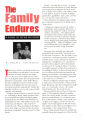
Show by Armando Sol6rzano T WAS A COLD MORNING in November of 1 9 1 2. Thousands of Mexicans, most of them single men, got off the train in Bingham, Utah, and were taken to Utah Copper Com-pany, where they began to work that same afternoon. The " Mexican strikebreakers," as they were known in town, had come to replace miners who were refusing to work until the management improved working conditions and salaries. For the Mexicans, their happiness at finding a job in Utah contrasted with the looks on their faces. They were alone, without their families, in a for-eign land. Many had left fiancees in Mexico waiting for them to save enough money that they could re-turn and get married. Accustomed to hard labor and strong families, the men faced arduous work in the mines, but they were not willing to sacrifice their families. Some decided to send for their wives and children; those who were engaged went back to marry and returned with their new brides. But the majority kept sending letters full of nostalgia and homesickness to their families. To start a Mexican family in Bingham or Garfield was a difficult, if not impossible, task. There were very few Mexican women available in the towns. As a miner named Santos Cabrera put it, " The only Mexican women you saw were either your mother or your sisters."' This scarcity of available Mexican women was still prevalent in 1930, when the Bing-ham census reported 1 ,258 single males and only in Utah 1 00 single females. Without wives, fiancees , or Mexican women around, Mexican miners lived in boar& nghouses, prepared meals by themselves, washed and ironed their own clothes, and sent money back to Mexico to support the families they had left behind. The entry of the U. S. into World War I increased the demand for silver, lead, and zinc. As a result, another Latino group arrived in Utah- Spanish Americans from Colorado, Texas, and New Mexico. The Spanish ~ mericanws~ e re particularly willing to work in Bingham because they felt that ' Utah was a pretty good state to raise a family, and there was not so much discrimination" as in other states. Un-like the Mexican miners, the Spanish Americans brought their families of as many as nine children with them. Most were very poor. In the early 1930s, the Great Depression caused the mining industry in Utah to collapse. Latino miners were the first ones to be fired, and most left the state. Many of those families who stayed were too proud to ask for government assistance. Such was the case with Juanita Jimenez, whose husband died of a disease contracted in the mines. She refused any assistance. " We never got help from the government. We never asked for anydung," she said. Many Latino miners looked for other job opportu-nities and found employment with the railroads. At times, some 70 percent of the temporary labor used in " extra gangs" had Spanish surnames. atinos also made important contributions to agriculture, especially in the Utah farming community of Garland, where they worked in the production and processing of sugar beets. In Garland, Latinos created the most visible Latino colony in Utah. At least 60 families moved there and lived in a very organized manner, working together in the beet fields. When the beet season was over, they worked as housekeepers. Latinos had no opportunity to attend Catholic church services in this predominantly Mormon area, but they traveled to Salt Lake City every weekend to attend Mass. With money provided by the sugar company, they built a schoolhouse and were able to cele-brate September 16, which is Mexican inde-pendence day, and other cultural events charac-teristic of Mexican tradi-tion. As the Latino families became more established in Utah, the need for social, political, and reli-gious organizations became evident. Initially, neither Mormon nor Catholic officials showed a great deal of interest in forming Spanish- speak-ing congregations. So Mexican and Spanish Americans families brought in priests, lead-ers, and missionaries from Mexico. During the 1930s, however, churches and other orga-time, the first generation of Latino children born in Utah started exploring new jobs. Lacking an ade-quate education, most had no choice but to do agri-cultural work, which they had done since early childhood. Emilio VAsquez, who was born in Eure-ka, Utah, had begun working at the age of ten, car-rying water and bringing lunches to the men work-ing in the fields. By the early 1940s, some Latino families started buying houses in Bingham. Ironically, some bought houses and apartment complexes with the money they had received by suing the railroad companies for work- related in- Young Latino couple, dab unknown. USHS. Previous page: Miner in Bilngham, Utah, during World War 11. juries and medical ex-penses. Usually, a fami-ly lived on one floor and rented the rest of the house to single La-tino miners and rail-road workers. With the rental income, families were able to pay for their homes, receive a secure and steady in-come, and cover med-ical expenses. Yet even when they had their own houses, it was difficult for La-tino children to grow up in the mining towns and railroad camps. In Bingham Canyon, Mike Melkndez felt " embar-rassed about my fami-ly" because his parents could not provide what other families provided for their children. Mike's father only had an old Oldsmobile and nizations developed various ways to serve the needs had no money to pay for Mike's driver's license. of the Latino families in the state. LDS Relief Also, his father was continuously criticized because Societies, women's self- help organizations, summer he could not speak English well. schools, bilingual classes, and mutual- aid societies Just when Utah Latinos were achieving some sta-all helped those indigent families who lacked even bility in the mining towns, the onset of World War I1 - the most primary resources. disrupted their families. The army and navy drafted world War 11- b roug- h t an end to unemployment, husbands and brothers; in response, some Latinas and various industries invited Latinos to move to and their daughters moved to Salt Lake City look- Utah to work. A new wave of Spanish- speaking workers arrived from New ~ e i caond colorado, primarily to work in the coal mines. At the same ing for jobs that allowed them to support their fam-ilies. At the same time, the shortage of men in the state led government officials to recruit hundreds of Puerto Ricans from New York City. This group of Spanish- speaking people increased the diversity of the Latino population in the state. Like the Mexi-cans of the 191 Os, Puerto Ricans in the 1940s were mainly single males who left their families behind. Not accustomed to mine labor or to intra- ethnic conflicts with Mexicans, Mexican Americans, and Spanish Americans, most Puerto Ricans left the state and returned either to New York or to their homeland. Only ten Puerto Rican families settled down and remained in Utah. These families became very successful and were able to buy houses. A few of them became leaders in the civil rights move-ment of the 1960s and 1970s in Utah. R y the beginning of the 1960s, sons and daughters of Latino miners, railroad workers, and migrant workers were willing to attend institutions of higher education and community colleges, but the economic barriers were almost insurmountable. In 1967 there were no more than ten Latino stu-dents at the University of Utah; the majority of them lacked financial support and worked as bus-boys in sorority houses, as janitors, as ditch- diggers for the county, or in similar jobs. During summer, some sprayed for mosquitos on campus. Mike Me- ICndez, who was born in Bingham Canyon, later said that h s family was so economically deprived that his parents only contributed five or ten dollars per month to hs academic expenses. In spite of the barriers, MelCndez graduated and became a minority advisor at the University of Utah. As an advisor he was especially interested in recruiting Latinas. Education, he believed, would be an asset for women in case something happened to their husbands, and it was a good thing to pass on to children. Latinas needed to be educated because they fulfilled two functions in their com-munities: They became not only mothers but also the most important educators of their families and communities. MelCndez's mother had been perhaps the first Latina to graduate from the University of Utah; she obtained a nursing degree in 1942. Following the Chicano civil rights movement in the Southwest, Utah Latinos engaged in discussions of the discrimination, segregation, and exclusion they experienced in " Zion." In these discussions, Latinos exhibited a wide range of opinions, depend-ing on the group to which they belonged. Mexican nationals and Mexican Americans felt that they had been subjected to high rates of discrimination in the workplace, schools, and political process. However, Spanish Americans in general denied that discrimi-nation was prevalent in the state. Valentin Ar6mbu-la, a mine worker born in Colorado, believed that discrimination was something that group members brought upon themselves: " If you conduct yourself like a white man, then they'll treat you like a whte man," he said. The fact that his three children g- r ad-uated from hig- h school with honors was a testimo-ny to him that discrimination was not an issue for his family in Utah. During the civil rights movement, an important advocate for Utah Latinos and their families was Father Gerald Merrill. Ordained in 1958, Father Merrill decided to work with Utah Mexican Amer-icans to end the cycle of discrimination and lack of opportunities and to incorporate Latinos into the educational and political system. The decisive factor that brought Father Merrill to work for Latinos was " the family warmth and the love that they so often felt for one another in spite of great difficulty they experienced." The hub of his activities was the Gua-dalupe Center at 346 West 100 South in Salt Lake, which was created with money raised from dances, tamale and menudo sales, and bingo. Through the Guadalupe Center, Father Merrill provided services to Latino migrant workers and elderly Latinos; he organized classes in Spanish and English; and he developed a class for training Latino leaders. n important goal for Father Merrill was to eliminate the divisions between Ro-man Catholics and Mormons, Mexican Americans and Spanish Americans, and Latinos and Anglos. During the 1970s and 1980s the Guadalupe Center became a place where people came to celebrate their family tradi-tions, baptisms, weddings, and quinceaEeras. Through the practice of ~ o r n ~ a d r a zt~ heoy, c~ re ated extended families. Also, Latino families helped form a credit union, which was called the West Side Fam-ily Cooperative. In addition, Father Merrill, in co-operation with Latino families, created the Cafi: la Morena, a Mexican American restaurant named in honor of La Virgen de Guadalupe. By the middle of the 1970s, Utah Latino families had experienced a transformation, especially in the relationships between parents and chldren. Francis Yaiiez observed that her chldren were being Amer-icanized and losing their roots and traditions. Her children hardly knew what a Mexican was and spoke very little Spanish. They also opposed Mex- ican ways of living: They wanted to leave home to prove salaries, assist in integration into mainstream live with their fianckes; they preferred to buy rather - society, defend the group's bilingualism and cultural - - - than to make tortillas; and they bought canned tenets, and improve the relationship between Latino beans instead of cooking them at home. What sad- Catholics and Latino LDS. Solutions to these prob-dened Mrs. Yaiiez most was the unwillingness of lems will be key if Latinos are to enter the new her sons and daughter to fight back against the dis- millennium on an equal basis with other groups in crimination they suffered at school and in the places the state. they worked. Yet regardless of their The community of Latino families in Utah is still in the making. In fact, the 1990s has dra-matically changed the profile of Latino families in the state. Since 1 990 the Utah Latino popula-tion has grown 42 per-cent; in Cache county alone the growth has reached 400 percent. This new wave of Latino immigrants has been caused by economic growth in Utah; families - ethnic or religious back-ground, Latinos and La-tinas consider the most sacred value in their his-tory and tradition to be their families, and that value has inspired them to contribute to thc cre-ation of a morc egalitari-an society in the United States. Utah Latinos such as Mike Melkndez are aware that they cannot change the world, or r- Utah, for that matter, I but certainly they can immigrate to the state to influence their families. work in agriculture, pro- In his own family, Mr. cessing plants, the ski Melkndez has taught his industry, hotels, restau- daughter to lovc all peo-rants, and clubs. ple, to understand and However, statistics show that since 1980 the economic condition of Rogue Garcia and family, San Juan County. practice acceptance of USHS. different cultures, to take care of the elderly, Latino families has not improved; on the contrary, it and to respect the diversity of religious beliefs. He continues to deteriorate. In 1980, Latino married concludes, " If 1 can teach her that, maybe 1 have couples earned 86.1 percent of the salary earned by succeeded in causing some change in Utah." *% lo 990 this percentage had dimin- Armando Solbrzano is associate professor for the depart-ished to 8 3.2. Median family income for Anglos in ment of Family and Consumer Studies at the University of 1990 reached $ 3 3,846, while for Latinos it was Utah. Sources for this article include the Collection on Utah $ 24,941. Single Latinas reported an income of less Minorities at the U of U Marriott Library and interviews conducted by the American West Center at the U of U. than $ 12,000 per year. At the present, 2 1 percent Notes: 1. Santos Cabrera was born in Mexico in 1886 and of Latino families in the state of Utah live in pover- was one of the first ~~~ i~~~~ to arrive to the state of utah. ty, while only 7.6 percent of Anglo families do. In Utah, Latino families have come to constitute an important economic and political force that should be recognized. As consumers, Latino fami-lies contribute more than two billion dollars to the state's economy, and they represent the largest vot-ing minority group. The community is trying to solve several challenges as they work to lower high numbers of high school drop- outs and to increase enrollment in institutions of higher education, im- 2. Spanish American refers to those Latinos who claimed that their parents were born in Spain and did not maintain any connection or relationship with Mexicans. Mexican nationals are Latinos who were born in Mexico but grew up in the U. S. Mexicans Americans are Latinos of Mexican descent who were born in the U. S. 3. A quinceaiiera is a celebration for young Mexican women who are fifteen years old. Part of this tradition is to bring the quinceaiiera to church to offer her life and purity to God and to announce to the whole community that this young women is on her way to greater responsibility and motherhood. 4. This is an old Mexican tradition in which the godparents accept the spiritual and material responsibility of their godchildren. d Eileen Hallet Stone and would always be something to do to feed the fami-ly. And that's why we came. [ Chinese] clan obliga-tions are similar to extended family obligations, except they are even less elective. It is your duty-no matter how you do it- to make sure these peo-ple don't starve. h m my+/ c uK% l h&, his father sent him and his sixteen- year- old brother to San Francisco to work and send money back to the family [ in China]. Now, the older brother, who had the promise of a job, was supposed to look after my father. But growing up, I always heard how terrible this brother was. He gambled and visited houses of prostitution. And when my father told him, " You're not supposed to do this; I'm going to write home to mother," his brother beat him up. After several beatings, my father said he ran away to a mining camp somewhere else in California and, gradually, worked his way up to Oregon.. . . For a while he worked in mining camps. Then, when he was fifteen, he borrovved $ 1 15 and bought the consignment for a lunch counter at the [ rail-road] depot [ in Mackey, Idaho]. It had six or eight chairs, and I believe it took hinl two years to pay the money back. Apparently, he did well, because years later, when he was about 38 and married, he had made enough money to open a restaurant and buy a ranch of several hundred acres. He had the first Sizzler idea, I think. He wanted to raise beef to use in his restaurant.. . . But then the big [ stock market] crash came, and beef prices plummeted. Then . . . Idaho farmers dis covered that Idaho Power and Li- g ht, which con trolled the irrigation water, decided to make a land grab. So, following the crash, the company raised their irrigation rates. They charged something like $ 27 per acre of water, which ruined everyone-- forced many to leave their homes. [ When we were] coming down from Idaho to Salt Lake, I recall that our train was like a funeral train.. . . Everyone was crying. My mother contin I remember arriving in Chinatown- Plum Alley [ between First and Second South and State and Main], which was less than a half a block long.. . . It turned out to be a tenement house. This was a tremendous comedown. In Idaho we had a house. But this place had rats and cockroaches. It was old and dirty. My mother grew even more depressed. Plum Alley, well, it was like a collection of seedy bars you'd see in New York.. . . All these single, mostly old men were there, gam-bling. And they had terrible personal habits. Their clothes were dirty, and they were generally r~">\* q~ ~ unkempt. I knew there was dope dealing.. . . >>?+; Q~$~$,&+; +:& bp2 None of these men living there had much of a'" 4wA\@ g" - future. They weren't going to make enough money to go back to China. They talked about it. But un-less one had a stroke of g- o od fortune while g- am-bling, they were never going to make it. And who was going to go back to China broke? . . . . These men led miserable lives. They died one by one and were usually buried by some relative or cla ber in the city cemetery. The only way they it back to China was if their family organizati sent money to exhume their bodies and take remains home. But my father had some money, and he a another fellow bought a restaurant on First South called the Bon Ton Cafk. Unfortunately, though, my father's health started to fail. He probably had hig- h blood pressure, whlch was not diagnosed. So he began having heart trou-ble and got pleurisy. And when I was thirteen, he died. I remember- he came home and asked me to put on some hot water for tea. As I did, he leaned back in his rocking chair and said, " I'm so tired.. . ." Then he was gone. I was scared must have had a massive hea no autopsy. The authorities one more Chinese dead. t with us." She was referring to the Japanese kids. said, " Okay." I didn't know the rule, see, that all ing I was going to have to be re inority kids sat in their own groups.. . . But thanks us]. So at Christmasti previous cxpci- iencc, I knew " trouble" meant you [ Department Store]. We lived in P were going to get beaten up.. . . another year and a half. I think it But discriminat~ on was absolutely pblic in Salt accept my father's philos e We couldn't go to city swimming pools. Our and I can understand h nts paid taxes, but we couldn't swim in the get help, and she didn't better theaters, we couldn't slt downstairs. We're go'lng to be all r~ gh After I graduated [ fi- om] high school, we mo ut of the foster home and went on our own. e secretarial work.. . . I was definitely lucky to nd work! But the thing I marvel at, in hindsight, is hat judg- e Reuben Clark allowed me to takc care of y brothers and sisters. I was sixteen- definitely Then [ two years after my father died], my mot ncler- age, you see.. . . 1 remember the four of us was sitting in the apartment onc day, and all o cnt into hir office, anti we told him we don't want sudden she started saylng things that didn't m be separated We don't want to be adopted out. sense [ She had suffcrcd a breakdown and had e hds were crylng. He said, " You don't need to be committed to thc Utah Statc Hospital. After th orry. We'll work something out." Then he asked took her away] we went to live ~ 11tah blue coll e, " Do you thinlc you can take care of these chil- Mormon family. ren?" I said ye?. He \ aid, " A11 right, I'm putt~ ng Now, this family d~ ttlh c best they could with ou on trial.. . We'll have a pollccwoman come under the circumstances. The rnothcr wanted u own and check on you once a month. You won't but her three boys felt it was a disgrace to have now when she's coming.. . And we'll sete how well " Chinks" living wlth them. I re~ ncmbcrt hcrc take care of these children." instantaneous gossip throughout the [ LDS] ward Well, I had just rented this little house by West about this family taking in Chinl.,~. T hen thcrc was a High School And, gosh, I remember 1 felt tremen daily parade of [ curious] ncighbori who came dous tcnrlon I washed all the kids' clothes weekly through to look at us.. I gave them heck if they got anything out of place. Recently, I'lc been thinking of wnting about ' Cause I never knew if this policewoman was com what it was like to grow up Chinese in the Inter- ing.. . . We wanted to have everything just so. .. I mountain West.. . . For our chiltircn's sake some remembrr there'd be times I was so tired from body ought to say, Look, wc went through terrible housework, I'd J times. Peoplc called you " Chm~ k " Thcy pulled thc~ r you're really fati eyes up at the corner. They beat you up. In fact, as you see llttle hub [ school] children, we hid in bushes unhl everybody went home so we wouldn't get beaten up. And we E~ llogueH: elen weren't just beaten up once in a whilc. We were who was of Japanese descent The two helped to relo-cate Japanese Americans during World War II. In later beaten up elerj single clay. years Helen acted as an advocate for Asian Amer~ cans I remember I walked into thc high school cafetc- and other ethnic qroups, she also served as utahfs I - . na on mv first dav with mv lunch I was voinv to sit firqt riirertnr of Ac~ nnn ffnirc |