| OCR Text |
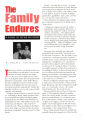
Show A family- the basic unit of society- is a group of kin and non- lun who interact on a daily basis and who cooperate in providing for the needs of chil-dren. A family can be nuclear, with a father, moth- ~ amyil er, and chldren. It may be extended, including a grandmother, grandfather, uncles, aunts, and cous-ins, or it may take various other forms. Native Americans, the original peoples of Utah, have traditionally depended on the family unit. In - - Endures A LOOK AT UTAH HISTORY B Y P H I L I P F . N O T A R I A N N I T HROUGHOUT HISTORYth, e family has had a pro-found influence on individuals. It serves many functions for family members, but maybe none is as key as its role in simple survival. After all, it is through the family that most people sustain themselves economically- and in Utah's hstory, the tasks of adaptation and survival echo as main themes in the peopling of the state. But issues of survival go beyond just sustaining life. Families also help their members to survive and prosper socially, culturally, and spiritually. Though it may have aspects in common with oth-ers, each family is unique. Family structures often vary among different cultural and ethnic groups, especially as they are influenced by historical and trahtional forces. But, while families may have dif-ferent forms, the function- that of survival-remains the same. Thus, for peoples of all cultures, races, ethnic origns, and time periods, the family unit forms an important " common ground" in Utah hstory. Navajo society, . . . families are organized around the mother, grandmother, and, sometimes, older sisters. A married man usually lives with his wife in her mother's community.. . . The children inherit the mother's clan, and the cousins of the clan are referred to as brothers and sisters. Because of these strong ties, a Navajo has deep obliga-tions in helping and in participating in functions involving his kin.. . . Males are obligated to their maternal clans and it is not unusual for a hus-band to leave his family to help his mother's kin. ' Among the Utes, the family has traditionally functioned as the center of life, " and loyalty to it was the fabric of existence." The Ute family was an extended one, and besides immediate members it included uncles, cousins, and maternal and paternal grandparents. " Grandparents were extremely im-portant for their judgment and for their intimate involvement in the rearing of children." All elders were hghly respected, and they had a major part in the teachng of children. As they told songs and sto-ries, the elders provided both entertainment and learning. Oral tradition- the handing down of his-tory and culture through storytelling- functioned as the main source of education.' When non- indigenous peoples began to migrate to Utah, many arrived as families. Others came in family- like groups. Still others immigrated as single men- or, occasionally, women- who usually formed families once they decided to stay. Mormons ( Church of Jesus Christ of Latter- day Saints, or LDS) migrated primarily as families. These were mostly nuclear, but many crossed the plains in extended families or as temporary mem-bers of other families. Families came to hold a spe-cial place in the religion, with the doctrine that families were bound together for life and eternity. This emphasis is still evident in the religion's stress on genealogy, or the tracing of family roots. Pioneer diaries abound with stories of family life, especially during the immigration to Utah. Jean Rio Baker wrote of her journey in 185 1 from England to Utah. At the beginning of her diary she noted the significance of the journey. I this day took leave of every Acquaintance I could collect together, in all human probability, never to see them again on Earth; I am now ( with my children) about to leave for ever my Native land, in order to gather with the Church of Christ, in the Valley of the Great Salt Lake, in North America. Passed our Medical Examination, and went on board the ship, George W. Bourne in which our passage is taken. Myself 6 sons, 1 Daughter, 1 Daughter- in- law, and my late Husband's Brother and Uncle and Aunt, also Mr. and Mrs. Derrick and their 4 ~ h l d r e n . ~ The trials and tribulations of the trek appear reg-ularly in her account. In one passage, Mrs. Baker places several issues in perspective. As I feared, my dear girls labor came on during the night, and at daybreak a little grandson was born to my very great joy. I have some fears for its life, but I do hope our Heavenly Father will spare it to us, and make it a blessing to us all, and honorable member of His Kingdom; the children are all over- joyed. I lost another Ox today by poison. 4 Baker's entry clearly demonstrates that survival for emigrants crossing the plains meant concern over family, animals, and terrain. All of these repre-sented factors the pioneers would need for success once they arrived at their destination. Settlement led to addi-tional demands on family and friends, and the pio-neers tried many solu-tions. A significant chal-lenge arose when the Left: Sarah S. Nisonger and her spinning wheel, Santaquin, c. 1894; George Edward Anderson photograph. Next page: Carnillo Manina house. USHS collections early Mormon church announced plural marriage as a religious principle. The practice of polygamy meant that several families could exist as separate units, yet be connected through one father.- his created the need for special arrangements, includ-ing separate housing and the need to work out rela-tionships among the wives. Often, the first wife granted the approval for additional wives. Martha Spence Heywood expressed it as follows: During the ceremony of the sealing I was struck with the fact that the first wife was not called upon to give away the other wives to her hus-band, but was asked if she was willing that he should take so and so to be his wife.' For some Utahns, polygamous family relationships continue to serve their perceived needs for reli-gious and social survival. Early immigrants brought with them the tools and supplies they would need to care for them-selves and families. Sarah Nisonger, who settled in Santaquin, carried a large spinning wheel. Others, trained in carpentry, brought woodworking tools. These early settlers, working to support their families, differed only in form from later immi-grants. People from Asia, southern and eastern Europe, and Mexico experienced similar situations as they came in search of economic opportunity. Often, single males arrived in Utah to labor in the - mines or on the railroads. At first, they intended to return to their homelands, but once they realized the opportunities available in America, they often decided to remain and establish families. Family life in Utah, then, was first of all based on the need for survival. But beyond its economic role, the family also played a critical social role in side architecture of northern Italy, the main liv-ing quarters were on the second floor and cows were kept on the first floor ( which was kept as , A J individual development. One aspect affected the clean as the second floor). During the cold days other, and both provided a vital the whole family went downstairs, where the sense of security. men talked or played cards, and the women knitted, spun, shucked Economically, the family role centered on the need to provide a Mother, father, com, ordidotherchores.~ heysat and h i 1 d re n a1 on benches that were set into walls living and an environment where while the children played in the the primary ties could be main- laboredfo r the manger under the watchful eyes of tained. ~ amilieso ften worked to- COm m On good, the parents. At night, the body gether, especially those engaged in heat rising from the animals farming and ranching. Family busi- helped somewhat to warm the nesses also meant that adults and children could sleeping quarters on the second floor. It was work as a team. Thus, relying on children to assist also traditional for these houses to have a sec-in the economic growth of the family, parents often Ond- flOor a porch On the first treated children as " little adults." Even children's floor so people could sit in the shade outside in - r clothing reflected adult dress. As mother, father, the wanner weather." and children all labored for the common good, the The landscape that surrounded homes, including roles of family members were- and continue to sheds, baking ovens, and other outbuildings, also be- blurred . Most families view the " home" as their economic and social anchor. Anthropologists view the physical structure of a home as a family's place in time and space. In fact, the house serves as a physical symbol of a family's existence. In turn, the way a house is built and the way in which its internal space is orga-nized and used illustrate a family's values. The Cam-illo Manina house, built in Spring Glen, Utah, by an reflected family values carried from otherplaces. Hmong immigrants from the mountains of Cam-bodia and Laos arrived in Utah in the late 1970s and early 1980s. However, the lack of appropriate housing caused many to leave the state; the refugees could not find housing large enough for their ex-tended family groups, and they could not find af-fordable neighborhoods where they could establish traditional clan groups.' Italian immigrant who had migrated from the prov- Social roles reveal the essence of a family. Various ince of Turin, illustrates how house types were sometimes transplanted. ethnic groups in Utah came from trahtions steeped in codes of behavior. Helen Papanikolas, the dean of The layout of the house.. . corresponds to re- Utah" ethnic it^, observed gional Italian vernacular architecture. In the hill- ". .. just as Mormons had a code, obedience to the priesthood, each group of immigrants had a code of honor that embodied the highest principles of behavior to one's family and oneself. "' There existed cultural expectations within families. Greeks honored filotimo, respect for the family. The Greek culture required that brothers assist in providing dowries for sisters. Mary Pappas Lines recalled that her father was the oldest son in his family, and it was his obligation to help raise a dowry for his sisters, which he did. So his first responsibility after he got here [ Utah] was to send whatever money he had back to his father to help his sister marry. It was understood he would do that before he could marry. 9 The Japanese grew up with the bushido code, showing reverence for authority and elders. Reverence for education, obedience and respect for parents and elders, loyalty to one's family, friends, and country were all part of the chl-dren's training. ' I think,' Toraji Koseh said, ' it comes from the samurai way of life, and chil-dren.. . obey.. . . [ It] just comes natural. ' I0 Such codes carried responsibility and showed that have dances at each other's homes.. . . There was no baby- sitting. We kids were all part of the milieu, part of the package. My godfather, Julio Lemos, was always there. He had a great handle-bar moustache. And after eating, we hds would go to bed. In the middle of the night, though, he would come and pick me up. He was usually drunk. And he'd dance all around with me. And if you think about significant others, the extend-ed family, it was there. There was a hell of a lot " family honor" played a vital of love there. And those role in society. What others times were terribly impor- " thought" of a family was tant. They gave me a sense of important. Sense of community, community, a sense of The relig- i ous institution of a Sense of belonging." belonging. n symbolic kinship proved sig- Fictive lunship- a way of nificant for many ethnic families. In Utah, this bringing close friends into the family circle-became embodied in the tradition of godfathers and extended the ability of the family to endure and godmothers. Godparents were bound in a special increase its support network. This became a way of way to children and were culturally obligated to provide for them in case their parents could not. Among Croatian immigrants in Utah, this practice remained important. According to John Pezell, Kum, yeah, that means " godfather." I'm godfa-ther to several.. . . I'm godfather both in the Roman Catholic church and the Orthodox church.. . . You see, a kumis is a very important part of the Slav people's background. What I mean [ is], if [ I'm your] godfather, if anything happened to you, to your mother or father, it is my responsibility to see that you have a proper bringing up both in education and health- wise and physical- wise.. . . They stress that quite a bit.. . . It was a sacred thing in the Slav people's language. . . . Actually, a godfather.. . among the Slav people is a fellow that is looked up to and is 1 A very well thought of." Mexican immigrants also car-ried the tradition of godparents to Utah. " Chldren showed deep respect for their parents. Fami-lies were close- knit with a high sense of loyalty to one another and included not only parents and children but also grandpar-ents, aunts, uncles, cousins, godparents, and in- law^."'^ Godparents were family. John Florez recalled, On the weekends, we [ Mexican families] would come together. We would sanctioning intimate non- hn ties. For example, Italian children might grow to view a close friend of the family as a comare or compare ( godmother or godfather) or as a zia or zio ( aunt or uncle). Thus, family existed also in thought and was not necessarily limited to blood ties. Traditions formed a framework for family activi-ty. This was often guided by the cycles of the year. The family worked together planting in spring, working a farm or garden during summer, harvest-ing in fall, and maintaining tools in winter. Much of this tradition centered on food and food prepara-tion. Native peoples joined together to gather pinenuts and to fish, hunt, and make pemmican. For southern and eastern Europeans, the storing of grain and baking of bread, making of wine, and butchering of beef, hogs, and lambs all meant fami-ly survival. But the " quality" of the product, for many immigrants, represented family honor. Food must be of high quality because it represented the family. Presenting a positive image of the farnily-bella @ a in Italian, for example- became of pri-mary importance. In its total context, the family has metaphysical sigruficance for many people. This even includes the role of the dead. Mormons baptize for the dead. Other groups honor the dead " spiritually" when physical presence is impossible. For instance, in one Italian cemetery a headstone marks a family grave-site, but the family is actually buried in Utah. Rel-atives remaining in the village of origin needed to remember the entire family and honor it by mark-ing a symbolic family grave in Italy. Similar " long distance" connections existed in photographs. For example, Chin Quan Chan, a Chinese businessman living in early twentieth- cen-tury Utah, could not be with his family physically. Therefore, he had his picture superimposed on that of his family in Chma. The photograph clearly shows the elder Chan, in a suit, out of place and proportion with the rest of his family, who are dressed in traditional clothing. If one could not be with the family physically, a psychological or spiri-tual presence helped to bridge the gap. To maintain a " connection" proved of vital importance ' for the sake of the family.'' The concept and demands of " family" also caused conflicts. Cultural and religious expectations often . led to guilt, Again, Helen Papanikolas offers some insights into the effects of cultural attitu'des and Left: Chin Quan Chan and his family. Above: Archie Henderson's pregnant widow and two of his children. I codes: " With such harsh codes that could easily spill into paranoia, it is no surprise that when young im-migrant men came to Utah, some of them became exhilarated at being free from their families and broke their nations' codes ." I4 Tragedies also affected families. Those living in the coal mining region of Carbon County were especially vulnerable. In the coal mines, an explo-sion could change a family situation in one spark of time. The 1924 explosion at Castle Gate killed 172 men, leaving many families without a father. Archie Henderson, one of only a few Afiican American miners in the area, died in the accident. His widow, four children, and one unborn child endured and adjusted in the best way they could. Life went on. Solid institutions bend but seldom break. So goes the family. Generational changes in family stru& re and function have changed, but the basic elements needed for survival remain. In an essay entitled " Dreams Do Come True," a third generation Italian American student penned, "~ amiliess tayed together and relied on each other for support and 10ve."'~ That these qualities remain important to many indi-cates that the family unit has survived. More impor-tant, the potential strength of the family is still criti-cal to survival both for family members and for the larger society of which it is such a basic element. Philip Notarianni is the coordinator of public pro-grams for the Utah State Historical Society. Endnotes . I. Clyqe J. Benally, " The Navajos," in Helen Z. Papanikolas, ed., The Peoples of Utah ( Salt Lake City: Utah State Historical Society, 1976), 17. 2. Floyd A. O'Neil, " The Utes, Southern Paiutes, and Gosiutes," in Peoples of Utah, 29. 3. " The Diary of Jean Rio Baker," in Kenneth L. Holmes, Covered Wagon Women: Diaries and Letters from the Western Trails 1840- 1890, vol. 3 ( Glendale, Calif., Arthur H. Clark Co., 198' 4), 2 12. 4. Ibi&, 273. 5. Juanita Brooks, ed., Not by Bread ~ Lne: T he journal qf Manha Spence Heywood, 1850- 56 ( Salt Lake City: Uqh State Historical Society, 1978), 12 1. 6. Cory Jensen and Philip F. NArianni, " The Camillo Manina House," in piazza, Spring 1999, 6. 7. John Hicks- Yang, " The Hmong: Refugees from Laos," unpublished manuscript in posses-sion of author. 8. Helen Papanikolas, " Ethnicity in Mormondom ..." in Thomas G. Alexander, ed., SouCButter and Hog Wash ... ( Provo: BYU Press, 1978). 93 9. Leslie G. Kelen and Eileen Hallet Stone, Missing Stories: An Oral History of Ethnic Minority Groups in Utah ( Salt Lake City: University of Utah Press, 1996), 4 18. 10. Helen Papanikolas and Alice Kasai, " Japanese Life in Utah," in Peoples of Utah, 35 1. I I. From an interview with George Pezell in Joseph Stipanovich, " Falcons in Flight ...," in Peoples of Utah, 368- 69. 12. Vicente V. Mayer, " After Escalante ..." in Peoples of Utah, 445. 13. Kelen and Stone, Missing Stories, 454. 14. Papanikolas, " Ethnicity in Mormondom," 97. 15. Jayceen Craven- Nicholson, " Dreams Do Come True," in piazza, Spring 1999, 2 1. |