| OCR Text |
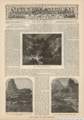
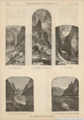
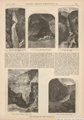
Show Scientific American Supplement, Vol. VI., No. 135. t Scientific American, established 1845. f NEW YORK, AUGUST 3, 1878. j Scientific American Supplement, $5 a year. Scientific American and Supplement, $7 a year. [Continued from SUPPLEMENT No. 131.] THE CANONS OF THE COLORADO. [Compiled from the report of Prof. J. W. Powell, Geologist, in charge U. S. Geological and Geographical survey of the Territories.] No. V. THOUGH in general this whole great region is an arid land of naked, barren rock, yet here and there can be found scanty forests and good grazing lands, but very rarely arable land. The low ridges running out from the base of the Yermilion Cliffs are usually covered by a scanty growth of cedars, fit only for fencing or firewood. About one-fourth the area of the plateaus above, on the Vermilion and White Cliffs, is covered by scattered pines and cedars, but they are of little value and scarcely accessible. The ridges running out from the foot of the eastern face of the Pauns-a-gunt Plateau are mostly covered by low, scrubby cedars; but in the intervening valleys are groves of pine which could afford considerable lumber, and on the plateau itself is the finest forest of pine and spruce in southern Utah. It is easily accessible from the valley of the Sevier River on the west, and when the country becomes settled will be quite valuable. The mesas in the basin of the Paria River are mostly covered by cedars and pinon pines. Where the canons of the streams widen into valleys, small groves of cottonwoods are common, and near the sources of these streams are scattered pitch-pines, birch thickets, and low, scrubby oaks. The eastern end of the Kai-par-o-wits Plateau is covered by a forest of pine and cedar. No timber of any value is found, in the Escalante Basin. The summit of the Aquarius Plateau is crowned by a forest of spruce, while aspens and birches fringe its lakes and streams. Further down, pines grow in open groves, and these continue till near the level of the Escalante Basin, where they give way to cedars. Upon the foot-hills of the Henry Mountains is a dense growth of low, scrubby cedars, and in the gulches near their summits are a few groves of aspen, pine and spruce. In the canon of the Dirty Devil Ri^er, and in other canons drained by the Colorado, are considerable quantities of cottonwood. Of the region from Kanab to the Dirty Devil, probably ten per cent, is covered by forests valuable for lumber; thirty per cent, by forests valuable for fencing and fuel; and the remainder by grass, sage, greasewood, loose sands, or naked rock. As irrigation is necessary to successful cultivation in all the region previously referred to, the amount of arable land depends solely upon the water su supply, cliff an Here and there a wine about the camp fires at night, making the wilderness merry with their revelries. They gather the seeds of gold- ___^ _ir_ __ ..„.__ .__J.jr_/_ _..... „ . en rods, sunflowers, grasses, and other plants. These they spring may burst out from a cliff* and furnish sufficient roast in a singular manner. They place the seeds with red water to irrigate from a hundred to a hundred and fifty hot coals in a willow tray, and by rapid and dexterous shak-acres. Pleasant Creek could irrigate about a thousand acres ing and tossing keep the coals aglow and the seeds and tray contiguous that would serve for cultivation. There is a from burning. Then they grind the seeds into a fine flour, settlement in the Paria Valley where the river is utilized for and make them into cakes and mush. For a mill they use a irrigation^ but much difficulty is experienced from the fact large flat rock lying upon the ground, and a cylindrical stone in their hands. They fill their laps with the seeds, making a hopper to the mill with their dusky legs, and grind by pushing the seeds across the rock to one edge, where the flour falls into a tray. A group of women will grind together, keeping time to a chant, or gossiping and chatting, while the young girls jest and chatter merrily. There is little game in the country, and the Indians are not supplied with guns, yet now and then they shoot a mountain sheep or a deer with their arrows. They get many rabbits, sometimes with arrows, sometimes with nets. They make a net, sometimes a hundred yards long, of the fibers of a native flax, and place it in a semicircle, with wings of sage brush! Then they have a circle hunt, and drive great numbers of rabbits into the in-closure, where they are shot with arrows. Most of the bows are of cedar, but the best are made of horn. The horns of mountain sheep are soaked in water till quite soft, then cut into thin strips and glued together. In the autumn grasshoppers are abundant. When cold weather sets in these insects are benumbed and may be gathered by the bushel. At such time the Indians dig a hole, place a layer of hot stones in the bottom, then a layer of grasshoppers, another layer of heated stones, next grasshoppers, and so on alternately till the hole is filled. The insects are thus roasted, and when cool are taken out, thoroughly dried, and ground into meal. Grasshopper gruel or grasshopper cake is a great treat for these people. The country has some archaeological interest. In one of the Canons the ruins of an old building were found by the explorers. There is a narrow plain between the river and the left wall of the canon, and here, on the brink of a rock two hundred feet high, stands this old house. Its walls are of stones laid in mortar with much regularity. Probably it was once three stories high; the first of which is still almost intact, the second much broken down, and of the third scarcely any trace remains. Quantities of flint FIG. 39.-ELFIN WATER POCKET. that the waters- are so highly charged with clay that they soon form an impervious coat over the soil, that prevents the water from sinking in. The lower end of Potato Valley, about five thousand feet above the sea, contains about two thousand acres of arable land, and a creek with sufficient water to irrigate it. Over all the country between the Pauns-a-gunt Plateau and the White Cliffs grass grows abundantly and there are many FIG, 86,-TOWER AT THE MOUTH OF THE DIRTY DEVIL RIVER, fine springs. In the Paria Basin, also, 'is considerable graz- i chips, arrow heads, and fragments of pottery are scattered ing land, and east of the Henry Mountains is some land that, though unfit for cultivation, is good for cattle. The eastern slope of the Aquarius Plateau has an average elevation of 7,000 feet above the sea, and, though too high for cultivation, affords the finest natural facilities for grazing. Grass is everywhere abundant, and streams of pure water are met at intervals of every two or three miles. Though but about one per cent, of the land between the Kanab and the Dirty Devil is fit for cultivation, probably sixty per cent, is more or less valuable for grazing. Barren as the country is, there are some Indians. These are perhaps in the most primitive state of any others on the continent. During the greater part of the year the climate is warm and dry, and they have no shelter. They clear a small circular space of ground and bank it about with brush and sand. Here they wallow during the day, and sleep at night in a promiscuous heap of men, women and children. They wear very little clothing. They live alone, cut off from all the world. They receive nothing from the government, and, being too poor to tempt the trader, and their country almost inaccessible, the white man never visits them. The mountain sides are covered with wild fruits, nuts and native grains, upon which they subsist. They eat the oose, the fruit of the yucca or Spanish bayonet. They gather the luscious fruit of a cactus plant, and eat them as grapes, or express the juice, making the dry pulp into cakes for winter, and drinking the FIG, 31- TEMPLES OF ROCK ROVERS' LAND. THE CANONS OF THE COLORADO, |