| OCR Text |
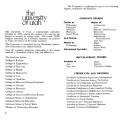
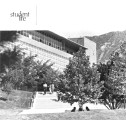
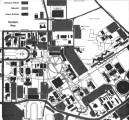
Show the The University of Utah, a state-assisted institution founded in 1850, admits all students who may be expected to succeed in college work. The nearly 22,000 students attending the University represent all counties in Utah, all states and 50 foreign countries. The University is accredited by the Northwest Association of Secondary and Higher Schools. Over 90 academic programs responding to the varied needs of a diversified student body are offered in: The Graduate School College of Business College of Engineering , College of Fine Arts College of Health College of Humanities College of Law College of Medicine College of Mines and Mineral Industries College of Nursing College of Pharmacy College of Science College of Social and Behavioral Science Graduate School of Architecture Graduate School of Education Graduate School of Social Work Division of Continuing Education 6 The University is authorized to grant the following degrees, certificates and diplomas: GRADUATE DEGREES Master of Architecture Arts Business Administration Education Engineering Engineering Administration Fine Arts Music Science Social Work Educational Specialist Statistics BACCALAUREATE DEGREES Bachelor of Music Arts Science Fine Arts University Studies CERTIFICATES AND DIPLOMAS Certificate in Business Supervisory Management Certificate in Computer Science Technology Certificate in Criminology and Corrections Certificate in International Relations Graduate Certificate in Latin American Studies Graduate Certificate in Middle East Area Studies Graduate Certificate in Public Administration Certificate in Secretarial Training Certificate in Social Welfare Associate in Art (Two-year Diploma) Associate in Science (Two-year Diploma) Associate Technical Aid Diploma Doctor of Philosophy Education Medicine Pharmacy Social Work |uris Doctor Master of PhilosophyStudents may major in any of the listed fields of study. "G" indicates the major is restricted to graduate students. "P" indicates a special program for students of secondary, education only. Accounting Anatomy (G) Anesthesiology (G) Anthropology Applied Mechanics (G) Arabic Architecture (G) Art Art (P) Audiology (G) Ballet Biochemistry (G) Bioengineering (G) Biology Biology (P) Business Administration (G) Business Administration- Industrial Relations (G) Chemical Engineering Chemical Physics (G) Chemistry Child and Family Development Civil Engineering Classics (G) Communication (G) Community Medicine (G) Comparative Literature (G) . Computer Science Cultural Foundations of Education (G) Economics Education (G) Educational Admin. (G) Educational Psychology (G) Educational Systems and Learning Resources (G) Electrical Engineering Elementary Certification (G) Elementary Education Engineering (G) Engineering Admin. (G) English English - Theatre (P) Experimental Pathology (G) Family & Consumer Studies Finance Foods and Nutrition French Fuels Engineering General Sciences (P) Geography Geological Engineering Geology Geophysics German Greek Health Science History Home Economics (P) Hospital Pharmacy (G) Human Resources Management (G) Industrial Engineering Latin Law (G) Leisure Studies Linguistics (G) Management Marketing Mass Communication Materials Science and Engineering Mathematics . Mechanical Engineering Medical Biology Medical Biophysics and Computing (G) Medical Technology Medicinal Chemistry (G) Medicine (G) Metallurgical Engineering Metallurgy (G) Meteorology Microbiology (G) Middle East Studies (G) Mining Engineering Modern Dance Music Music Education (P) Nuclear Engineering (G) Nursing Persian Pharmacology (G) Pharmacy Pharmacy Administration (G) Philosophy Physical Education Physical Therapy Physics Physiology (G) Political Science Psychology Russian Science Education (G) Secondary Certification Social Science Social Work (G) Sociology Spanish Special Education Speech and Hearing Science Speech Communication (G) Speech Pathology (G) Speech Pathology and Audiology (G) Speech-Theatre (P) Statistics (G) Theatre University Studies Doctoral degrees arc held by 75 percent of the 1700 member teaching faculty. There are 1800 additional clinical, adjunct, research and visiting faculty members. The 1500-acre University campus is in the foothills of the Wasatch mountain range and borders Salt Lake City. 149 permanent buildings, 209 classrooms, 100 laboratories and a research park house the continually expanding academic and research activities. The University is administered by an Institutional Council under the State Board of Regents; by the president, five vice presidents and the Council of Academic Deans. College councils composed of faculty members and students are organized under the University Senate and make personnel, curriculum and general policy decisions for the University's colleges. 7 |