| OCR Text |
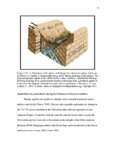
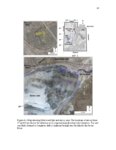
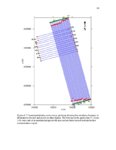
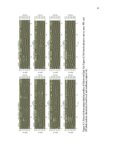
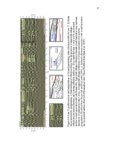
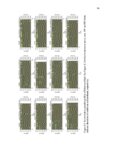
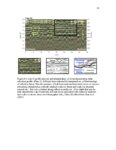
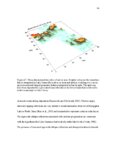
Show 93 and FitzGerald, 2001) and the shallow angled lakeward reflections are similar to swash lamination facies (Figure 4.4e) (Shan et al., 2015). Reflections in shore-parallel profiles (Figure 4.5) are also resolved to depths of ~60 ns. The profile of line 62 transects the crest of the northwesternmost geometric feature observed in line 17 (Figure 4.1) and several vertically stacked horizontal reflections are discernable along its length (Figure 4.6a). Closer examination of a part of line 62 (Figure 4.6b), whose reflections were traced, shows what appear to be low angle downlap concave or convex terminations at less than ~20 ns depth that lie above a strong reflection surface at ~20 ns depth (Figure 4.6c). The horizontal reflections are similar to reflections described for washover sheets, whereas the truncated concave or convex terminations are similar to washover channels (Figure 4.6d) (Shan et al., 2015). The three-dimensional matrix at a time slice of ~20 ns depth reveals an isosurface coterminous with strong amplitude reflections in many profiles (Figures 4.3 and 4.5). Vertical exaggeration of this time slice shows two prominent subsurface features (Figure 4.7) preserved in Bitterweed Spit sediments that are coterminous with the convex-up cross-sectional shapes observed in line 17 (Figure 4.4a). Discussion The features with convex-up cross-sectional shapes in shore-perpendicular profiles are interpreted as representing two barrier landforms, although only half of the northwesternmost feature was imaged in the GPR survey. Sigmoidal-oblique reflections are observed at depths less than ~20 ns in line 17 and downlap onto low angle, lakeward dipping reflections (Figure 4.4c). The sigmoidal-oblique reflections are interpreted as foresets created by uniform progradation, the preservation of which is indicative of few |