| OCR Text |
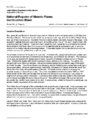
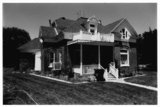
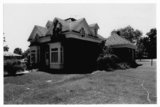
Show NFS Form 10-900-a Utah WordPerfect 5.1 Format (Revised Feb. 1993) 0MB No. 10024-0018 United States Department of the Interior National Park Service National Register of Historic Places Continuation Sheet Section No. 7 Page 1 James H. and Rhoda H. Gardner House, Lehi, Utah County, UT Narrative Description The James H. and Rhoda H. Gardner house, built in 1896, is on the northwest corner of 200 East and 300 North Streets. The house is surrounded by houses of similar age, with some infill buildings dating from out of the historic period. It exhibits Victorian Eclectic stylistic elements, typical of the larger, more elaborate buildings that were often built in Lehi during this period. It is a 1-1/2 story, central-block-withprojecting-bays type building. 1 Walls are of red, unpainted brick, supported by a limestone foundation. The limestone most likely came from a quarry in the Lake Mountains southwest of Lehi, a common source for the locally ubiquitous building material. A truncated hipped roof covers the house and has multiple dormers and gable-ended projecting bays. The principal facade of the house is the east side. A central entry, topped with a transom window and brick segmental arched head, is flanked by two single-story, wood framed bay windows. The windows in the bays are topped with leaded transom lights, topped by bracketed cornices and small hipped roofs. Pedimented gables with returns surmount a heavy cornice at the roof line. The gables are shingled with wood fishscale shingles. Similar pedimented gables top the eastern bays of the south and north facades. Tripartite windows (a double-hung window flanked by two narrow fixed-sash lights) pierce each gable. Wood-shingled dormers, elaborately decorated with carved and turned wood trim, pierce the north, east, and south slopes of the roof. The south dormer shelters a doorway that provides access to the south porch roof. This porch was added sometime between 1898 and 1907. Ghost marks on the brick wall indicate that at some time the porch was enclosed; it was rebuilt to original form during a recent renovation. A one-story brick addition was also added to the northwest corner at approximately the same time as the porch. The addition is topped with a pyramidal roof awkwardly tied into the main section of the roof. A wood cornice, similar to that on the main house, but simpler, marks the junction of the walls and roof. The interior layout is typical of the central-block-with-projecting-bays-type house. A hall and parlor are entered from the main entrance on the east side of the house. West of the hall and parlor, accessed from a door on the south side of the house, is another sitting room. Service functions are concentrated in the northwest corner of the main block and in the northwest addition. A central stair leads to bedrooms on the second floor. The interior remains in a good state of preservation, though somewhat altered over the years to accommodate changing lifestyles. Sanborn Maps from 1898,1907,1922, and 1931 show that a wood-framed garage once occupied the northwest corner of the site; it was demolished sometime after the historic period. Currently, there are no outbuildings on the property. See continuation sheet |