| OCR Text |
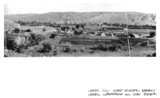
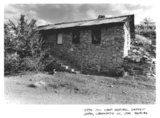
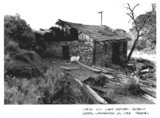
Show NPS Form 10-900-a (8-86) Utah WordPerfect Format OMB No. 1024-0018 United States Department of the Interior National Park Service National Register of Historic Places Continuation Sheet Section number 7 Page 2 Leeds CCC Camp Historic District, Leeds, Washington Co., Utah small bath, toilet and basin, in the northeast corner. Eight inches west from the front door a partition extended from the south wall to the north wall with a door opening near the front (south). The same basic type of construction was used for this building -- stone walls with rough plaster, painted white. While the gabled roof has collapsed, it was covered inside with a ceiling of wallboard or celotex. Illumination was again from one, single wire lights, one in each room. The concrete floor had a linoleum floor cover. At the entrance, a small concrete walk, two feet wide, extends to the west and south to the terracing and steps. A level terrace, about twelve feet wide, was formed around this building with concrete retaining walls on the downslope sides. Officers from Fort Douglas and the CCC camp -- the "upper echelon," as one man called them, used this building. Commander Shipley also had his office here. While it is significantly deteriorated, the form and feeling of the building remain. The other major, contributory feature (structure) of the district is the extensive stone terracing with integral stairways. The southwest side of the hill, between the buildings on ground level and the buildings on the top of the hill was all terraced. Each level being approximately 48 inches high and the top of each terrace was leveled out somewhat. The steps were made of the same local stone as used for the terracing, and these started on the east side of Building 2. There are four rows of terracing, with eight to ten steps between each row. On the southwest side of hill, going down to the north side of blacksmith shop (Building 3) there also exists a row of steps. On the west side, from the Building 4, a road goes down to the old road that was in use then. Approximately 120 feet to the north, from the bottom of this road, there is a stone horse corral. (This feature may be more closely associated with the U.S. Forest Service usage of the site.) Extensive rock work was done in the camp area but has been substantially destroyed. Some still remains outside of the proposed district (i.e., behind an existing house owned by the Prisbreys, the stone pier at the entrance to Mulberry, and near the on-ramp to 1-15). Demolished buildings include the barracks which each housed 50 men, the dining hall, the library, and several other essentially temporary structures (see historic photos). These frame buildings were typically built on concrete foundations with 10 to 12 inch wide board-and-batten siding and simple gable roofs. No type of insulation was used. Light was provided through multiple light, hopper (bottom hinged) windows and single, bare light bulbs with exposed wiring. Interior furnishings were spartan. Also destroyed over the years were the latrines, showers, and swimming pool. The latrines were earth pits with seats made of wood, twenty holes each. Urinals were of galvanized iron and were nailed to the wall. Shower rooms were the same type of plank construction with concrete floors, 20 shower heads and floor drains. The pool was filled in c. 1980 when some CCC stone work on Main Street was destroyed by the Leeds Town Council. The stone work was bladed down together with large trees overhanging the wall and street. The debris was pushed into the old CCC swimming pool at the west end of the road (now called Mulberry). Just beyond the pool area is the fence of 1-15. X See continuation sheet |