| OCR Text |
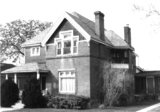
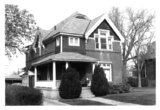
Show Harper J. Dininny House 938 E. Logan Avenue Salt Lake City, Utah 84105 -2- Continuation of Description Dininny House. There is a belt course of bricks set at an angle below the second story window on the facade. Other elements common to a majority of Perkins' houses are: the bargeboard with recessed panels, supported by brackets at the corners; the Victorian window panels on the facade; and the projecting bay on the east side of the building. A large single pane first floor window with a transom appears on many of the houses. The transom on the Dininny House has been divided Into three square sections. The opening has been highlighted by a sandstone lintel, sill, and by projecting bricks along the sides of the window. The second story window is a three part panel with a transom that projects above the rest of the panel. A hood mold above the three sections projects slightly, visually tying the parts of the window into a distinctive viiole. A three part window with a large central panel and two smaller side windows has been included in the design of the facade of seven of the ten houses in Perkins' Addition, and on the side wing of the John W. Judd House, 918 East Logan Avenue. The type used in the Dininny House is one of three or four types repeated throughout the subdivision. The bay on the east side is three sided and capped with a tent roof. A chimney extends through the front panel of the bay. A wide band resembling a frieze divides the two stories of the bay. The second story section is open, and has screens. The geometric pattern of the balustrade was a common feature on many of the Addition houses, and there is one identical to this one on the Mabry-Van Pelt House, 946 East 1700 South. A porch with a simple balustrade, and supported on Tuscan columns wraps around the west corner on the first floor, and is quite different from the two story gable roof porches of most of the other houses in the Addition. The 1911 Sanborn-Paris map indicates that there was at one time a two story porch, the common porch configuration in Perkins 1 houses. The second story porch was enclosed in some time after 1911, and the first story porch was extended around the corner of the house. A major extension was added to the rear of the house about 1960. It is a one story brick wing with a frame second story, and part of it is evident from the front of the house, but it does not affect the original integrity of the house. The Dininny House was divided into apartments in 1929, and changes to the interior of the house no doubt have been made. The house from the outside, however, still maintains its original integrity, and is significant as a unique type in Perkins ! Addition. Continuation of History None of the titles to the Perkins' .Addition properties were officially transferred until June 1891, ^hen George W.E. Griffith of Metropolitan Investment Company was the owner of legal record, even though contracts and agreements for the sale of lots and the construction of houses were being made as early as November 1890 with Gilbert L. Chamberlin, the original promoter of the subdivision. |