| OCR Text |
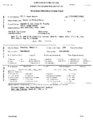
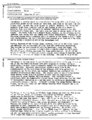
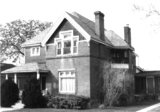
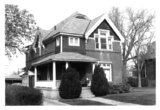
Show Street Address:_________________________________________Site No: Architect/Builder: £ o UJ O CC < Building Materials: Brick Building Type/Style: Victorian Eclectic ___________:_________________________________________________________________________________________________ Description of physical appearance & significant architectural features: (Include additions, alterations, ancillary structures, and landscaping if applicable) The Harper J. Dininny House is a two story brick house with a jerkinhead roof, projecting gables on the facade and west side, and a bay on the east side with a tent roof. As with the other houses in Perkins' Addition, its design was probably drawn from a pattern book or was created as one of a nunber of patterns that were made available to Perkins ' Addition investors for the selection of a house type. One basic plan was used to design seven of the ten houses. The basic form of the Dininny House, however, is one of three in the Addition that varies from tine common type rather dramatically. Uiereas all of the other houses have a prominent gable or gables on the facade and as a major roof configuration, the gable here has been reduced to at least half the size, and is merely a projection off of the jerkinhead roof. Various features of the Dininny House , however , link it to the other houses in the Addition, and to the types of plans used for subdivision development. They include the combination of building materials, brick and frame. The Dininny House is two stories in height with a shingle sided top half story. The second story windows penetrate the frame gable section. In all of the houses in the Addition distinctive belt courses and a change in material serve to interrupt the vertical thrust of the building. The same is true of the K >cc o <2 1 Statement of Historical Significance: Construction Date: The Harper J. Dininny House is architecturally and historically significant as one of the ten remaining houses that were original to Perkins' Addition subdivision, the most visually cohesive example of a streetcar subdivision in Salt Lake City. Streetcar subdivisions played a major role in the transformation of the land south of the original city from agricultural to residential use in the 1890s, and Perkins' Addition was considered the standard of subivision excellence. The Dininny House is one of three houses vhose design varies from the standard pattern that was repeated with variations in seven Perkins Addition houses. This variation within a subdivision \Aiich is dominated by similar house types indicates that the ideal of personalized expression as a selling point in subdivision development^occasionally became a reality. Although a unique type among Perkins Addition houses, the Dininny house has many design features vhich visually tie it to other Perkins houses. The Harper J. Dininny House at 925 East Logan Avenue was built in 1891 as one of the thirteen large, brick houses constructed in Perkins 1 Addition subdivision by Metropolitan Investment Company. Harper J. Dininny, an attorney, had come from Denver in March 1891 to act as the local agent for Metropolitan Investment Company, a Salt Lake real estate firm that had been created by a group of Denver real estate developers and financiers.2 Dininny, who lived at 810 East 100 South vhile this subdivision was being completed in 1891, conducted the company's real estate development affairs, which were primarily concentrated in Perkins' Addition. Ha and his wife, Sarah, bought this house in June 1891 for $9280 from J.C. Dobbins, vho had received legal title to the property immediately before selling it to Dininny, but vho had apparently contracted several months previously to have the house built either for himself or as speculative property. |